A simple pendulum of length $l$ is made to oscillate with an amplitude of $45$ degrees. The acceleration due to gravity is $g$. Let $T_0=2 \pi \sqrt{l / g}$. The time period of oscillation of this pendulum will be
KVPY 2015, Advanced
Download our app for free and get started
(c)
For a simple pendulum, equation of tangential motion is
$F_T=-m g \sin \theta$
$\Rightarrow m l \alpha=-m g \sin \theta$
$\Rightarrow \frac{d^2 \theta}{d t^2}+g \frac{l}{l} \sin \theta=0$
Now, $\quad \sin \theta=\theta-\frac{\theta^3}{3 !}+\ldots$
Approximately, $\sin \theta \approx \theta\left(1-\frac{\theta^2}{6}\right)$
Now, replacing $\theta_{ av }^2=\frac{1}{2} \theta_0^2$
We have, $\frac{d^2 \theta}{d t^2}+\frac{g}{l}\left(1-\frac{\theta_0^2}{12}\right) \theta=0$
$\therefore \quad \omega=\frac{g}{l}\left(1-\frac{\theta_0^2}{12}\right)$
So, time period of oscillation is
$T=\frac{2 \pi}{\omega}=2 \pi \sqrt{\frac{g}{l}}\left[\left(1-\frac{\theta_0^2}{12}\right)^{-\frac{1}{2}}\right]$
Now, taking binomial approximately
$T \approx 2 \pi \sqrt{\frac{g}{l}} \cdot\left(1+\frac{\theta_l^2}{24}\right)$
Clearly, this is greater than $T_0=2 \pi \sqrt{\frac{g}{l}}$.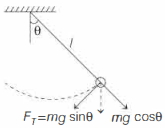

Download our appand get started for free
Experience the future of education. Simply download our apps or reach out to us for more information. Let's shape the future of learning together!No signup needed.*
Similar Questions
- 1The motion of a particle executing $S.H.M.$ is given by $x = 0.01\sin 100\pi (t + .05)$, where $x$ is in metres and time is in seconds. The time period is ..... $\sec$View Solution
- 2The amplitude of vibration of a particle is given by ${a_m} = ({a_0})/(a{\omega ^2} - b\omega + c);$ where ${a_0},a,b$ and $c$ are positive. The condition for a single resonant frequency isView Solution
- 3A particle starts oscillating simple harmonically from its equilibrium position then, the ratio of kinetic energy and potential energy of the particle at the time $T/12$ is : ($T =$ time period)View Solution
- 4Springs of spring constants $K, 2K, 4K, 8K,$ ..... are connected in series. A mass $40\, gm$ is attached to the lower end of last spring and the system is allowed to vibrate. What is the time period of oscillation ..... $\sec$. (Given $K = 2\, N/cm$)View Solution
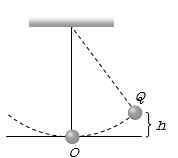
- 5The bob of a simple pendulum is displaced from its equilibrium position $O$ to a position $Q$ which is at height h above $O$ and the bob is then released. Assuming the mass of the bob to be $m$ and time period of oscillations to be $2.0\, sec$, the tension in the string when the bob passes through $O$ isView Solution
- 6A spring is stretched by $5 \,\mathrm{~cm}$ by a force $10 \,\mathrm{~N}$. The time period of the oscillations when a mass of $2 \,\mathrm{~kg}$ is suspended by it is :(in $s$)View Solution
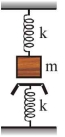
- 7A mass $m$ is suspended from a spring of force constant $k$ and just touches another identical spring fixed to the floor as shown in the figure. The time period of small oscillations isView Solution
- 8A simple pendulum performs simple harmonic motion about $X = 0$ with an amplitude $A$ and time period $T$. The speed of the pendulum at $X = \frac{A}{2}$ will beView Solution
- 9A spring is stretched by $5 \,\mathrm{~cm}$ by a force $10 \,\mathrm{~N}$. The time period of the oscillations when a mass of $2 \,\mathrm{~kg}$ is suspended by it is :(in $s$)View Solution
- 10Assume that a tunnel is dug along a chord of the earth, at a perpendicular distance $( R / 2)$ from the earth's centre, where $'R'$ is the radius of the Earth. The wall of the tunnel is frictionless. If a particle is released in this tunnel, it will execute a simple harmonic motion with a time periodView Solution