The motion of a particle executing $S.H.M.$ is given by $x = 0.01\sin 100\pi (t + .05)$, where $x$ is in metres and time is in seconds. The time period is ..... $\sec$
Easy


Download our appand get started for free
Experience the future of education. Simply download our apps or reach out to us for more information. Let's shape the future of learning together!No signup needed.*
Similar Questions
- 1View SolutionWhich of the following expressions represent simple harmonic motion
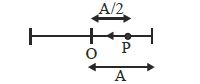
- 2A particle starts from a point $P$ at a distance of $A/2$ from the mean position $O$ and travels towards left as shown in the figure. If the time period of $SHM$ , executed about $O$ is $T$ and amplitude $A$ then the equation of motion of particle isView Solution
- 3If the maximum velocity and maximum acceleration of a particle executing $SHM$ are equal in magnitude, the time period will be .... $\sec$View Solution
- 4A weightless spring which has a force constant oscillates with frequency $n$ when a mass $m$ is suspended from it. The spring is cut into two equal halves and a mass $2m $ is suspended from it. The frequency of oscillation will now becomeView Solution
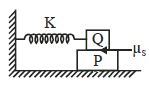
- 5A block $P$ of mass $m$ is placed on a smooth horizontal surface. A block $Q$ of same mass is placed over the block $P$ and the coefficient of static friction between them is ${\mu _S}$. A spring of spring constant $K$ is attached to block $Q$. The blocks are displaced together to a distance $A$ and released. The upper block oscillates without slipping over the lower block. The maximum frictional force between the block isView Solution
- 6The potential energy of a particle with displacement $X$ is $U(X)$. The motion is simple harmonic, when ($K$ is a positive constant)View Solution
- 7View SolutionIn damped oscillation graph between velocity and position will be
- 8Starting from the origin a body oscillates simple harmonically with a period of $2\ s$. After what time will its kinetic energy be $75\%$ of the total energy?View Solution
- 9A pendulum is hung from the roof of a sufficiently high building and is moving freely to and fro like a simple harmonic oscillator. The acceleration of the bob of the pendulum is $20\; m/s^2$ at a distance of $5\; m$ from the mean position. The time period of oscillation isView Solution
- 10A particle moves on $x-$ axis according to the equation $x = x_0\,\,sin^2\,\omega t,$ the motion is simple harmonicView Solution