MCQ
A sinusoidal progressive wave is generated in a string. It’s equation is given by $y = (2\,\, mm) sin (2\pi x - 100 \pi t + \pi /3)$. The time when particle at $x = 4$ $m$ first passes through mean position, will be
  • A
    $\frac{1}{{150}}\, sec$
  • B
    $\frac{1}{{12}}\, sec$
  • $\frac{1}{{300}}\,sec$
  • D
    $\frac{1}{{100}}\,sec$ 

Answer

Correct option: C.
$\frac{1}{{300}}\,sec$
c
$y=2 m m \sin \left(2 \pi x-100 \pi t+\frac{\pi}{3}\right)$

$\Rightarrow 0=2 \sin \left(2 \pi x-100 \pi t+\frac{\pi}{3}\right)$

$\Rightarrow n \pi=8 \pi-100 \pi t+\frac{\pi}{3}(n=0,1,2,3 \dots)$

$\Rightarrow t_{\min }=\frac{\frac{25 \pi}{3}-n \pi}{100 \pi}=\frac{\pi}{3} / 100 \pi=\frac{1}{300} s$

Need a full question paper?

Generate a complete, print-ready paper with questions like this in minutes — across 16+ boards, with answer keys.

Start Generating Free

Similar questions

To break a wire of one meter length, minimum $40 \,kg \,wt$. is required. Then the wire of the same material of double radius and $6 \,m$ length will require breaking weight ....... $kg \,wt$
Arrange the following compound in increasing order of their reactivity in nucleophilic addition reaction :
$(P)$ Benzaldehyde     $(Q)$ $p-$ Tolualdehyde
$(R)$ $P-$ Nitrobenzaldehyde $(S)$ Acetophenone
A uniform rod of length $L$ has a mass per unit length $\lambda$ and area of cross-section $A$. If the Young's modulus of the rod is $Y$. Then elongation in the rod due to its own weight is ...........
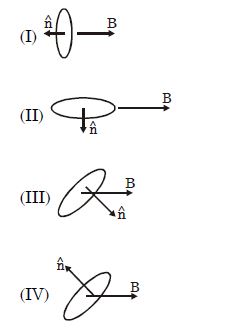
A current carrying loop is placed in a uniform magnetic field in four different orientations; $I,\, II,\, III$ and $IV,$ arrange them in the decreasing order of potential energy
Three balls of same masses are projected with equal speeds at angle $15^{\circ}, 45^{\circ}, 75^{\circ}$, and their ranges are respectively $R_1, R_2$ and $R_3$, then
A particle $A$ has charge $+q$ and particle $B$ has charge $+ 4q$ with each of them having the same mass $m$. When allowed to fall from rest through same electrical  potential difference, the ratio of their speed $V_A : V_B$ will be :-
Experimentally it is found that $12.8\,eV$ energy is required to separate a hydrogen atom into a proton and an electron. So the orbital radius of the electron in a hydrogen atom is $\frac{9}{ x } \times 10^{-10}\,m$. The value of the $x$ is $\left(1\,eV =1.6 \times 10^{-19}\,J , \frac{1}{4 \pi \in_0}=9 \times 10^9\,Nm ^2 / C ^2\right.$ and electronic charge $=1.6 \times 10^{-19}\,J\,C$ )
The position of a body moving along $x-$axis at time $t$ is given by $x=\left(t^2-4 t+6\right) m$. The distance travelled by body in time interval $t=0$ to $t=3 s$ is $...... m$
Two concentric coplanar circular loops of radii ${r_1}$ and ${r_2}$ carry currents of respectively ${i_1}$ and ${i_2}$ in opposite directions (one clockwise and the other anticlockwise.) The magnetic induction at the centre of the loops is half that due to ${i_1}$ alone at the centre. If ${r_2} = 2{r_1}.$ the value of ${I_2}/{I_1}$ is....
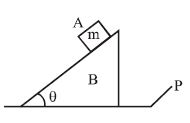
In the figure shown $'P'$ is a plate on which a wedge $B$ is placed and on $B$ a block $A$ of mass $m$ is placed. The plate is suddenly removed and system of $B$ and $A$ is allowed to fall under gravity. Neglecting any force due to air on $A$ and $B$, the normal force on $A$ due to $B$ is