MCQ
$A$ slender uniform rod of length $\lambda$ is balanced vertically at a point $P$ on a horizontal surface having some friction. If the top of the rod is displaced slightly to the right, the position of its centre of mass at the time when the rod becomes horizontal :
  • lies at some point to the right of $P$
  • B
    lies at some point to the left of $P$
  • C
    must be $\lambda /2$ to the right of $P$
  • D
    lies at $P$

Answer

Correct option: A.
lies at some point to the right of $P$
a

Need a full question paper?

Generate a complete, print-ready paper with questions like this in minutes — across 16+ boards, with answer keys.

Start Generating Free

Similar questions

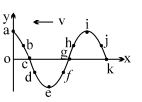
The figure represents the instantaneous picture of a longitudinal harmonic wave travelling along the negative $x$-axis. Identify the correct statement $(s)$ related to the movement of the points shown in the figure. The points of maximum rarefaction are
A mass $M$ is suspended from a spring of negligible mass. The spring is pulled a little and then released so that the mass executes $S.H.M.$ of time period $T$. If the mass is increased by m, the time period becomes $5T/3$. Then the ratio of $m/M$ is
A simple pendulum of length $l$ and mass $m$ of the bob is suspended in a car that is travelling with a constant speed $v$ around a circular path of radius $R$. If the pendulum undergoes oscillations with small amplitude about its equilibrium position, the frequency of its oscillations will be
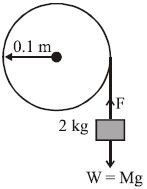
The moment of inertia of a solid flywheel about its axis is $0.1\,kg-m^2$. A tangential force of $2\,kg\,wt$. is applied round the circumference of the flyweel with the help of a string and mass arrangement as shown in the figure. If the radius of the wheel is $0.1\,m,$ find the angular acceleration of the solid fly wheel (in $rad/sec^2$)
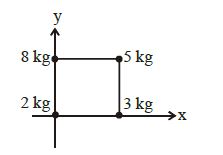
Four bodies of masses $2, 3, 5$ and $8\,kg$ are placed at the four corners of a square of side $2\,m$ as shown. The position of $CM$ will be
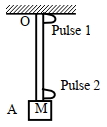
A block $\mathrm{M}$ hangs vertically at the bottom end of a uniform rope of constant mass per unit length. The top end of the rope is attached to a fixed rigid support at $O$. A transverse wave pulse (Pulse $1$ ) of wavelength $\lambda_0$ is produced at point $O$ on the rope. The pulse takes time $T_{O A}$ to reach point $A$. If the wave pulse of wavelength $\lambda_0$ is produced at point $A$ (Pulse $2$) without disturbing the position of $M$ it takes time $T_{A 0}$ to reach point $O$. Which of the following options is/are correct?

(image)

[$A$] The time $\mathrm{T}_{A 0}=\mathrm{T}_{\mathrm{OA}}$

[$B$] The velocities of the two pulses (Pulse $1$ and Pulse $2$) are the same at the midpoint of rope.

[$C$] The wavelength of Pulse $1$ becomes longer when it reaches point $A$.

[$D$] The velocity of any pulse along the rope is independent of its frequency and wavelength.

A wheel is subjected to uniform angular acceleration about its axis. Initially its angular velocity is zero. In the first $2$ sec, it rotates through an angle ${\theta _1}$. In the next $2$ sec, it rotates through an additional angle ${\theta _2}$. The ratio of ${\theta _2}\over{\theta _1}$ is
A man is standing on a rough $(\mu = 0.5)$ horizontal disc rotating with constant angular velocity of $5$ $rad/sec.$ At what distance from centre should he stand so that he does not slip on the disc?
Keeping the number of moles, volume and temperature the same, which of the following are the same for all ideal gases?
A mosquito is moving with a velocity $\overrightarrow{ v }=0.5 t ^{2} \hat{ i }+3 t \hat{ j }+9 \hat{ k }\, m / s$ and accelerating in uniform conditions. What will be the direction of mosquito after $2 \,s$ ?