MCQ
A wheel is subjected to uniform angular acceleration about its axis. Initially its angular velocity is zero. In the first $2$ sec, it rotates through an angle ${\theta _1}$. In the next $2$ sec, it rotates through an additional angle ${\theta _2}$. The ratio of ${\theta _2}\over{\theta _1}$ is
  • A
    $1$
  • B
    $2$
  • $3$
  • D
    $5$

Answer

Correct option: C.
$3$
c
(c) Using relation $\theta = {\omega _0}t + \frac{1}{2}a{t^2}$

${\theta _1} = \frac{1}{2}(\alpha ){(2)^2} = 2\alpha $…$(i)$ (As ${\omega _0} = 0,t = 2\,\sec $)

Now using same equation for $t = 4 \,sec$, $\omega_0 = 0$

${\theta _1} + {\theta _2} = \frac{1}{2}\alpha {(4)^2} = 8\alpha $…$(ii)$

From $(i)$ and $(ii)$,

${\theta _1} = 2\alpha $and${\theta _2} = 6\alpha $    $\frac{{{\theta _2}}}{{{\theta _1}}} = 3$

Need a full question paper?

Generate a complete, print-ready paper with questions like this in minutes — across 16+ boards, with answer keys.

Start Generating Free

Similar questions

A uniform heavy disc is rotating at constant angular velocity $\omega$ about a vertical axis through its centre and perpendicular to the plane of the disc.  Let $L$ be its angular momentum.  A lump of plasticine is dropped vertically on the disc and sticks to it.  Which will be constant
Motion of a particle in $x - y$ plane is described by a set of following equations $x=4 \sin \left(\frac{\pi}{2}-\omega t\right) m$ and $y=4 \sin (\omega t) m$. The path of particle will be 
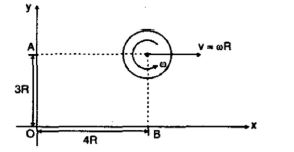
A disc of mass $M$ and radius $R$ moves in the $x-y$ plane as shown in the figure. The angular momentum of the disc at the instant shown is
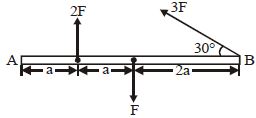
Three forces $F,\,2F$ and $3F$ act on a rod $AB$ which is pivoted at $A$. The anticlockwise moment of forces $F,\,2F$ and $3F$ about the pivot are respectively
A wire fixed at the upper end stretches by length $l$ by applying a force $F$. The work done in stretching is
If $\overrightarrow A \times \overrightarrow B = \overrightarrow C ,$then which of the following statements is wrong
The distance of the Sun from earth is $1.5 \times 10^{11} \,m$ and its angular diameter is $(2000) \,s$ when observed from the earth. The diameter of the Sun will be ...........
An ideal gas, initially in state $\left( P _{12}, V _1, T _1\right)$ is expanded isobarically to $\left( P _{12}, V _2, T _2\right)$, then adiabatically $\left( P _{34}, V _3, T _3\right)$. It is then contracted isobarically to $\left( P _{34}, V _4, T _4\right)$ and finally adiabatically back to the initial state. The efficiency of this cycle is
A body is thrown vertically upwards. If air resistance is to be taken into account, then the time during which the body rises is
A particle of mass $m$ is moving in a straight line with momentum $p$. Starting at time $t = 0$, a force $F = kt$ acts in the same direction on the moving particle during time interval $T$ so that its momentum changes from $p$ to $3p$. Here $k$ is a constant. The value of $T$ is