MCQ
A soap bubble is given negative charge, its radius will:
- AIncrease
- BDecrease
- CRemain unchanged
- DFluctuate
Explanation:
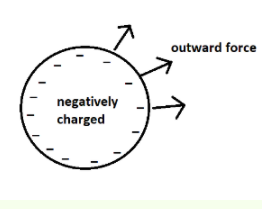
The charge will be distributed uniformly over the surface of the bubble by symmetry.
As we know, they want to step much farther apart, as charges repel, the only path outward, taking with them the soap surface.
At the same point, the rise in the restored force of the soap film (surface tension) would be equal and contrary to the electrostatic force, which will result in a new (larger) radius of equilibrium.
Because of the ionic similarities, this can happen to both positive and negatively charged bubbles.Therefore, when a negative charge is given to the soap bubble, then its radius will increase.
Generate a complete, print-ready paper with questions like this in minutes — across 16+ boards, with answer keys.
If an electron moves from rest from a point at which potential is 50 volt to another point at which potential is 70 volt, then its kinetic energy in the final state will be
|
(a) 3.2 × 10⁻¹⁰ J |
(b) 3.2 × 10⁻¹⁸ J |
(c) 1 N |
(d) 1 dyne |
If an electron oscillates at a frequency of 1 GHz it gives
|
(a) X-rays |
(b) Mirowaves |
(c) Infrared rays |
(d) None of these |
A particle moving in a magnetic field increases its velocity, then its radius of the circle
|
(a) Decreases |
(b) Increases |
(c) Remains the same |
(d) Becomes half |
Two long straight parallel conductors separated by a distance of 0.5m carry currents of 5A and 8A in the same direction. The force per unit length experienced by each other is
|
(a) 1.3 |
(b) 1.6 |
|
(c) 16 |
(d) 16 |
A fish is a little away below the surface of a lake. If the critical angle is 49°, then the fish could see things above the water surface within an angular range of θ° where

|
(a) θ = 49° |
(b) θ = 90° |
(c) θ = 98° |
(d) θ = 24 |

