Question
A solid aluminium sphere and a solid copper sphere of twice the radius are heated to the same temperature and are allowed to cool under identical surrounding temperatures. Assume that the emissivity of both the spheres is the same. Find the ratio of:
  1. The rate of heat loss from the aluminium sphere to the rate of heat loss from the copper sphere.
  2. The rate of fall of temperature of the aluminium sphere to the rate of fall of temperature of the copper sphere. The specific heat capacity of aluminium = 900Jkg-1°C-1 and that of copper= 390Jkg-1°C-1. The density of copper = 3.4 times the density of aluminium.
Answer

E → Energy radiated per unit area per unit time

Rate of heat flow → Energy radiated

  1. Per time $=\text{E}\times\text{A}$

So, $\text{E}_\text{Al}=\frac{\text{e}\sigma\text{T}^4\times\text{A}}{\text{e}\sigma\text{T}^4\times\text{A}}$

$=\frac{4\pi\text{r}^2}{4\pi(2\text{r})^2}$

$=\frac{1}{4}$ $\big[\therefore1:4\big]$

  1. Emissivity of both are same

$=\frac{\text{m}_1\text{S}_1\text{dT}_1}{\text{m}_2\text{S}_2\text{dT}_2}=1$

$\Rightarrow\frac{\text{dT}_1}{\text{dT}_2}=\frac{\text{m}_2\text{S}_2}{\text{m}_1\text{S}_1}$

$=\frac{\text{s}_14\pi\text{r}_1^3\times\text{S}_2}{\text{s}_24\pi\text{r}_2^3\times\text{S}_1}$

$=\frac{1\times\pi\times900}{3.4\times8\pi\times390}$

$=1:2:9$

Need a full question paper?

Generate a complete, print-ready paper with questions like this in minutes — across 16+ boards, with answer keys.

Start Generating Free

Similar questions

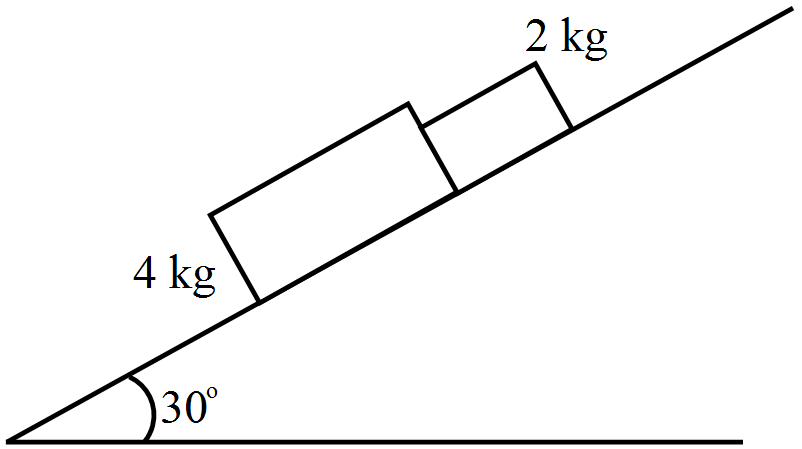
Figure shows two blocks in contact sliding down an inclined surface of inclination 30°. The friction coefficient between the block of mass 2.0kg and the incline is $\mu_1,$ and that between the block of mass 4.0kg and the incline is $\mu_2.$ Calculate the acceleration of the 2.0kg block if:

  1. $\mu_1=0.20$ and $\mu_2=0.30$
  2. $\mu_1=0.30$ and $\mu_2=0.20$ Take $\text{g}=10\text{m/s}^2.$

The optical properties of a medium are governed by the relative permitivity $(\in_\text{r})$ and relative permeability $(\mu_\text{r})$. The refractive index is defined as $\sqrt{\mu_\text{r}\in_\text{r}}=\text{n}$.For ordinary material $\in_\text{r}=0\text{ and }\mu_\text{r}<0$ and the positive sign is taken for the square root. In 1964, a Russian scientist V. Veselago postulated the existence of material with $\in_\text{r}=0\text{ and }\mu_\text{r}<0$. Since then such 'metamaterials' have been produced in the laboratories and their optical properties studied. For such materials $\text{n}=-\sqrt{\mu_1\in_1}$. As light enters a medium of such refractive index the phases travel away from the direction of propagation.
  1. According to the description above show that if rays of light enter such a medium from air (refractive index = 1) at an angle ? In 2nd quadrant, them the refracted beam is in the 3rd quadrant.
  2. Prove that Snell's law holds for such a medium.
A uniform rod of length L lies on a smooth horizontal table. A particle moving on the table strikes the rod perpendicularly at an end and stops. Find the distance travelled by the centre of the rod by the time it turns through a right angle. Show that if the mass of the rod is four times that of the particle, the collision is elastic.
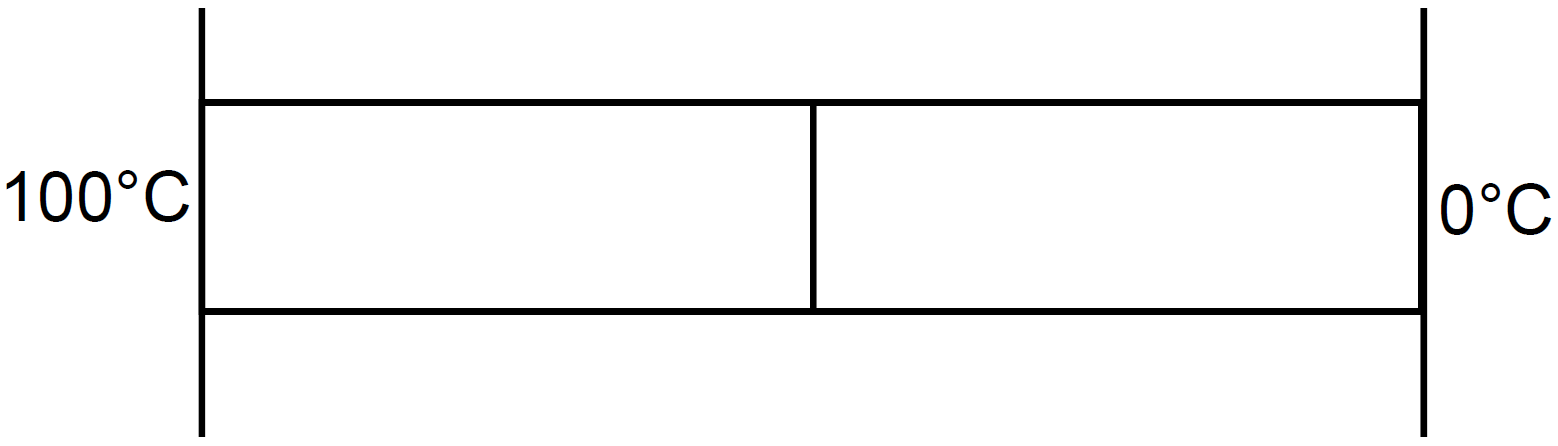
The two rods shown in figure, have identical geometrical dimensions. They are in contact with two heat baths at temperatures 100°C and 0°C. The temperature of the junction is 70°C. Find the temperature of the junction if the rods are interchanged.

A long, straight wire is fixed horizontally and carries a current of 50.0A. A second wire having linear mass density 1.0 × 10⁻⁴kg/m is placed parallel to and directly above this wire at a separation of 5.0mm. What current should this second wire carry such that the magnetic repulsion can balance its weight?
The magnetic field B and the magnetic intensity H in material are found to be 1.6T and 1000A/m reepectively. Calculate the relative permeability $\mu_\text{r}$ and the susceptibility x of the material.
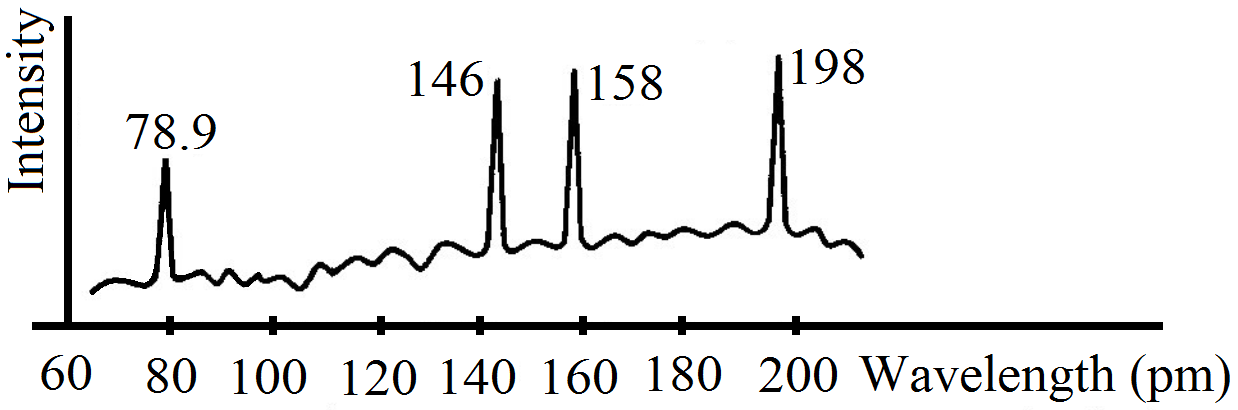
Continuous X-rays are made to strike a tissue paper soaked with polluted water. The incoming X-rays excite the atoms of the sample by knocking out the electrons from the inner shells. Characteristic X-rays are analysed and the intensity is plotted against the wavelength. Assuming that only $\text{K}_\alpha$ intensities are detected, list the elements present in the sample from the plot. Use Moseley's equation v - (25 × 1014Hz)(Z - 1)2.

One day Chetan’s mother developed a severe stomach ache all of a sudden. She was rushed to the doctor who suggested for an immediate endoscopy test and gave an estimate of expenditure for the same. Chetan immediately contacted his class teacher and shared the information with her. The class teacher arranged for the money and rushed to the hospital. On realising that Chetan belonged to a below average income group family, even the doctor offered concession for the test fee. The test was conducted successfully.
Answer the following questions based on the above information:
  1. Which principle in optics is made use of in endoscopy?
  2. Briefly explain the values reflected in the action taken by the teacher.
  3. In what way do you appreciate the response of the doctor on the given situation?
Analyze the force acting on a moving charge in a uniform magnetic field.###Analyze the magnetic force acting on a moving charged particle in a magnetic field. Write the magnitude of force in different conditions. Write suitable rule for finding the direction of force.
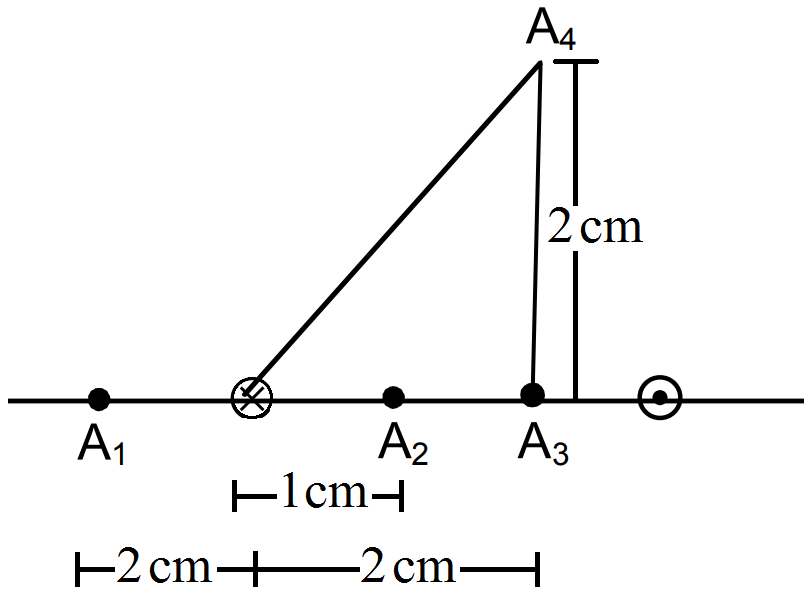
Figure shows two parallel wires separated by a distance of 4.0cm and carrying equal currents of 10A along opposite directions. Find the magnitude of the magnetic field B at the points A1, A2, A3 and A4.