Calculate the amount of heat radiated per second by a body of surface area 12cm2 kept in thermal equilibrium in a room at temperature 20°C. The emissivity of the surface = 0.80 and $\sigma=6.0\times10^{-8}\text{Wm}^{-2}\text{K}^{-4}.$
View full solution →Question types
Heat Transfer question types
82 questions across 6 question groups — pick any mix to generate a Physics paper with step-by-step answer keys.
82
Questions
6
Question groups
5
Question types
01
2 Marks Questions
7 Q→023 Marks Question
17 Q→031 Marks Question
3 Q→044 Marks Questions
6 Q→05M.C.Q (1 Marks)
16 Q→065 Marks Questions
33 Q→Sample Questions
Heat Transfer questions
One sample from each question group in this chapter. Select any group above to see the full set with answer keys.
A copper sphere is suspended in an evacuated chamber maintained at 300K. The sphere is maintained at a constant temperature of 500K by heating it electrically. A total of 210W of electric power is needed to do it. When the surface of the copper sphere is completely blackened, 700W is needed to maintain the same temperature of the sphere. Calculate the emissivity of copper.
On a hot summer day we want to cool our room by opening the refrigerator door and closing all the windows and doors. Will the process work ?
Why is a white dress more comfortable than a dark dress in summer?
Does a body at 20°C radiate in a room, where the room temperature is 30°C? If yes, why does its temperature not fall further?
The heat current is written as $\frac{\triangle\text{Q}}{\triangle\text{t}}.$ Why don't we write $\frac{\text{dQ}}{\text{dt}}?$
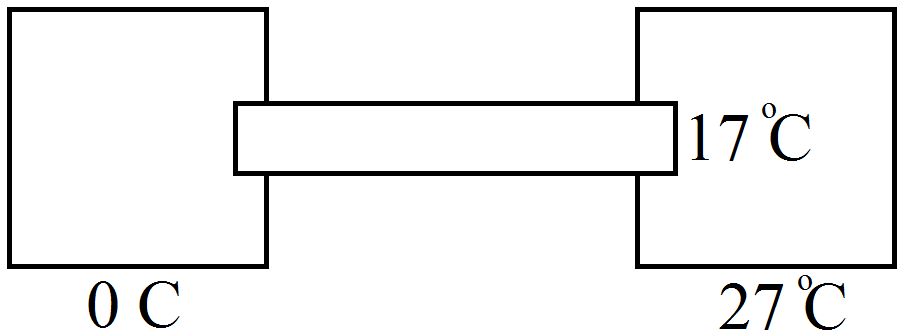
View full solution →A cylindrical rod of length 50cm and cross sectional area 1cm2 is fitted between a large ice chamber at 0°C and an evacuated chamber maintained at 27°C as shown in figure. Only small portions of the rod are inside the chambers and the rest is thermally insulated from the surrounding. The cross section going into the evacuated chamber is blackened so that it completely absorbs any radiation falling on it. The temperature of the blackened end is 17°C when steady state is reached. Stefan constant $\sigma=6\times10^{-8}\text{W/m}^{-2}\text{K}^{-4}.$ Find the thermal conductivity of the material of the rod.
View full solution →A uniform slab of dimension 10cm × 10cm × 1cm is kept between two heat reservoirs at temperatures 10°C and 90°C. The larger surface areas touch the reservoirs. The thermal conductivity of the material is $ 0.80\text{wm}^{-1}{^{\circ}}\text{C}^{-1}.$ Find the amount of heat flowing through the slab per minute.
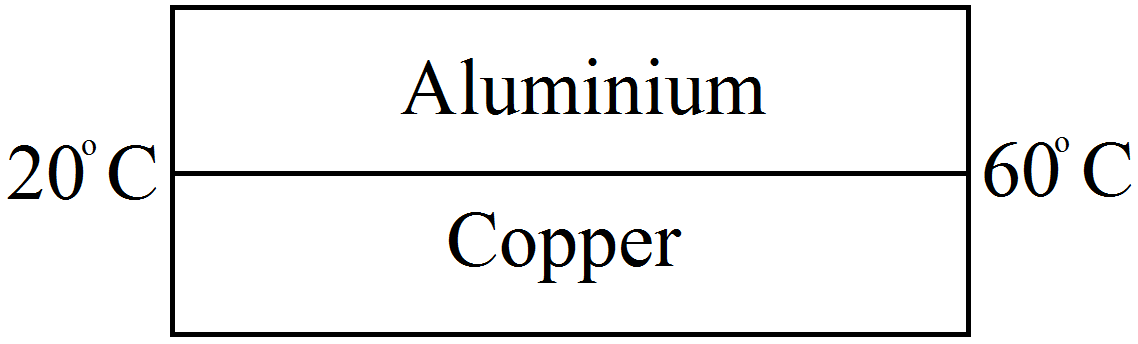
View full solution →An aluminium rod and a copper rod of equal length 1.0m and cross-sectional area 1cm2 are welded together as shown in figure. One end is kept at a temperature of 20°C and the other at 60°C. Calculate the amount of heat taken out per second from the hot end. Thermal conductivity of aluminium = 200Wm-1°C-1 and of copper = 390Wm-1°C-1.
The normal body-temperature of a person is 97°F. Calculate the rate at which heat is flowing out of his body through the clothes assuming the following values. Room temperature = 47°F, surface of the body under clothes= 1.6m2, conductivity of the cloth $= 0.04\text{Js}^{-1}\text{m}^{-1}{^{\circ}}\text{C}^{-1},$ thickness of the cloth = 0.5cm.
View full solution →Assume that the total surface area of a human body is 1.6m2 and that it radiates like an ideal radiator. Calculate the amount of energy radiated per second by the body if the body temperature is 37°C. Stefan constant $\sigma$ is 6.0 × 10⁻⁸Wm-2K-4.
View full solution →Standing in the sun is more pleasant on a cold winter day than standing in shade. Is the temperature of air in the sun considerably higher than that of the air in shade?
The temperature of the atmosphere at a high altitude is around 500°C. Yet an animal there would freeze to death and not boil. Explain.
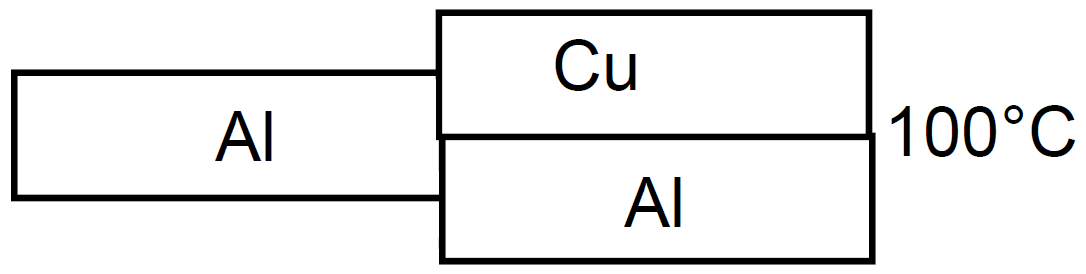
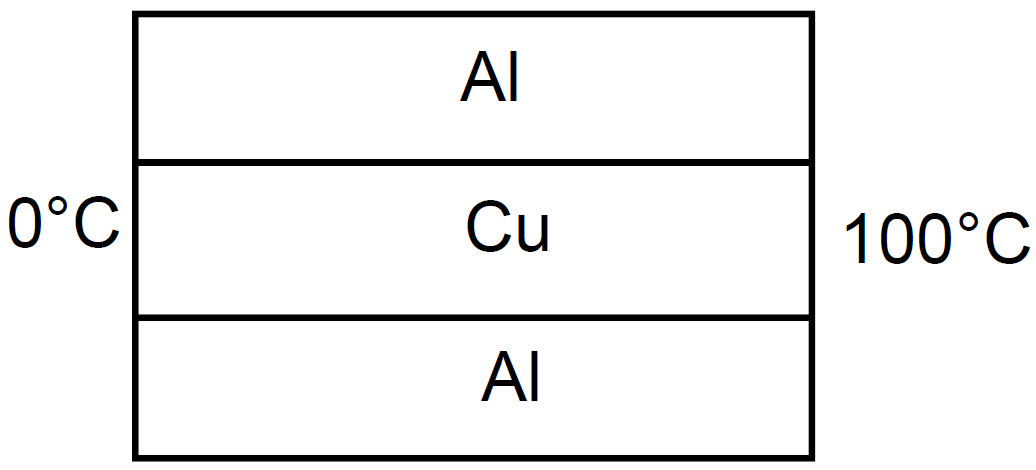
The three rods shown in figure, have identical geometrical dimensions. Heat flows from the hot end at a rate of 40 Win the arrangement (a) Find the rates of heat flow when the rods are joined as in arrangement (b) and in (c) Thermal conductivities of aluminium and copper are 200Wm-1°C-1 and 400Wm-1°C-1 respectively. 
On a winter day when the atmospheric temperature drops to -10°C, ice forms on the surface of a lake.
View full solution →- Calculate the rate of increase of thickness of the ice when 10cm of ice is already formed.
- Calculate the total time taken in forming 10cm of ice. Assume that the temperature of the entire water reaches 0°C before the ice starts forming. Density of water = 1000kgm-3, latent heat of fusion of ice $=3.36\times10^5\text{Jkg}^{-1}$ and thermal conductivity of ice $=1.7\text{Wm}^{-1}{^{\circ}}\text{C}^{-1}.$ Neglect the expansion of water on freezing.
Cloudy nights are warmer than the nights with clean sky. Explain.
Consider the situation shown in figure. The frame is made of the same material and has a uniform cross-sectional area everywhere. Calculate the amount of heat flowing per second through a cross section of the bent part if the total heat taken out per second from the end at 100°C is 130J.
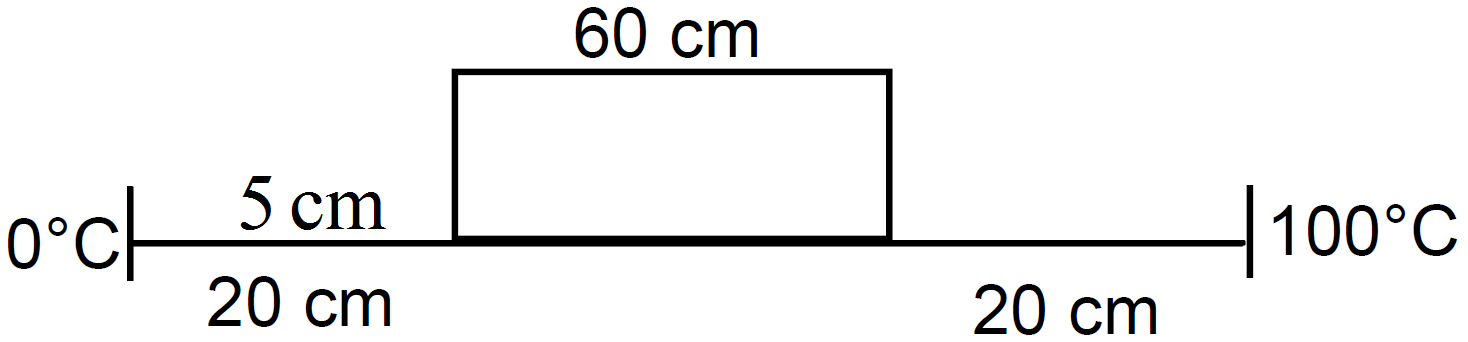
Suppose the bent part of the frame of the previous problem has a thermal conductivity of 780Js-1m-1°C-1 whereas it is 390Js-1m-1°C-1 for the straight part. Calculate the ratio of the rate of heat flow through the bent part to the rate of heat flow through the straight part.
A heated body emits radiation which has maximum intensity near the frequency v0. The emissivity of the material is 0.5. If the absolute temperature of the body is doubled:
View full solution →- The maximum intensity of radiation will be near the frequency 2v0
- The maximum intensity of radiation will be near the frequency $\frac{\text{v}_0}{2}$
- The total energy emitted will increase by a factor of 16.
- The total energy emitted will increase by a factor of 8.
One end of a metal rod is dipped in boiling water and the other is dipped in melting ice:
- All parts of the rod are in thermal equilibrium with each other.
- We can assign a temperature to the rod.
- We can assign a temperature to the rod after steady state is reached.
- The state of the rod does not change after steady state is reached.
In a room containing air, heat can go from one place to another:
- By conduction only.
- By convection only.
- By radiation only.
- By all the three modes.
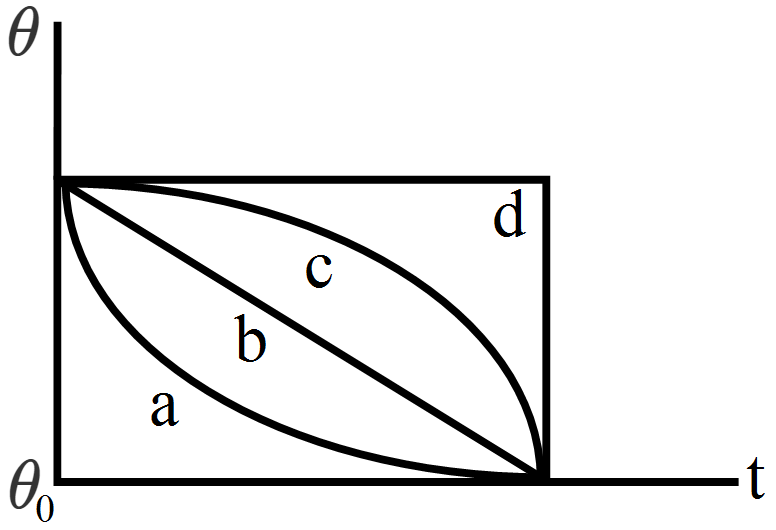
A hot liquid is kept in a big room. Its temperature is plotted as a function of time. Which of the following curves may represent the plot?
The thermal conductivity of a rod depends on:
- Length.
- Mass.
- Area of cross section.
- Material of the rod.
An icebox almost completely filled with ice at 0°C is dipped into a large volume of water at 20°C. The box has walls of surface area 2400cm2, thickness 2.0mm and thermal conductivity $0.06\text{Wm}^{-1}{^{\circ}}\text{C}^{-1}.$ Calculate the rate at which the ice melts in the box. Latent heat of fusion of ice $= 3.4\times10^5\text{Jkg}^{-1}.$
View full solution →A solid aluminium sphere and a solid copper sphere of twice the radius are heated to the same temperature and are allowed to cool under identical surrounding temperatures. Assume that the emissivity of both the spheres is the same. Find the ratio of:
- The rate of heat loss from the aluminium sphere to the rate of heat loss from the copper sphere.
- The rate of fall of temperature of the aluminium sphere to the rate of fall of temperature of the copper sphere. The specific heat capacity of aluminium = 900Jkg-1°C-1 and that of copper= 390Jkg-1°C-1. The density of copper = 3.4 times the density of aluminium.
Why does blowing over a spoonful of hot tea cools it? Does evaporation play a role? Does radiation play a role?
A pitcher with 1mm thick porous walls contains 10kg of water. Water comes to its outer surface and evaporates at the rate of 0.1gs-1. The surface area of the pitcher (one side)= 200cm2. The room temperature = 42°C, latent heat of vaporization $ =2.27\times10^6\text{Jkg}^{-1},$ and the thermal conductivity of the porous walls $=0.80\text{Js}^{-1}\text{m}^{-1}{^{\circ}}\text{C}^{-1}.$ Calculate the temperature of water in the pitcher when it attains a constant value.
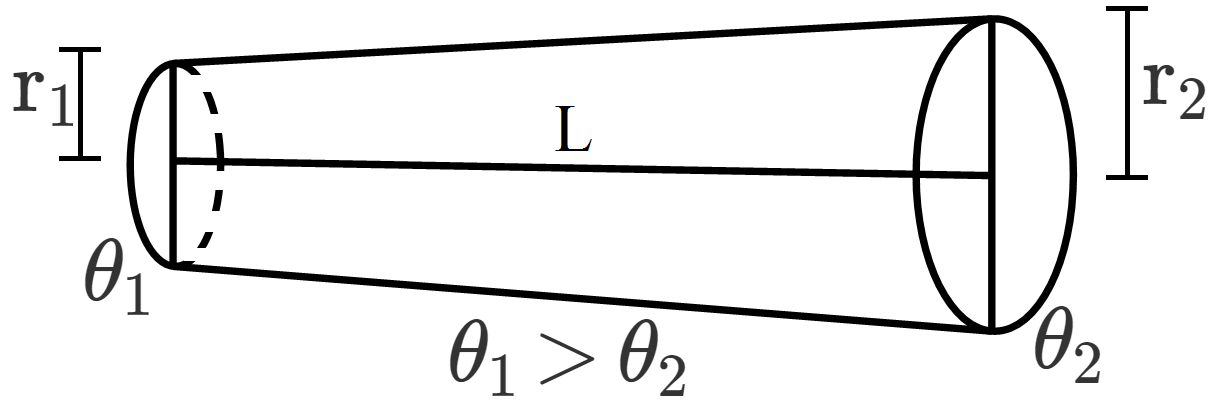
View full solution →Find the rate of heat flow through a cross section of the rod shown in figure, $\big(\theta_2>\theta_1\big).$ Thermal conductivity of the material of the rod is K.
View full solution →Generate a Heat Transfer paper free
Pick question groups from the list above, set marks and difficulty, and export a branded PDF with step-by-step answer keys. First 3 chapters free — no signup.