- $\text{T}_2-\text{T}_1$
- $\text{T}_2^2-\text{T}_1^2$
- $\text{T}_2^3-\text{T}_1^3$
- $\text{T}_2^4-\text{T}_1^4$
$\text{T}_2^4-\text{T}_1^4$
Explanation:
From stefan-Boltzmann law, the energy of thermal radiation per unit time by a blackbody of surface are A is given by,
$\text{u}-\sigma\text{AT}^4$
Here, $\sigma$ is stefan-Boltzmann constant.
Since the temperature of the solid is less than the surrouncings, the temperature of the solid will increase with time until it reaches equilibrium with the surroundings. The rate of emission from the soild will be proportional to $\text{T}_1^4$ and rate of emission from the surroundings will be proportional to $\text{T}_2^4.$
So, the net rate of increase in temperature will be proportional to $\text{T}_2^4-\text{T}^4_1.$
Generate a complete, print-ready paper with questions like this in minutes — across 16+ boards, with answer keys.
Four resistances of 100 W each are connected in the form of square. Then, the effective resistance along the diagonal points is
|
(a) 200 W |
(b) 400 W |
(c) 100 W |
(d) 150 W |
The nucleus
splits exactly in half in a fission reaction in which two neutrons are released. The resultant nuclei are
|
(a) |
(b) |
(c) |
(d) |
The mass defect for the nucleus of helium is 0.0303 a.m.u. What is the binding energy per nucleon for helium in MeV
|
(a) 28 |
(b) 7 |
(c) 4 |
(d) 1 |
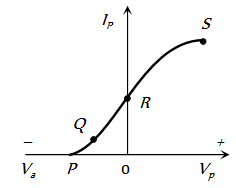
The point representing the cut off grid voltage on the mutual characteristic of triode is

| (a) S | (b) R |
(c) O |
(d) P |
The energy equivalent of 1 kilogram of matter is about
|
(a) |
(b) 1 J |
(c) |
(d) |