MCQ
A solid cube of side $l$ is made to oscillate about a horizontal axis passing through one of its edges. Its time period will be
  • $2\pi \sqrt {\frac{{2\sqrt 2 }}{3}\frac{l}{g}} $
  • B
    $2\pi \sqrt {\frac{2}{3}\frac{l}{g}} $
  • C
    $2\pi \sqrt {\frac{{\sqrt 3 }}{2}\frac{l}{g}} $  
  • D
    $2\pi \sqrt {\frac{2}{{\sqrt 3 }}\frac{l}{g}} $
Answer

Correct option: A.
$2\pi \sqrt {\frac{{2\sqrt 2 }}{3}\frac{l}{g}} $
a
We have the moment of inertia of a cube about its centroidal axis as

$I=\frac{1}{6} m l^{2}$

its moment of inertia about one of its edge is

$\frac{1}{6} m l^{2}+\frac{1}{2} m l^{2}=\frac{2}{3} m l^{2}$

Now time period of any compound pendulum is

$T=2 \pi \sqrt{\frac{I}{m g R}}$

or $T=2 \pi \sqrt{\frac{\frac{2}{3} m l^{2}}{m g \frac{l}{\sqrt{2}}}}$

or $T=2 \pi \sqrt{\frac{2 \sqrt{2} l}{3 g}}$

Need a full question paper?

Generate a complete, print-ready paper with questions like this in minutes — across 16+ boards, with answer keys.

Start Generating Free

Similar questions

A projectile is fired vertically upwards with an initial velocity $u$. After an interval of $T$ seconds a second projectile is fired vertically upwards, also with initial velocity $u$.
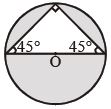
From a circular disc of radius $R$ a triangular portion is cut (see fig.). The distance of  $COM$ of the remaining disc from centre of disc $O$ is:-
A block slides down an inclined plane of slope of angle $\theta $ with a constant velocity. It is then projected up the plane with an initial velocity $u$. The distance upto which it will rise before coming to rest is
If the law of gravitation, instead of being inversesquare law, becomes an inversecube law.
  1. Planets will not have elliptic orbits.
  2. Circular orbits of planets is not possible.
  3. Projectile motion of a stone thrown by hand on the surface of the earth will be approximately parabolic.
  4. There will be no gravitational force inside a spherical shell of uniform density.
The angular momentum of a flywheel having a moment of inertia of $0.4\, kg\, m^2$ decreases from $30$ to $20\, kg\, m^2/s$ in a period of $2$ second . The average torque acting on the flywheel during this period is ......... $N . m$
The motion of a mass on a spring, with spring constant ${K}$ is as shown in figure. The equation of motion is given by $x(t)= A sin \omega t+ Bcos\omega t$ with $\omega=\sqrt{\frac{K}{m}}$ Suppose that at time $t=0$, the position of mass is $x(0)$ and velocity $v(0)$, then its displacement can also be represented as $x(t)=C \cos (\omega t-\phi)$, where $C$ and $\phi$ are
A uniform rod $AB$ of length $l$ and mass $m$ is free to rotate about point $A$ . The rod is released from rest in the horizontal position. Given that the moment of inertia of the rod about $A$ is $\frac {ml^2}{3}$ , the initial angular acceleration of the rod will be 
The ratio of escape velocity at earth $\left( v _{ e }\right)$ to the escape velocity at a planet $\left( u _{ p }\right)$ whose radius and mean density are twice as that of earth is:
An object of mass $m$ moves with constant speed in a circular path of radius $R$ under the action of a force of constant magnitude $F$. The kinetic energy of object is ............
A block of mass $5\,kg$ is placed at rest on a table of rough surface. Now, if a force of $30\,N$ is applied in the direction parallel to surface of the table, the block slides through a distance of $50\,m$ in an interval of time $10\,s$. Coefficient of kinetic friction is (given, $g =10\,ms ^{-2}$)