MCQ
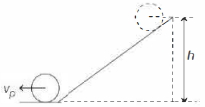
A solid cylinder $P$ rolls without slipping from rest down an inclined plane attaining a speed $v_p$ at the bottom. Another smooth solid cylinder $Q$ of same mass and dimensions slides without friction from rest down the inclined plane attaining a speed $v_q$ at the bottom. The ratio of the speeds $\frac{v_q}{v_p}$ is
  • A
    $\sqrt{\frac{3}{4}}$
  • $\sqrt{\frac{3}{2}}$
  • C
    $\sqrt{\frac{2}{3}}$
  • D
    $\sqrt{\frac{4}{3}}$

Answer

Correct option: B.
$\sqrt{\frac{3}{2}}$
b
(b)

In presence of friction, cylinder rolls and by energy conservation, we have

Initial potential energy $=$ Kinetic energy at bottom

$m g h =( KE )_{\text {translation }}+( KE )_{\text {rotation }}$

$=\frac{1}{2} m v^2+\frac{1}{2} I \omega^2$

$=\frac{1}{2} m v^2+\frac{1}{2}\left(\frac{1}{2} m r^2\right) \omega^2$

$=\frac{3}{4} m v^2 \quad[\therefore v=r \omega]$

So, $\quad v_p=\sqrt{\frac{4}{3} g h}$

In absence of friction, cylinder slips without rolling.

Hence, $\frac{1}{2} m v^2=m g h$

$\Rightarrow \quad v_q=\sqrt{2 g h}$

So, ratio of $v_q / v_p=\frac{\sqrt{2 g h}}{\sqrt{\frac{4}{3} g h}}=\sqrt{\frac{3}{2}}$

Need a full question paper?

Generate a complete, print-ready paper with questions like this in minutes — across 16+ boards, with answer keys.

Start Generating Free

Similar questions

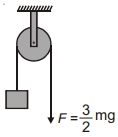
In the arrangement shown, the mass $m$ will ascend with an acceleration (Pulley and rope are massless)
The mean free path of the molecules of a gas is proportional to:
The time dependence of the position of a particle of mass $m = 2$ is given by $\vec r\,(t)\, = \,2t\,\hat i\, - 3{t^2}\hat j$ Its angular momentum with respect to the origin at time $t = 2$ is
If temperature increases, the surface tension of a liquid
A wheel having moment of inertia $4 \,kg m ^2$ about its symmetrical axis, rotates at rate of $240 \,rpm$ about it. The torque which can stop the rotation of the wheel in one minute is ............ $Nm$
A particle of mass $m$ is moving in a circular path of constant radius $r$ such that its centripetal acceleration $a_c$ is varying with time $t$ as, $a_c = k^2rt^2,$ the power delivered to the particle by the forces acting on it is
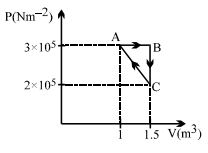
Considere the thermodynamics cycle shown on $PV$ diagram. The process $A \rightarrow B$ is isobaric, $B \rightarrow C$ is isochoric and $C \rightarrow A$ is a straight line process. The following internal energy and heat are given $: \Delta U_{A \rightarrow B} = + 400\,\, kJ$ and $Q_{B \rightarrow C} = - 500\,\, kJ$ The heat flow in the process $Q_{C \rightarrow A}$ is  ...... $kJ$
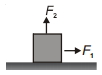
In the figure shown, horizontal force $F_1$ is applied on a block but the block does not slide. Then as the magnitude of vertical force $F_2$ is increased from zero the block begins to slide; the correct statement is
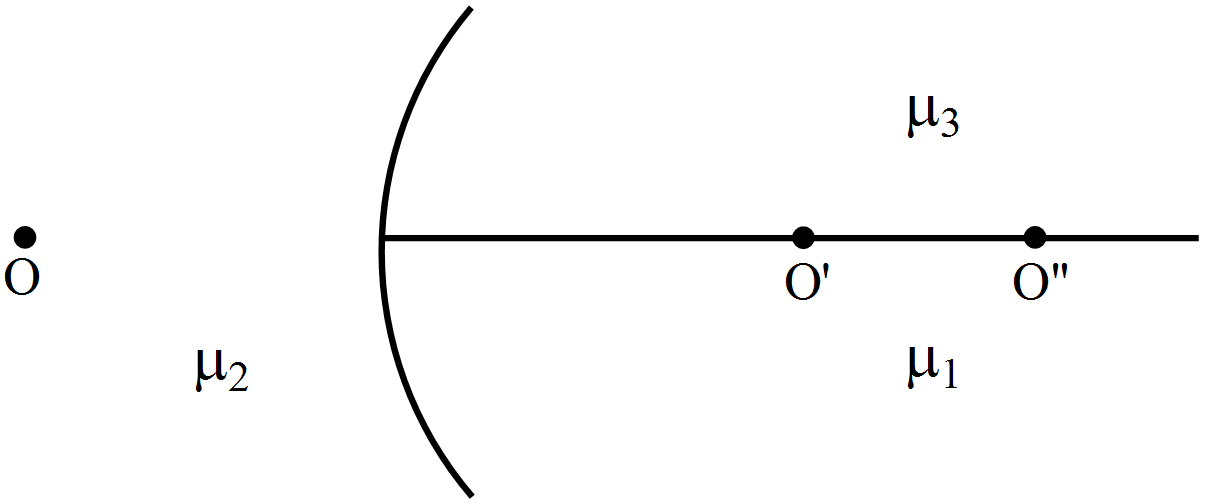
Three transparent media of refractive indices $\mu_1,\mu_2$ and $\mu_3.$ A point object O is placed in the medium $\mu_2.$ If the entire medium on the right of the spherical surface has refractive index $\mu_1,$ the image forms at O'. If this entire medium has refractive index $\mu_3,$ the image forms at O". In the situation shown:
  1. The image forms between O' and O"
  2. The image forms to the left of O'
  3. The image forms to the right of O"
  4. Two images form, one at O' and the other at O".

The principle of ‘parallax’  is used in the determination of distances of very distant stars. The baseline $AB$ is the line joining the Earth’s two locations six months apart in its orbit around the Sun. That is, the baseline is about the diameter of the Earth’s orbit $\approx 3 \times 10^{11}\;m$. However, even the nearest stars are so distant that with such a long baseline, they show parallax only of the order of $1”$ (second) of arc or so. A parsec is a convenient unit of length on the astronomical scale. It is the distance of an object that will show a parallax of $1”$ (second of arc) from opposite ends of a baseline equal to the distance from the Earth to the Sun. How much is a parsec in terms of metres ?