Question
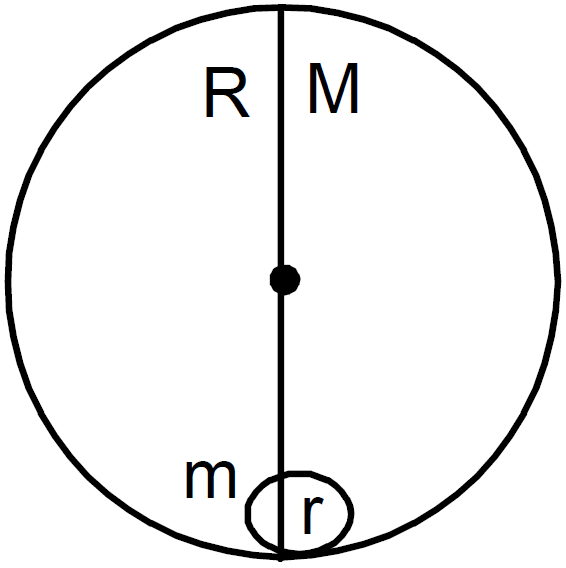
A solid sphere of mass m and radius r is placed inside a hollow thin spherical shell of mass M and radius R as shown in A particle of mass m' is placed on the line joining the two centres at a distance x from the point of contact of the sphere and the shell. Find the magnitude of the resultant gravitational force on this particle due to the sphere and the shell if,
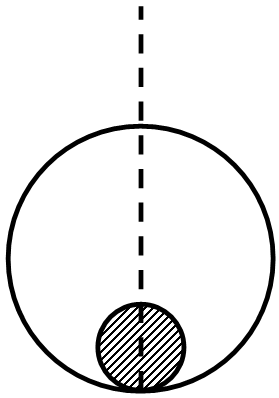
  1. r < x < 2r.
  2. 2r < x < 2R.
  3. x > 2R.

Answer

  1. m' is placed at a distance x from ‘O’.
If r < x, 2r, Let’s consider a thin shell of man

$\text{dm}=\frac{\text{m}}{\big(\frac{4}{3}\big)\pi\text{r}^2}\times\frac{4}{3}\pi\text{x}^3=\frac{\text{mx}^3}{\text{r}^3}$

Thus $\int\text{dm}=\frac{\text{mx}^3}{\text{r}^3}$

Then gravitational force $\text{F}=\frac{\text{Gmdm}}{\text{x}^2}=\frac{\frac{\text{Gmx}^3}{\text{r}^3}}{\text{x}^2}=\frac{\text{Gmx}}{\text{r}^3}$
  1. x < 2R, then F is due to only the sphere.
$\text{F}=\frac{\text{Gmm'}}{(\text{x}-\text{r})^2}$
  1. If x > 2R, then Gravitational force is due to both sphere & shell, then due to shell,
$\text{F}=\frac{\text{GMm'}}{(\text{x}-\text{R})^2}$

due to the sphere $=\frac{\text{Gmm'}}{(\text{x}-\text{r})^2}$

So, Resultant force $=\frac{\text{Gmm'}}{(\text{x}-\text{r})^2}+\frac{\text{GMm'}}{(\text{x}-\text{R})^2}$

Need a full question paper?

Generate a complete, print-ready paper with questions like this in minutes — across 16+ boards, with answer keys.

Start Generating Free

Similar questions

Establish the following vector inequalities geometrically or otherwise: $|\text{a}-\text{b}|\ge||\text{a}|-|\text{b}||$When does the equality sign above apply?
In deriving Bernoulli’s equation, we equated the work done on the fluid in the tube to its change in the potential and kinetic energy.
  1. What is the largest average velocity of blood flow in an artery of diameter $2 × 10⁻³m$ if the flow must remain laminar?
  2. Do the dissipative forces become more important as the fluid velocity increases? Discuss qualitatively.
A satellite is in an elliptic orbit around the earth with aphelion of $6R$ and perihelion of 2R where $R = 6400km$ is the radius of the earth. Find eccentricity of the orbit. Find the velocity of the satellite at apogee and perigee. What should be done if this satellite has to be transferred to a circular orbit of radius $6R$?[$G = 6.67 \times 10^{–11}$ SI units and $4M = 6 \times 10^{24}kg$]
A ball of mass m, moving with a speed $2v_0$, collides inelastically $(e > 0)$ with an identical ball at rest. Show that:
For a general collision, the angle between the two velocities of scattered balls is less than $90°$
Position $x$, time of particle moving in onedimensional motion depends on as follows :
$x=5+5 t-t^2$
(All quantities are in SI units) For this motion draw (i) displacement-time (ii) Velocity-time (iii) Acceleration-time graphs for the time interval $t=0 sec$ to $t=6 sec$ and describe the motion.
An oxygen cylinder of volume 30 litres has an initial gauge pressure of 15 atm and a temperature of 27°C. After some oxygen is withdrawn from the cylinder, the gauge pressure drops to 11 atm and its temperature drops to 17°C. Estimate the mass of oxygen taken out of the cylinder ($R = 8.31J ~mol^{-1}K^{-1}$, molecular mass of $O_2 = 32u$).
A turn of radius 20m is banked for the vehicles going at a speed of 36 km/h. If the coefficient of static friction between the road and the tyre is 0.4, what are the possible speeds of a vehicle so that it neither slips down nor skids up?
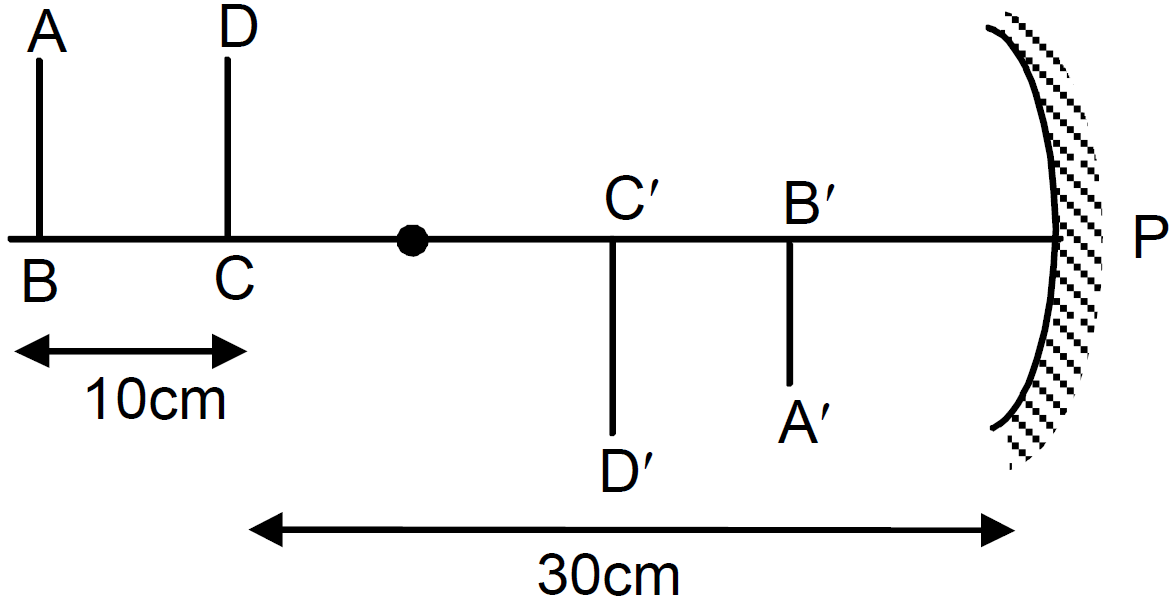
A U-shaped wire is placed before a concave mirror having radius of curvature 20cm. Find the total length of the image.
Two identical heavy spheres are separated by a distance $10$ times their radius. Will an object placed at the mid point of the line joining their centres be in stable equilibrium or unstable equilibrium? Give reason for your answer.
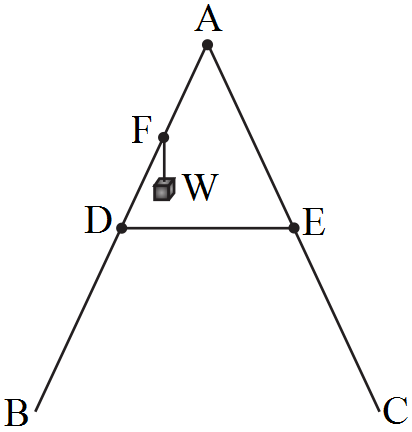
As shown in the two sides of a step ladder BA and CA are 1.6m long and hinged at A. A rope DE, 0.5m is tied half way up. A weight 40kg is suspended from a point F, 1.2m from B along the ladder BA. Assuming the floor to be frictionless and neglecting the weight of the ladder, find the tension in the rope and forces exerted by the floor on the ladder. (Take $g = 9.8m/s^2$​​​​​​​) (Hint: Consider the equilibrium of each side of the ladder separately).