MCQ
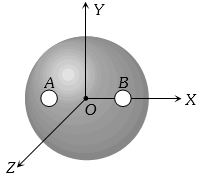
A solid sphere of uniform density and radius $4$ units is located with its centre at the origin $O$ of coordinates. Two spheres of equal radii $1$ unit with their centres at $A(-2, 0, 0)$ and $B(2, 0, 0)$ respectively are taken out of the solid leaving behind spherical cavities as shown in figure
  • A
    The gravitational force due to this object at the origin is zero
  • B
    The gravitational potential is the same at all points on the circle ${y^2} + {z^2} = 4$
  • C
    The gravitational potential is the same at all points of the circle ${y^2} + {z^2} = 36$
  • All of the above

Answer

Correct option: D.
All of the above
d
(d) Since cavities are symmetrical w.r.t. $O$. So the gravitational force at the centre is zero. 

The radius of the circle ${z^2} + {y^2} = 36$ is $6$.

For all points for $r \ge 6,$ the body behaves as if whole of the mass is concentrated at the centre. So the gravitational potential is same. 

Above is true for ${z^2} + {y^2} = 4$ as well.

Need a full question paper?

Generate a complete, print-ready paper with questions like this in minutes — across 16+ boards, with answer keys.

Start Generating Free

Similar questions

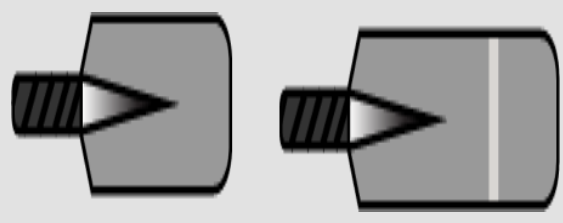
A cricket bat is cut at the location of its centre of mass as shown Then:
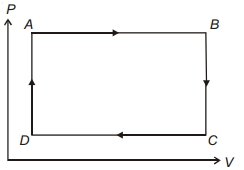
The pressure and volume of a gas are changed as shown in the $P-V$ diagram in this figure. The temperature of the gas will ........
A source of sound gives five beats per second when sounded with another source of frequency $100\,{s^{ - 1}}$. The second harmonic of the source together with a source of frequency $205\,{s^{ - 1}}$ gives five beats per second. What is the frequency of the source .... ${s^{ - 1}}$
We have half a bucket $(6l)$ of water at $20\,^oC$  . If we want water at $40\,^oC$, how much steam at $100\,^oC$ should be added to it ?
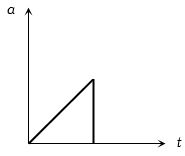
The acceleration-time graph of a body is shown below The most probable velocity-time graph of the body is
The potential energy of an object of mass $m$  moving in $xy$  plane in a conservative field is given by $U = ax + by,$  where $x$  and  $y$  are position coordinates of the object. Find magnitude of its acceleration
A glass rod of radius $1.0\,mm$ is inserted symmetrically into a vertical capillary tube of radius $2\,mm$ such that their lower ends are at same level. This arrangement is now dipped in water. The height to which water will rise into the tube will be ...... $mm$ ( $S.T.$ of water $= 75 \times 10^{-3}\,N/m$ )
$A$ bal $A$ collides elastically with another identical ball $B$ initially at rest $A$ is moving with velocity of $10m/ s$ at an angle of $60^o$ from the line joining their centres. Select correct alternative :
Two sitar strings, $A$  and $B,$  playing the note $'Dha'$  are slightly out of tune and produce beats and frequency  $5\,Hz.$  The tension of the string $B$ is slightly increased and the beat frequency is found to decrease by  $3\,Hz$ . If the frequency of $A$ is $425\,Hz,$  the original frequency of $B$ is  ... $Hz$
Particle $A$ of mass $m _{1}$ moving with velocity $(\sqrt{3} \hat{i}+\hat{j})\, ms ^{-1}$ collides with another particle $B$ of mass $m _{2}$ which is at rest initially. Let $\overrightarrow{ V }_{1}$ and $\overrightarrow{ V }_{2}$ be the velocities of particles $A$ and $B$ after collision respectively. If $m _{1}=2\, m _{2}$ and after collision $\overrightarrow{ V }_{1}=(\hat{ i }+\sqrt{3} \hat{ j })\, ms ^{-1},$ the angle between $\overrightarrow{ V }_{1}$ and $\overrightarrow{ V }_{2}$ is$......^o$