MCQ
$A$ solid sphere with a velocity (of centre of mass) $v$ and angular velocity $\omega$ is gently placed on a rough horizontal surface. The frictional force on the sphere:
  • A
    must be forward (in direction of $v$)
  • B
    must be backward (opposite to $v$)
  • C
    cannot be zero
  • none of the above

Answer

Correct option: D.
none of the above
d
The sphere has a constant velocity and angular velocity, thus when it is placed on the surface no frictional force would act on it as there is no angular acceleration.

Without any acceleration there is no force involved and thus frictional force would be absent.

Need a full question paper?

Generate a complete, print-ready paper with questions like this in minutes — across 16+ boards, with answer keys.

Start Generating Free

Similar questions

A body of mass $2\,kg$ is moving with velocity $10 \,m/s$ towards east. Another body of same mass and same velocity moving towards north collides with former and coalsces and moves towards north-east. Its velocity is
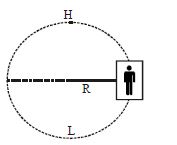
A cage revolves around a vertical circle of radius $R$ with constant linear speed $\sqrt {gR}$ . The cage is connected to the revolving arm in such a manner that a boy of mass $m$ remains always vertical while standing on a weighing machine kept inside the cage. It is found that
There will be decrease in potential energy of the system, if work is done upon the system by
A ball of $0.4\,kg$ mass and a speed of $3\, m/s$ has a head-on, completely elastic  collision with a $0.6-kg$ mass initially at rest. Find the speeds of both balls after the  collision:
A freshly prepared radioactive source of half-life 2h emits radiation of intensity which is 64 times the permissible safe level. The minimum time after which it would be possible to work safely with this source is:
  1. 6h
  2. 12h
  3. 24h
  4. 128h
Time period of a simple pendulum is $T$ inside a lift when the lift is stationary. If the lift moves upwards with an acceleration $g / 2,$ the time period of pendulum will be
A hospital uses an ultrasonic scanner to locate tumours in a tissue. The operating frequency of the scanner is $4.2 MHz$. The speed of sound in a tissue is $1.7 \,km-s^{-1}$. The wavelength of sound in the tissue is close to
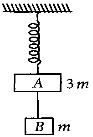
Two blocks $A$ and $B$ of masses $3\,m$ and $m$ respectively are connected by a massless and inextensible string. The whole system is suspended by a massless spring as shown in figure. The magnitudes of acceleration of $A$ and $B$ immediately after the string is cut, are respectively
$8$ mercury drops coalesce to form one mercury drop, the energy changes by a factor of
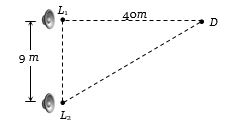
Two loudspeakers $L_1$ and $L_2$ driven by a common oscillator and amplifier, are arranged as shown. The frequency of the oscillator is gradually increased from zero and the detector at $D$ records a series of maxima and minima. If the speed of sound is $330\,ms^{-1}$ then the frequency at which the first maximum is observed is .... $Hz$