Question
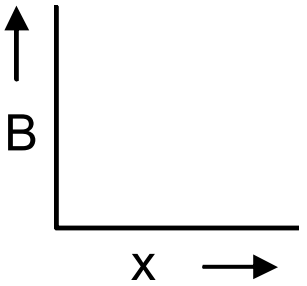
A solid wire of radius 10cm carries a current 5.0A distributed uniformly over its cross-section. Find the magnetic field B at a point at a distance (a) 2cm (b) 10cm and (c) 20cm away from the axis. Sketch a graph of B versus x for 0 < x < 20cm.
Answer

  1. $r = 10cm = 10 \times 10^{-2}m$
$x = 2 \times 10^{-2}m,$
i = 5A
i in the region of radius 2cm
$\frac{5}{\pi(10\times\times10^{-2})^2}\times\pi(2\times10^{-2})^2=0.2\text{A}$
$\text{B}\times\pi(2\times10^{-2})^2=\mu_0(0-2)$
$\Rightarrow\text{B}=\frac{4\pi\times10^{-7}\times0.2}{\pi\times4\times10^{-4}}=\frac{0.2\times10^{-7}}{10^{-4}}=2\times10^{-4}$
  1. 10cm radius
$\text{B}\times\pi(10\times10^{-2})^2=\mu_0\times5$
$\Rightarrow\text{B}=\frac{4\pi\times10^{-7}\times5}{\pi\times10^{-2}}=20\times10^{-5}$
  1. x = 20cm
$\text{B}\times\pi(20\times10^{-2})^2=\mu_0\times5$
$\Rightarrow\text{B}=\frac{\mu_0\times5}{\pi\times(20\times10^{-2})^2}=\frac{4\pi10^{-7}\times5}{\pi\times400\times10^{-4}}=5\times10^{-5}$

Need a full question paper?

Generate a complete, print-ready paper with questions like this in minutes — across 16+ boards, with answer keys.

Start Generating Free

Similar questions

A neutron moving with a speed υ strikes a hydrogen atom in ground state moving towards it with the same speed. Find the minimum speed of the neutron for which inelastic (completely or partially) collision may take place. The mass of neutron = mass of hydrogen $= 1.67 \times 10^{-27}kg.$
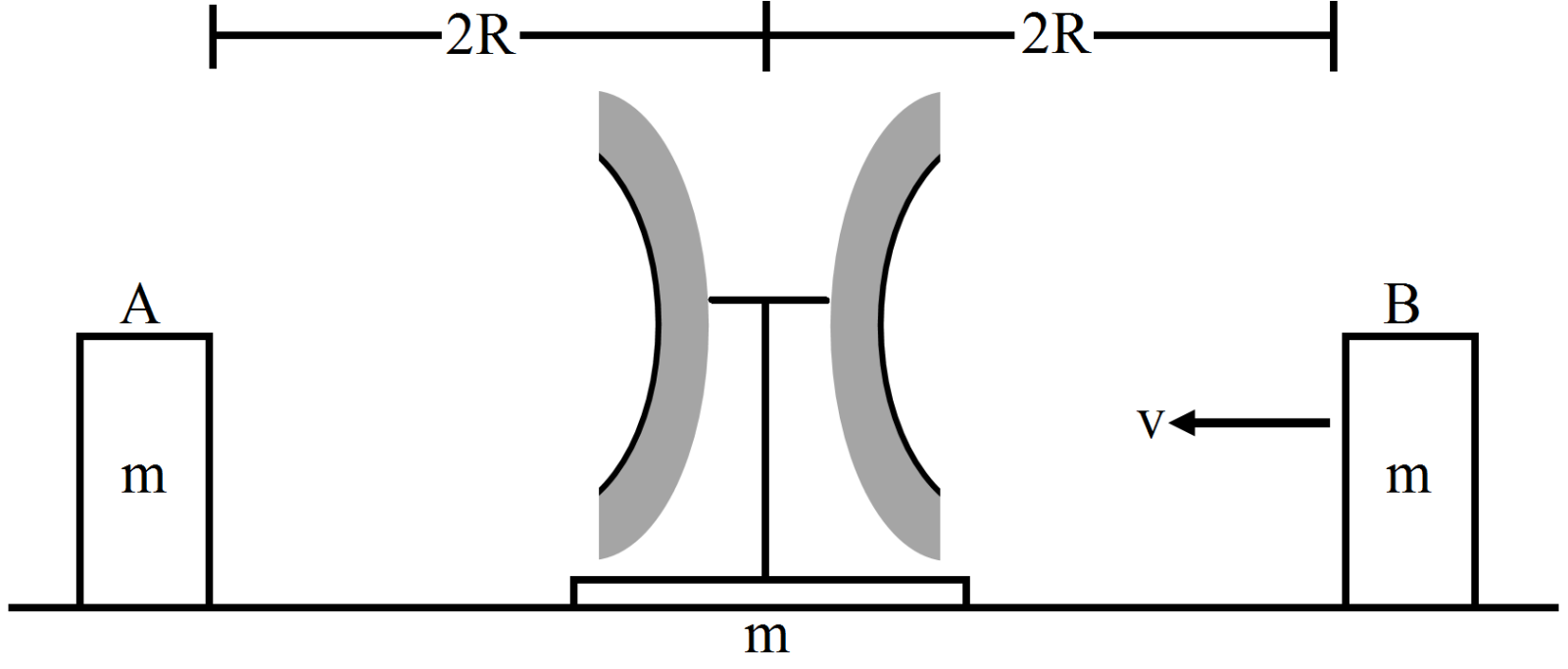
Two concave mirrors of equal radii of curvature R are fixed on a stand facing opposite directions. The whole system has a mass m and is kept on a frictionless horizontal table.

Two blocks A and B, each of mass m, are placed on the two sides of the stand. At t = 0, the separation between A and the mirrors is 2 R and also the separation between B and the mirrors is 2 R. The block B moves towards the mirror at a speed v. All collisions which take place are elastic. Taking the original position of the mirrors-stand system to be x = 0 and X-axis along AB, find the position of the images of A and B at t =
  1. $\frac{\text{R}}{\text{v}}$
  2. $\frac{3\text{R}}{\text{v}}$
  3. $\frac{5\text{R}}{\text{v}}$
A calorimeter of negligible heat capacity contains 100cc of water at 40°C. The water cools to 35°C in 5 minutes. The water is now replaced by K-oil of equal volume at 40°C. Find the time taken for the temperature to become 35°C under similar conditions. Specific heat capacities of water and K-oil are $4200Jkg^{-1}K^{-1}$ and $2100Jkg^{-1}K^{-1}$ respectively. Density of K-oil $= 800kgm^3.$
Answer the following question:
Long distance radio broadcasts use short-wave bands. Why?
An electron and a positron are released from (0, 0, 0) and (0, 0, 1.5R) respectively, in a uniform magnetic field $\text{P}=\text{B}_0\vec{\text{i}}$, each with an equal momentum of magnitude p = eBR. Under what conditions on the direction of momentum will the orbits be nonintersecting circles?
Deutrium was discovered in 1932 by Harold Urey by measuring the small change in wavelength for a particular transition in ${ }^1 \mathrm{H}$ and ${ }^2 \mathrm{H}$. This is because, the wavelength of transition depend to a certain extent on the nuclear mass. If nuclear motion is taken into account then the electrons and nucleus revolve around their common centre of mass. Such a system is equivalent to a single particle with a reduced mass $\mu$, revolving around the nucleus at a distance equal to the electron-nucleus separation. Here $\mu=\frac{m_e M}{m_e+M}$ where $M$ is the nuclear mass and me is the electronic mass. Estimate the percentage difference in wavelength for the $1^{\text {st }}$ line of the Lyman series in ${ }^1 \mathrm{H}$ and ${ }^2 \mathrm{H}$. (Mass of ${ }^1 \mathrm{H}$ nucleus is $1.6725 \times 10^{-27} \mathrm{~kg}$, Mass of ${ }^2 \mathrm{H}$ nucleus is $3.3374 \times 10^{-27} \mathrm{~kg}$, Mass of electron $=9.109 \times 10^{-31} \mathrm{~kg}$ ).
Do the same exercise as above with the replacement of the earlier transformer by a 40, 000-220V step-down transformer (Neglect, as before, leakage losses though this may not be a good assumption any longer because of the very high voltage transmission involved). Hence, explain why high voltage transmission is preferred?
Nuclei with magic no. of proton Z = 2, 8, 20, 28, 50, 52 and magic no. of neutrons N = 2, 8, 20, 28, 50, 82 and 126 are found to be very stable.
  1. Verify this by calculating the proton separation energy Sp for $^{120}Sn (Z = 50)$ and $^{121}Sb = (Z = 51)$. The proton separation energy for a nuclide is the minimum energy required to separate the least tightly bound proton from a nucleus of that nuclide. It is given by,
$Sp = (M_{Z-1'\ N} + M_H - M_{Z,N}) c^2.$
Given $^{119}In = 118.9058u, ^{120}Sn = 119.902199u, ^{121}Sb = 120.903824u, ^1H = 1.0078252u.$
  1. What does the existance of magic number indicate?
A uniform rod pivoted at its upper end hangs vertically. It is displaced through an angle of 60° and then released. Find the magnitude of the force acting on a particle of mass dm at the tip of the rod when the rod makes an angle of 37° with the vertical.
An electron emitted by a heated cathode and accelerated through a potential difference of 2.0 kV, enters a region with uniform magnetic field of 0.15 T. Determine the trajectory of the electron if the field,
  1. is transverse to its initial velocity,
  2. makes an angle of 30º with the initial velocity.