Question
An electron emitted by a heated cathode and accelerated through a potential difference of 2.0 kV, enters a region with uniform magnetic field of 0.15 T. Determine the trajectory of the electron if the field,
  1. is transverse to its initial velocity,
  2. makes an angle of 30º with the initial velocity.
Answer

Magnetic field strength, $B = 0.15$ TCharge on the electron,$ e = 1.6 \times 10^{-19} C$
Mass of the electron, $m = 9.1 \times 10^{-31} kg$
Potential difference, $V = 2.0 kV = 2 \times 10^3 V$
Thus, kinetic energy of the electron $= eV$
$\Rightarrow\text{eV}=\frac{1}{2}\text{mv}^{2}$
$\text{v}=\sqrt\frac{2\text{ev}}{\text{m}}.........(1)$
Where,
v = velocity of the electron
  1. Magnetic force on the electron provides the required centripetal force of the electron. Hence, the electron traces a circular path of radius r.
Magnetic force on the electron is given by the relation,
$\text{B ev}$
$\text{Centripetal force}=\frac{\text{mv}^{2}}{\text{r}}$
$\therefore\text{Bev}=\frac{\text{mv}^{2}}{\text{r}}$
$\text{r}=\frac{\text{mv}}{\text{Be}}.........(2)$
From equations (1) and (2), we get
$\text{r}=\frac{\text{m}}{\text{Be}}\Big[\frac{2\text{ev}}{\text{m}}\Big]^{\frac{1}{2}}$
$=\frac{9.1\times10^{-31}}{0.15\times1.6\times10^{-19}}\times\Big(\frac{2\times1.6\times10^{-19}\times2\times10^{3}}{9.1\times10^{-31}}\Big)^{\frac{1}{2}}$
$=100.55\times10^{-5}$
$=1.01\times10^{-3}\text{m}$
$=1\text{mm}$
Hence, the electron has a circular trajectory of radius 1.0 mm normal to the magnetic field.
  1. When the field makes an angle θ of 30° with initial velocity, the initial velocity will be,
$\text{v}_{1}=\text{v}\sin\theta$
From equation (2), we can write the expression for new radius as: $\text{r}_{1}=\frac{\text{mv}_{1}}{\text{Be}}$
$=\frac{\text{mv}\sin\theta}{\text{Be}}$
$=\frac{9.1\times10^{-31}}{0.15\times1.6\times10^{-19}}\times\Big(\frac{2\times1.6\times10^{-19}\times2\times10^{3}}{9\times10^{-31}}\Big)^{\frac{1}{2}}\times\sin30^{\circ}$
$=0.5\times10^{-31}\text{m}$
$=0.5\text{mm}$
Hence, the electron has a helical trajectory of radius 0.5 mm along the magnetic field direction.

Need a full question paper?

Generate a complete, print-ready paper with questions like this in minutes — across 16+ boards, with answer keys.

Start Generating Free

Similar questions

A stone is thrown vertically upward with a speed of 28m/s.
  1. Find the maximum height reached by the stone.
  2. Find its velocity one second before it reaches the maximum height.
  3. Does the answer of part.
  4. Change if the initial speed is more than 28m/s suchas 40m/s or 80m/s?
A car accelerates on a horizontal road due to the force exerted by:
  1. The engine of the car.
  2. The driver of the car.
  3. The earth.
  4. The road.
Two parallel wires seprated by a distance of 10cm carry currents of 10A and 40A along-the same direction. Where should a third current be placed so that it experiences no magnetic force?
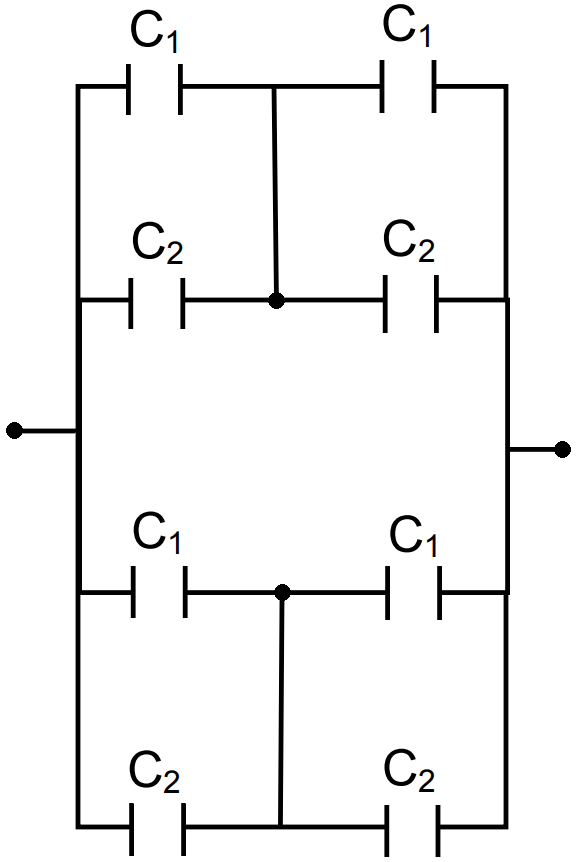
Take $\text{C}_1=4.0\mu\text{F}$ and $\text{C}_2=6.0\mu\text{F}$ in figure. Calculate the equivalent capacitance of the combination between the points indicated.

A convex lens of focal length 20cm and a concave lens of focal length 10cm are placed 10cm apart with their principal axes coinciding. A beam of light travelling parallel to the principal axis and having a beam diameter 5.0mm, is incident on the combination. Show that the emergent beam is parallel to the incident one. Find the beam diameter of the emergent beam.
The plates of a capacitor of capacitance $10\mu\text{F},$ charged to $60\mu\text{C},$ are joined together by a wire of resistance $10\Omega$ at t = 0. Find the charge on the capacitor in the circuit at (a) t = 0 (b) $\text{t}=30\mu\text{s}$ (c) $\text{t}=120\mu\text{s}$ and (d) t = 1.0ms.
Three rods of lengths 20cm each and area of cross section $1cm^2$ are joined to form a triangle ABC. The conductivities of the rods are $\text{K}_\text{AB}=50\text{Js}^{-1}\text{m}^{-1}{^{\circ}}\text{C}^{-1},\ \text{K}_\text{BC}=200\text{Js}^{-1}\text{m}^{-1}{^{\circ}}\text{C}^{-1}$ and $\text{K}_\text{AC}=400\text{Js}^{-1}\text{m}^{-1}{^{\circ}\text{C}}^{-1}.$ The junctions A, B and C are maintained at $40^\circ C, 80^\circ C$ and $80^\circ C$ respectively. Find the rate of heat flowing through the rods AB, AC and BC.
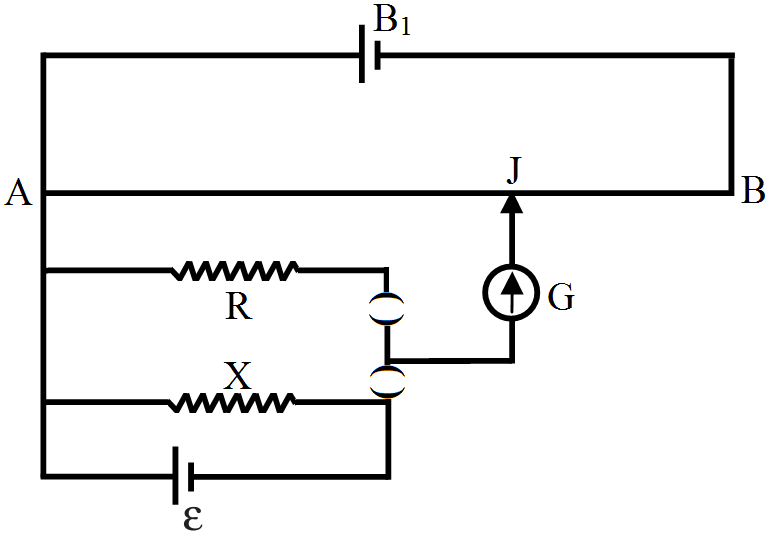
Figure shows a potentiometer circuit for comparison of two resistances. The balance point with a standard resistance $\text{R}=10.0\Omega$ is found to be 58.3cm, while that with the unknown resistance X is 68.5cm. Determine the value of X. What might you do if you failed to find a balance point with the given cell $\varepsilon.$
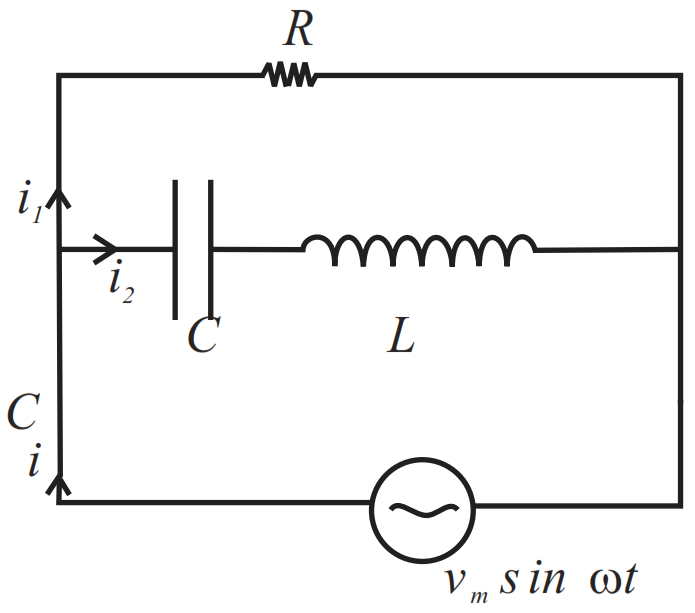
Consider the LCR circuit shown in Fig. Find the net current i and the phase of i. Show that . Find the impedence Z for this circuit.
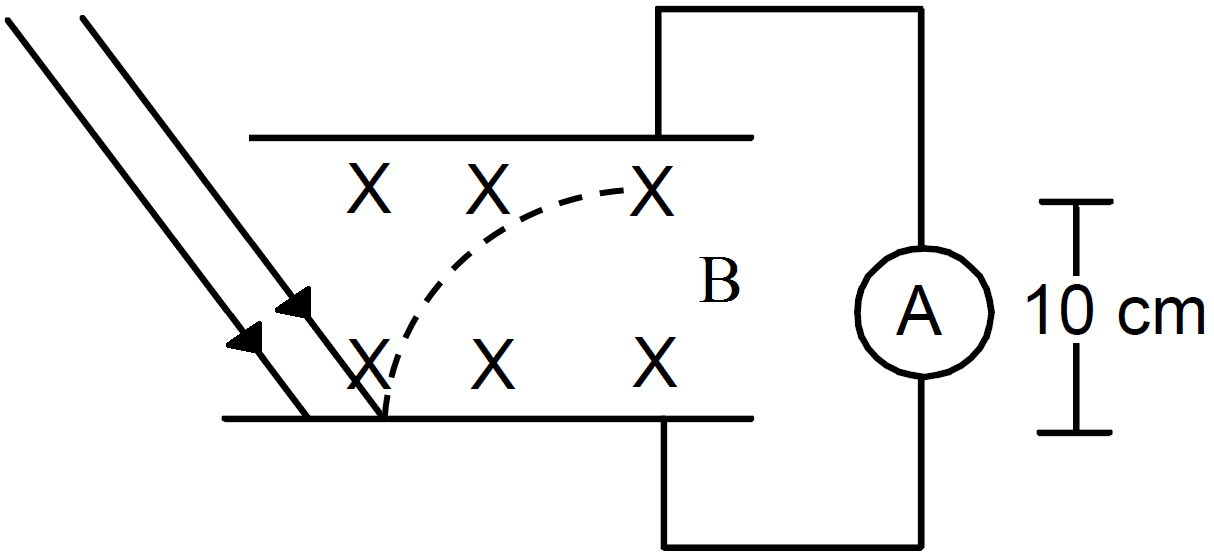
In an experiment on photoelectric effect, the emitter and the collector plates are placed et a separation of 10cm and are connected through en ammeter without any cell A magnetic field B exists parallel to the plates. The work function of the emitter is 2.39eV and the light incident on it has wavelengths between 400nm and 600nm. Find the minimum value of B for which the current registered by the ammeter is zero. Neglect any effect of space charge.