MCQ
A solution of methyl amine
  • A
    Turns blue litmus red
  • Turns red litmus blue
  • C
    Does not affect red or blue litmus
  • D
    Bleaches litmus

Answer

Correct option: B.
Turns red litmus blue
b
(b) $\underset{\text{(Litmus}\,\,\text{paper)}}{\mathop{\text{Red}}}\,\xrightarrow{C{{H}_{3}}N{{H}_{2}}}$   Blue

This litmus paper test shows basic nature of amine.

Need a full question paper?

Generate a complete, print-ready paper with questions like this in minutes — across 16+ boards, with answer keys.

Start Generating Free

Similar questions

Which concentrations can be calculated if the mole fraction and density of an aqueous solution of $HCl$ are known? $1.$ Molality $2.$ Molarity $3.$ Percentage by mass
Order of number of chelate ring is correct for

$(i)\, [Co(en)_2(Ox)]^+$

$(ii)\, [Fe(Trien)(Ox)]^+$

$(iii)\, [Ca(EDTA)]^{-2}$

$(iv)\, [Pt(Ox)_2 (H_2O)_2]$

One mole of an organic compound requires $0.5$ mole of oxygen to produce an acid. The compound may be
Correct order of bond dissociation energy
The reagent, from the following, which converts benzoic acid to benzaldehyde in one step is
If solubility of $NaCl$ at ${20\,^o}C$ is $35\,gm$ per $ 100\,gm$ of water. Then on adding $50\,gm$ of $NaCl$ to the same volume at same temperature the salt remains undissolved is .......... $gm$.
Potassium chlorate is prepared by electrolysis of $\mathrm{KCl}$ in basic solution as shown by following equation.

$6 \mathrm{OH}^{-}+\mathrm{Cl}^{-} \rightarrow \mathrm{ClO}_{3}^{-}+3 \mathrm{H}_{2} \mathrm{O}+6 \mathrm{e}^{-}$

A current of $x A$ has to be passed for $10 h$ to produce $10.0 \mathrm{~g}$ of potassium chlorate. The value of $\mathrm{x}$ is $.......$ (Nearest integer)

(Molar mass of $\left.\mathrm{KClO}_{3}=122.6 \mathrm{~g} \mathrm{~mol}^{-1}, \mathrm{~F}=96500 \mathrm{C}\right)$
The $\text{CFSE}$ for octahedral $\left[\mathrm{CoCl}_6\right]^{4-} 18,000 \ cm^{-1}$ . The $\text{CFSE}$ for tetrahedral $\left[\mathrm{CoCl}_4\right]^{2-}$ will be:
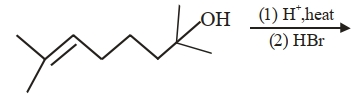
The major product in the given reaction is
Which of the following oxide is diamagnetic