MCQ
A sphere is rolled on a rough horizontal surface. It gradually slows down and stops. The force of friction tries to:
  1. Decrease the linear velocity.
  2. Increase the angular velocity.
  3. Increase the linear momentum.
  4. Decrease the angular velocity.
  • $A$ and $B$
  • B
    $B$ and $C$
  • C
    $A$ and $D$
  • D
    $B$ and $D$

Answer

Correct option: A.
$A$ and $B$
If a sphere is rolled on a rough horizontal surface, the force of friction tries to oppose the linear motion and favours the angular motion.

Need a full question paper?

Generate a complete, print-ready paper with questions like this in minutes — across 16+ boards, with answer keys.

Start Generating Free

Similar questions

The distance of two planets $($neptune and saturn$)$ from sun are $10^{13}$ and $10^{12}$m respectively. The ratio of time period of the planets is:
A tuning fork of unknown frequency produoes $4$ beats per second when sounded with another tuning fork of frequency $254 \,Hz$. It gives the same number of beats per second when unknown tuning fork loaded with wax. The unknown frequency before loading with wax is ..........
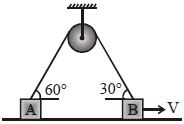
For the given diagram when block $B$ is pulled with velocity $V$ then velocity of block $A$ will be :-
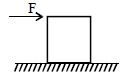
A force $F$ is applied on the top of a cube as shown in the figure. The coefficient of friction between the cube and ground is $\mu$. If $F$ is gradually increased the cube will topple before sliding then range of $\mu$ is:-
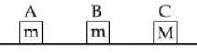
Three blocks $A, B$ and $C$ are lying on a smooth horizontal surface, as shown in the figure. $A$ and $B$ have equal masses, $m$ while $C$ has mass $M$. Block $A$ is given an initial speed $v$ towards $B$ due to which it collides with $B$ perfectly inelastically. The combined mass collides with $C$, also perfectly inelastically. The combined mass collides with $C$, also perfectly inelastically if $\frac{5}{6}^{th}$ of the initial kinetic energy is lost in whole process. What is value of $M/m$ ?
Consider the quantities, pressure, power, energy, impulse, gravitational potential, electrical charge, temperature, area. Out of these, the only vector quantities are
A body is slipping from an inclined plane of height $h$ and length $l$. If the angle of inclination is $\theta $, the time taken by the body to come from the top to the bottom of this inclined plane is
The $M.I.$ of a body about the given axis is $1.2\,kg \times m^2$ and initially the body is at rest. In order to produce a rotational kinetic energy of $1500\,joule$ an angular acceleration of $25\,rad/sec^2$ must be applied about that axis for a duration of ........ $\sec$.
A heavy stone is thrown in from a cliff of height h in a given direction. The speed with which it hits the ground:
A force $\vec F\, = \,(2\hat i\, - \,\hat j\, + 3\hat k)$ is acting at a point $(-1, 2, -3).$ Find its torque about the origin