MCQ
A sphere is rotating about a diameter:
  • A
    The particles on the surface of the sphere do not have any linear acceleration.
  • The particles on the diameter mentioned above do not have any linear acceleration.
  • C
    Different particles on the surface have different angular speeds.
  • D
    All the particles on the surface have same linear speed.
Answer

Correct option: B.
The particles on the diameter mentioned above do not have any linear acceleration.
Linear acceleration of a rotating particle is given as:
$\overrightarrow{\text{a}}=\overrightarrow{\text{r}}\times\overrightarrow{\alpha}$
$(b)$ The sphere is rotating about a diameter; therefore, the position vector of the particles on the diameter is zero. Thus, linear acceleration of the particle is zero.
$(c)$ and $(d):$ All the particles of the body have the same angular velocity. All the particle on the surface have different linear speeds that depend on the position of the particle from the axis of rotation.

Need a full question paper?

Generate a complete, print-ready paper with questions like this in minutes — across 16+ boards, with answer keys.

Start Generating Free

Similar questions

A couple produces
Two wires $A$ and $B$ of the same material have radii in the ratio $2 : 1$ and lengths in the ratio $4 : 1$. The ratio of the normal forces required to produce the same change in the lengths of these two wires is:
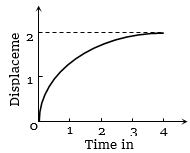
The displacement of a particle as a function of time is shown in the figure. The figure shows that
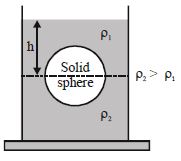
A solid sphere of radius $r$ is floating at the  interface of two immiscible liquids of densities $\rho_1$ and $\rho_2\,\, (\rho_2 > \rho_1),$ half of its volume lying in each. The height of the upper liquid column from the interface of the two liquids is $h.$ The force exerted on the sphere by the upper liquid is $($ atmospheric pressure $= p_0\,\,\&$ acceleration due to gravity is $g) $
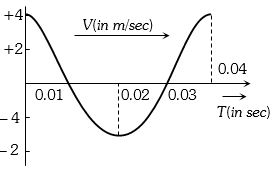
The velocity-time diagram of a harmonic oscillator is shown in the adjoining figure. The frequency of oscillation is ..... $Hz$
A body of mass $2\, kg$ is hung on a spring balance mounted vertically in a lift. If the lift descends with an acceleration equal to the acceleration due to gravity $‘g’$, if the lift moves up with an acceleration equal to the acceleration due to gravity, the reading on the spring balance will be .......... $kg$
The sum of all electromagnetic forces between different particles of a system of charged particles is zero:
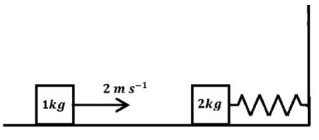
A spring-block system is resting on a frictionless floor as shown in the figure. The spring constant is $2.0 N m ^{-1}$ and the mass of the block is $2.0 kg$. Ignore the mass of the spring. Initially the spring is in an unstretched condition. Another block of mass $1.0 kg$ moving with a speed of $2.0 m s ^{-1}$ collides elastically with the first block. The collision is such that the $2.0 kg$ block does not hit the wall. The distance, in metres, between the two blocks when the spring returns to its unstretched position for the first time after the collision is. . . . . .
If the position vector of a particle is

$\vec r =  - \cos \,t\hat i + \sin \,t\hat j - 18\,t\hat k$

then what is the magnitude of its acceleration ?

A sphere is suspended by a thread of length $l$. What minimum horizontal velocity has to be imparted the ball for it to reach the height of the suspension