Question
A spherical shell made of plastic, contains a charge Q distributed uniformly over its surface. What is the electric field inside the shell? If the shell is hammered to deshape it without altering the charge, will the field inside be changed? What happens if the shell is made of a metal?
Answer

As the shell is made of plastic, it is non-conducting. But as the charge is distributed uniformly over the surface of the shell, the sum of all the electric field vectors at the centre due to this kind of distribution is zero. But when the plastic shell is deformed, the distribution of charge on it becomes non-uniform. In other words, the sum of all the electric field vectors is non-zero now or the electric field exists at the centre now.
In case of a deformed conductor, the field inside is always zero.

Need a full question paper?

Generate a complete, print-ready paper with questions like this in minutes — across 16+ boards, with answer keys.

Start Generating Free

Similar questions

A uniform wire of resistance $100\Omega$ is melted and recast as a wire of length is double that of the original. What would be the resistance of the wire?
A given coin has a mass of 3.0 g . Calculate the nuclear energy that would be required to separate all the neutrons and protons from each other. For simplicity assume that the coin is entirely made of ${ }_{29}^{63} Cu$ atoms (of mass 62.92960 u )
Do all the thermocouples have a neutral temperature?
A liquid-nitrogen container is made of a 1cm thick styrofoam sheet having thermal conductivity $0.025\text{Js}^{-1}\text{m}^{-1}{^\circ}\text{C}^{-1}.$ Liquid nitrogen at 80K is kept in it. A total area of 0.80m2 is in contact with the liquid nitrogen. The atmospheric temperature is 300K. Calculate the rate of heat flow from the atmosphere to the liquid nitrogen.
How electromagnetic waves are produced? What is the source of the energy accompanied by any propagating electromagnetic wave?
(i) In far switches of household electrical appliances
(ii) In medical diagnosis
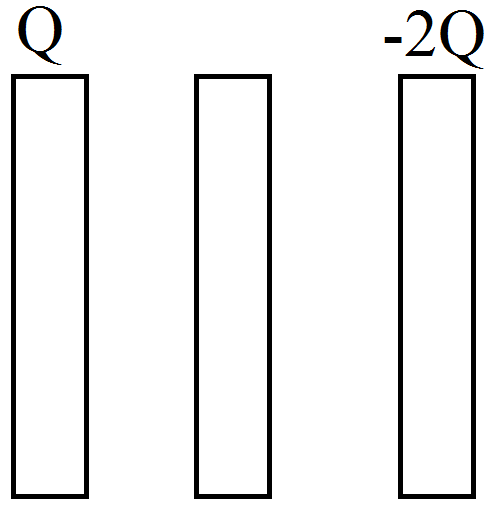
Three identical metal plates with large surface areas are kept parallel to each other as shown in figure. The leftmost plate is given a charge Q, the rightmost a charge -2Q and the middle one remains neutral. Find the charge appearing on the outer surface of the rightmost plate.

Let $\overrightarrow{\text{A}}$ and $\overrightarrow{\text{B}}$ be the two vectors of magnitude 10 unit each. If they are inclined to the X-axis at angles 30° and 60° respectively, find the resultant.
Is it easier to take out a nucleon from carbon or from iron? Fi-om iron or from lead?
Derive the formula for the force acting on current carrying rod placed in a magnetic field.
  1. Draw a schematic diagram of a reflecting telescope.
  2. State the advantages of reflecting telescope over refracting telescope.