MCQ
A spherical solid ball of $1\,kg$ mass and radius $30\,cm$ is rotating about an axis passing through its centre with an angular velocity of $50\,radian/s$ . The kinetic energy of rotation is ......... $J$.
  • A
    $4500$
  • B
    $90$
  • C
    $910$
  • $45$

Answer

Correct option: D.
$45$
d
since $\mathrm{K}$$. E.$ of rotation $=\frac{1}{2} \mathrm{I} \omega^{2}, \mathrm{I}=\frac{2}{5} \mathrm{MR}^{2}$

$\therefore \quad \mathrm{K.} \mathrm{E} \cdot=\frac{1}{2} \times \frac{2}{5} \times 1 \times(.3)^{2} \times(50)^{2}=45 \mathrm{J}$

Need a full question paper?

Generate a complete, print-ready paper with questions like this in minutes — across 16+ boards, with answer keys.

Start Generating Free

Similar questions

Four persons $K,\,L,\,M$ and $N$ are initially at the corners of a square of side of length $d$. If every person starts moving, such that $K$ is always headed towards $L,\,L$ towards $M,\,M$ is headed directly towards $N$ and $N$ towards $K$, then the four persons will meet after
Which one of the following is not a unit of British system of units?
The term 'fluid' is used for ............
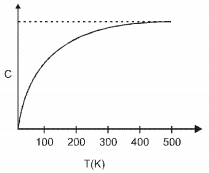
The figure below shows the variation of specific heat capacity $(C)$ of a solid as a function of temperature $(T)$. The temperature is increased continuously from $0$ to $500 \ K$ at a constant rate. Ignoring any volume change, the following statement$(s)$ is (are) correct to a reasonable approximation.$Image$

$(A)$ the rate at which heat is absorbed in the range $0-100 \ K$ varies linearly with temperature $T$.

$(B)$ heat absorbed in increasing the temperature from $0-100 \ K$ is less than the heat required for increasing the temperature from $400-500 \ K$.

$(C)$ there is no change in the rate of heat absorbtion in the range $400-500 \ K$.

$(D)$ the rate of heat absorption increases in the range $200-300 \ K$.
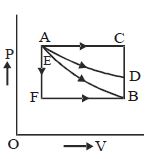
An ideal system can be brought from state $A$ to $B$ through four paths as shown in the figure. The energy given to the system is minimum in
The mass and volume of a body are $4.237g$ and $2.5\ cm^3$, respectively. The density of the material of the body in correct significant figures is:
Which of the following is true about the angular momentum of a cylinder down a slope without slipping
A body of mass $10\ kg$ is acted upon by two perpendicular forces, $6N$ and $8N.$ The resultant acceleration of the body is:
A car having a mass of $1000\, kg$ is moving at a speed of $30\, metres/sec$. Brakes are applied to bring the car to rest. If the frictional force between the tyres and the road surface is $5000$ newtons, the car will come to rest in ........ $\sec$
A ball falls vertically downward and bounces off a horizontal floor.The speed of the ball just before reaching the floor $\left(u_1\right)$ is equal to the speed just after leaving contact with the floor $\left(u_2\right), u_1=u_2$. The corresponding magnitudes of accelerations are denoted respectively by $a_1$ and $a_2$. The air resistance during motion is proportional to speed and is not negligible. If $g$ is acceleration due to gravity, then