MCQ
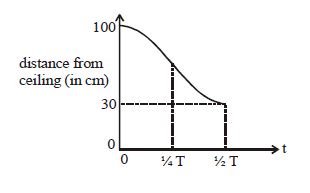
A spring hangs vertically from the ceiling and a mass is attached to its free end. When the mass is pulled down and released, it oscillates vertically with simple harmonic motion of period $T$ . The variation with time $t$ of its distance from the ceiling is as shown. Which statement gives a correct deduction from this graph?
  • A
    The amplitude of the oscillation is $70\ cm$
  • B
    The kinetic energy is maximum at $t = \frac {1}{2}\ T$ 
  • C
    The restoring force on the mass increases between $t = 0$ and $t = \frac {1}{4}\ T$ 
  • The speed is maximum at  $t = \frac {1}{4}\ T$ 
Answer

Correct option: D.
The speed is maximum at  $t = \frac {1}{4}\ T$ 
d
Speed is maximum at the mean position
Distance between extreme position $ = 2A$ .
$2A = 70$
$A = 35\ cm$

Need a full question paper?

Generate a complete, print-ready paper with questions like this in minutes — across 16+ boards, with answer keys.

Start Generating Free

Similar questions

A particle moves from $x=0$ to $x=x_1$ under the influence of force $F =-k x$. The work done in this will be :
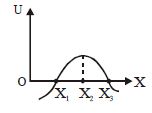
In the figure shown the potential energy $(U)$ of a particle is plotted against its position $'x'$ from origin. The particle at
Mark the correct options:
  1. Gauss's law is valid only for symmetrical charge distributions.
  2. Gauss's law is valid only for charges placed in vacuum.
  3. The electric field calculated by Gauss's law is the field due to the charges inside the Gaussian surface.
  4. The flux of the electric field through a closed surface due to all the charges is equal to the flux due to the charges enclosed by the surface.
Modulus of rigidity of ideal liquids is
A dimensionless quantity:
  1. Never has a unit.
  2. Always has a unit
  3. May have a unit.
  4. Does not exist.
Two projectiles $A$ and $B$ are thrown with the same speed but angles are $40^{\circ}$ and $50^{\circ}$ with the horizontal. Then
Match the following columns.
colum $I$ colum $II$
$(A)$ Constant positive acceleration $(p)$ Speed may increase
$(B)$ Constant negative acceleration $(q)$ Speed may decrease
$(C)$ Constant displacement $(r)$ Speed is zero
$(D)$ Constant slope of $a-t$ graph $(s)$ Speed must increase
The elasticity of invar
Two cars OF SAME LENGTH move in the same direction along parallel roads. One of them is a 100m long travelling with a velocity of 7.5 ms−1. How long will it take for the first car to overtake the second car?
A ball is thrown up, it reaches a maximum height and then comes down. If t1(t2 > t1) are the times that the ball takes to be at a particular height then the time taken by the ball to reach the highest point is: