MCQ
A spring when stretched by $2 \mathrm{~mm}$ its potential energy becomes $4 \mathrm{~J}$. If it is stretched by $10 \mathrm{~mm}$, its potential energy is equal to
  • A
    $4 J$
  • B
    $54 J$
  • C
    $415 \mathrm{~J}$
  • None

Answer

Correct option: D.
None
(d) $U=\frac{1}{2} k x^2$ if $x$ becomes 5 times then energywillbecome25timesi.e$4\times 25=100 \mathrm{~J}$

Need a full question paper?

Generate a complete, print-ready paper with questions like this in minutes — across 16+ boards, with answer keys.
Start Generating Free

Similar questions

No bias is applied to a $P-N$ junction, then the current
A photon and an electron have equal energy E. $\lambda_{\text {photon }} / \lambda_{\text {electron }}$ is proportional to
A fireman of mass $60 \mathrm{~kg}$ slides down a pole. He is pressing the pole with a force of $600 \mathrm{~N}$. The coefficient of friction between the hands and the pole is 0.5 , with what acceleration will the fireman slide down $\left(g=10 \mathrm{~m} / \mathrm{s}^2\right)$
An electric bulb illuminates a plane surface. The intensity of illumination on the surface at a point $2 \mathrm{~m}$ away from the bulb is $5 \times 10^{-4}$ phot (lumen/ $\mathrm{cm}$ ). The line joining the bulb to the point makes an angle of 60 with the normal to the surface. The intensity of the bulb in candela is
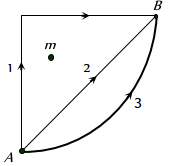
If $W_1, W_2$ and $W_3$ represent the work done in moving a particle from $A$ to $B$ along three different paths $1, 2$ and $3$ respectively (as shown) in the gravitational field of a point mass $\mathrm{m}$, find the correct relation between $W_1, W_2$ and $W_3$
Image
A point source of $100$ candela is held $5 \mathrm{~m}$ above a sheet of bloting paper which reflects $75 \%$ of light incident upon it. The illuminance of blotting paper is
If an ammeter is connected in parallel to a circuit, it is likely to be damaged due to excess
The excess of pressure inside a soap bubble than that of the outer pressure is
The coordinates of a moving particle at any time ' $t$ ' are given by $x=$ $\alpha t$ and $y=\beta t$. The speed of the particle at time ' $t$ ' is given by
The displacement is given by $x=2 t^2+t+5$, the acceleration at $t=2 s$ is