Question
A square is inscribed in an isosceles right triangle so that the square and the triangle have one angle common. Show that the vertex of the square opposite the vertex of the common angle bisects the hypotenuse.
Answer


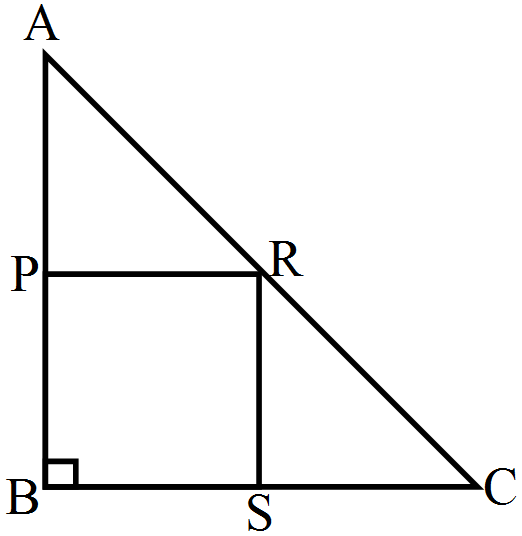
Let $\triangle\text{ABC}$ be an isosceles right triangle, right-angled at B.

$\Rightarrow\text{AB = BC}$

Let PBSR be a square inscribed in $\triangle\text{ABC}$ with common $\angle\text{B}.$

$\Rightarrow\text{PB = BS = SR = RP}$

Now, $\text{AB} - \text{PB = BC} -\text{BS}$

 $\Rightarrow\text{AP = CS ...(i)}$

In $\triangle\text{APR}$ and $\triangle\text{CSR}$

$\text{AP = CS}$ [from (i)]

$\angle\text{APR}=\angle\text{CSR}$ (Each 90°)

$\text{PR = SR}$ (sides of a square)

$\therefore\triangle\text{APR}\cong\triangle\text{CSR}$ (by SAS congruence criterion)

$\Rightarrow\text{AR = CR}$ [C.P.C.T.]

Thus, point R bisects the hypotenuse AC.

Need a full question paper?

Generate a complete, print-ready paper with questions like this in minutes — across 16+ boards, with answer keys.
Start Generating Free

Similar questions

The radius and height of a right circular cone are in the ratio 5 : 12 and its volume is 2512 cubic cm. Find the slant height and radius of the cone. $($Use $\pi=3.14).$
Three girls Ishita, Isha and Nisha are playing a game by standing on a circle of radius 20m drawn in a park. Ishita throws a ball to Isha, Isha to Nisha and Nisha to Ishita. If the distance between Ishita and Isha and between Isha and Nisha is 24m each, what is the distance between Ishita and Nisha.
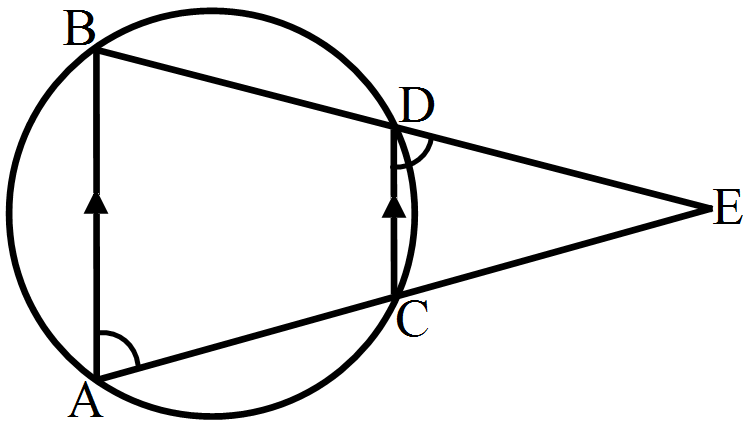
In the given figure, AB and CD are two parallel chords of a circle. If BDE and ACE are straight lines, intersecting at E, prove that $\triangle\text{AEB}$ is isosceles.

The aggregate monthly expenditure of a family was Rs. 18720 during the first 3 months, Rs 20340 during the next 4 months and Rs. 21708 during the last 5 months of a year. If the total saving during the year be Rs. 35340 find the average monthly income of the family.
Find the area of a triangle whose sides are 3cm, 4cm and 5cm respectively.
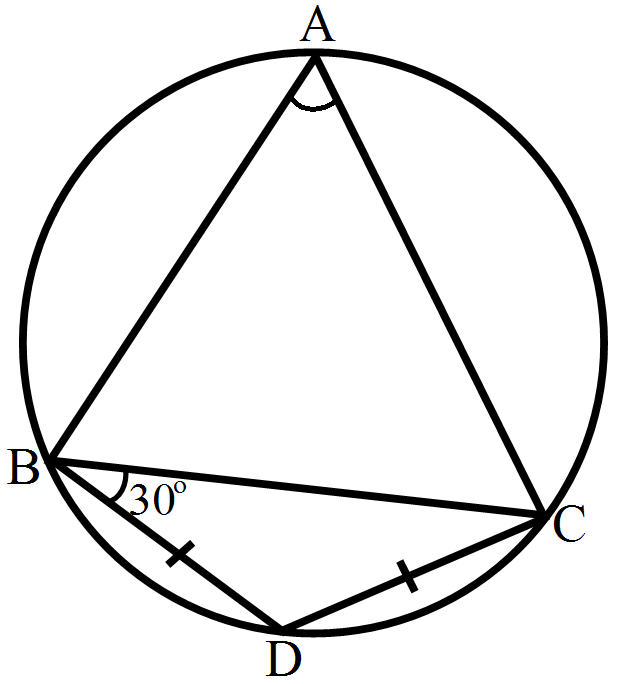
In the given figure, BD = DC and $\angle\text{CBD}=30^\circ,$ find $\angle\text{BAC}.$

P and Q are points on opposite sides AD and BC of a parallelogram ABCD such that PQ passes through the point of intersection O of its diagonals AC and BD. Show that PQ is bisected at O.
The final marks in mathematics of 30 students are as follows:

53, 61, 48, 60, 78, 68, 55, 100, 67, 90, 75, 88, 77, 37, 84, 58, 60, 48, 62, 56, 44, 58, 52, 64, 98, 59, 70, 39, 50, 60
  1. Arrange these marks in ascending order 30 to 39 one group 40 to 49 second group etc.

Now answer the following:

  1. What is the lowest score?
  2. What is the highest score?
  3. What is the range?
  4. If 40 is the pass mark how many failed?
  5. How many have scored 75 or more?
  6. Which observations between 50 and 60 have not actually appeared?
  7. How many have scored less than 50?
30 circular plates, each of radius 14cm and thickness 3cm are placed one above the another to form a cylindrical solid. Find:
  1. The total surface area.
  2. Volume of the cylinder so formed.
The monthly wages of 30 workers in a factory are given below:
83.0, 835, 890, 810, 835, 836, 869, 845, 898, 890, 820, 860, 832, 833, 855, 845, 804, 808, 812, 840, 885, 835, 836, 878, 840, 868, 890, 806, 840, 890.
Represent the data in the form of a frequency distribution with class size 10.