Question types

Quadrilaterals question types

114 questions across 5 question groups — pick any mix to generate a Maths paper with step-by-step answer keys.

114
Questions
5
Question groups
5
Question types
Sample Questions

Quadrilaterals questions

One sample from each question group in this chapter. Select any group above to see the full set with answer keys.

Q 1M.C.Q1 Mark
Short Answer Questions.
What special name can be given to a quadrilateral PQRS if $\angle\text{P}+\angle\text{S}=180^{\circ}?$
View full solution
Q 2M.C.Q1 Mark
Short Answer Questions.
In a quadrilateral PQRS, the diagonals PR and QS bisect each other. If $\angle\text{Q}=56^{\circ},$ determine $\angle\text{R}.$
View full solution
Q 3M.C.Q1 Mark
Short Answer Questions.
All the angles of a quadrilateral can be obtuse. Is this statement true? Give reasons for your answer.
View full solution
Q 4M.C.Q1 Mark
Short Answer Questions.
If D and E are respectively the midpoints of the sides AB and BC of $\triangle\text{ABC}$ in which AB = 7.2cm, BC = 9.8cm and AC = 3.6cm then determine the length of DE.
View full solution
Q 5M.C.Q1 Mark
Short Answer Questions.
Can we form a quadrilateral whose angles are 70°, 115°, 60° and 120°? Give reasons for your answer.
View full solution
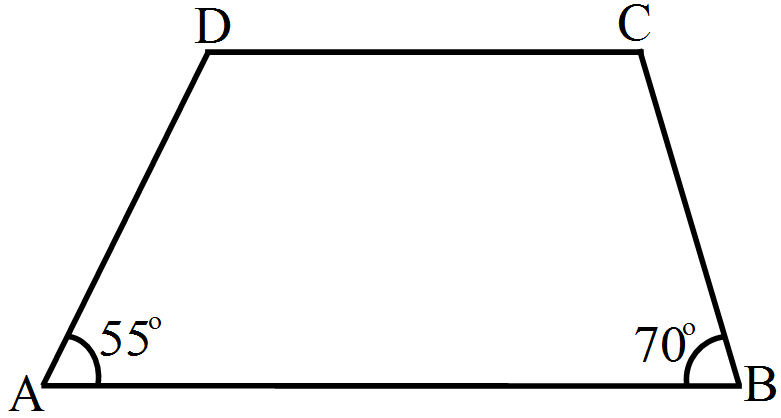
In the adjoining figure, ABCD is a trapezium in which AB || DC. If $\angle\text{A}=55^{\circ}$ and $\angle\text{B}=70^{\circ},$ find $\angle\text{C}$ and $\angle\text{D}.$

View full solution
In a parallelogram ABCD, points M and N have been taken on opposite sides AB and CD respectively such that AM = CN. Show that AC and MN bisect each other.

View full solution
Q 113 Marks Question3 Marks
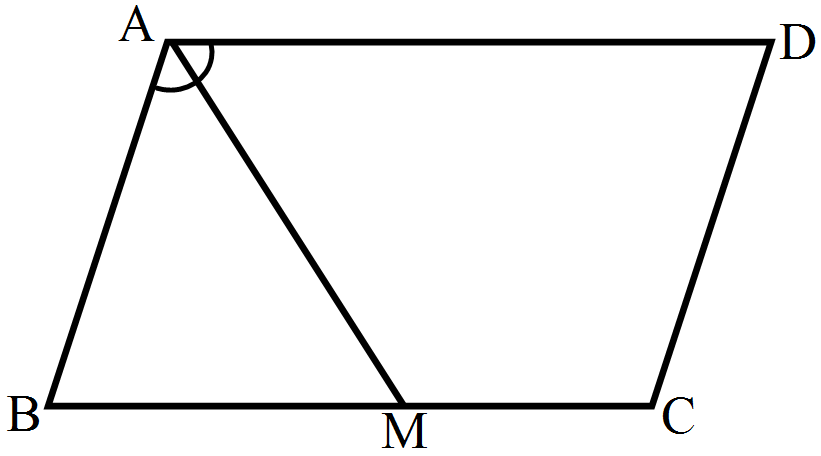
In the adjoining figure, M is the midpoint of side BC of a parallelogram ABCD such that $\angle\text{BAM}=\angle\text{DAM}.$ Prove that AD = 2CD.
View full solution
Q 123 Marks Question3 Marks
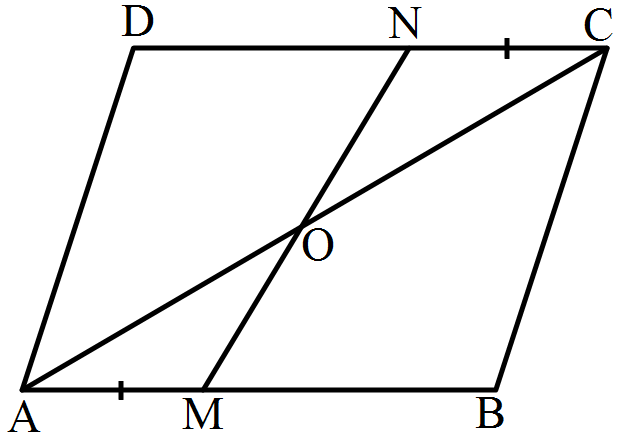
M and N are points on opposite sides AD and BC of a parallelogram ABCD such that MN passes through the point of intersection O of its diagonals AC and BD. Show that MN is bisected at O.
View full solution
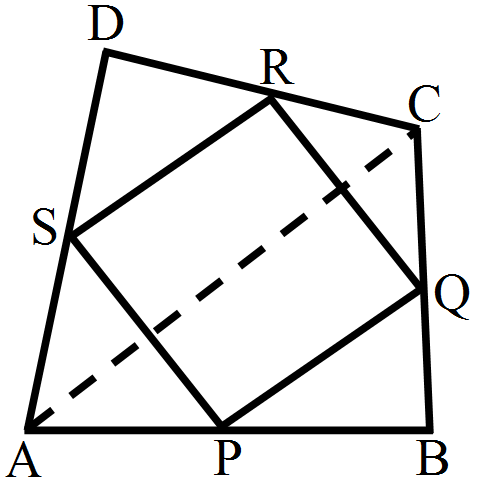
P , Q, R and S are respectively the midpoints of the sides AB, BC, CD and DA of a quadrilateral ABCD. Show that:
  1. PQ || AC and $\text{PQ}=\frac{1}{2}\text{AC}$
  2. PQ || SR
  3. PQRS is a parallelogram.

View full solution
In the adjoining figure, ABCD is a square and $\triangle\text{EDC}$ is an equilateral triangle. Prove that:
  1. AE = BE,
  2. $\angle\text{DAE}=15^{\circ}.$
View full solution
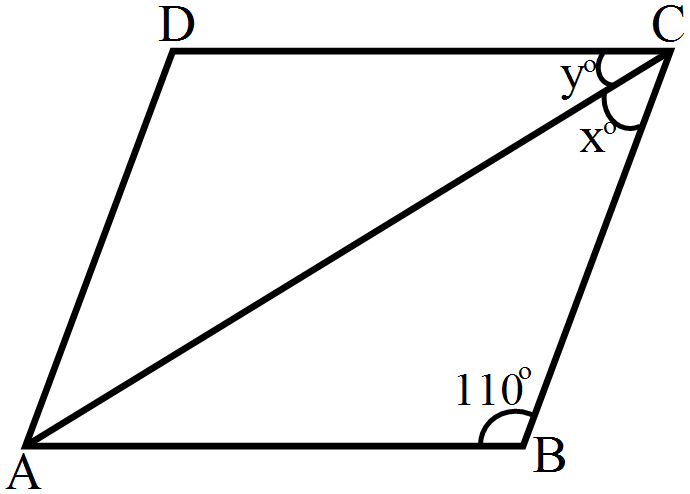
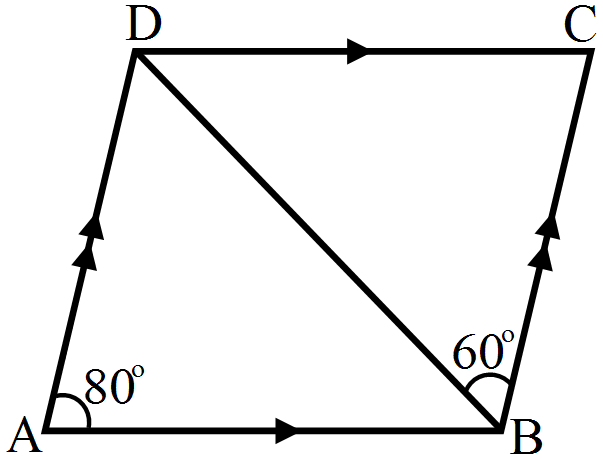
In the adjoining figure, ABCD is a parallelogram in which $\angle\text{DAB}=80^{\circ}$ and $\angle\text{DBC}=60^{\circ}.$ Calculate $\angle\text{CDB}$ and $\angle\text{ADB}.$

View full solution
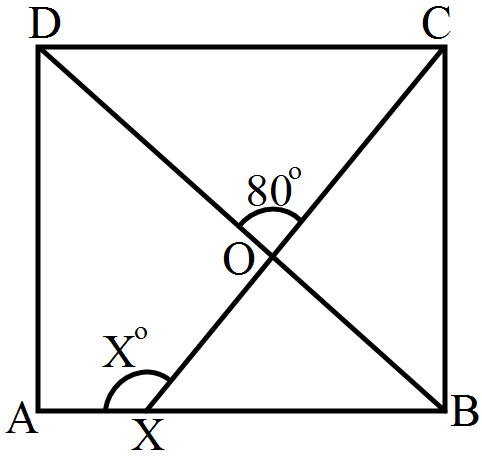
In the adjoining figure, ABCD is a square. A line segment CX cuts AB at X and the diagonal BD at O such that $\angle\text{COD}=80^{\circ}$ and $\angle\text{OXA}=\text{x}^{\circ}.$ Find the value of x.

View full solution
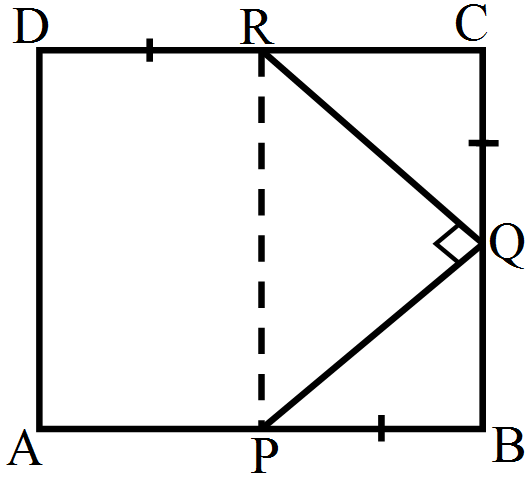
In the given figure, ABCD is a square and $\angle\text{PQR}=90^{\circ}.$ If PB = QC = DR, prove that:

  1. QB = RC,
  2. PQ = QR,
  3. $\angle\text{QPR}=45^{\circ}$

View full solution

Generate a Quadrilaterals paper free

Pick question groups from the list above, set marks and difficulty, and export a branded PDF with step-by-step answer keys. First 3 chapters free — no signup.

Download App