MCQ
A square loop, carrying a steady current $I,$ is placed in a horizontal plane near a long straight conductor carrying a steady current $I_1$ at a distance $d$ from the conductor as shown in figure. The loop will experience
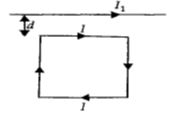
  • a net attractive force towards the conductor
  • B
    a net repulsive force away from the conductor
  • C
    a  net torque acting upward perpendicular to the horizontal plane
  • D
    a net torque acting downward normal to the horizontal plane

Answer

Correct option: A.
a net attractive force towards the conductor
a
$F_{2}=-F_{4}$

$F_{1}=\frac{\mu_{0} I_{1} \Pi}{2 \pi d l}$

$F_{2}=\frac{\mu_{0} I_{1} I}{2 \pi(d+l)}$

$F_{1}>F_{3}$

$F_{n e t}=F_{1}-F_{3}$

So, wire attract loop.

Need a full question paper?

Generate a complete, print-ready paper with questions like this in minutes — across 16+ boards, with answer keys.

Start Generating Free

Similar questions

A sample of hydrogen like atoms produces an emission spectrum consisting of $10$ wavelength arising out of all transitions possible. During this process the maximum angular impulse on an electron going from higher energy level to a lower energy level is
In a double slit arrangement fringes are produced using light of wavelength $4800 Å$. One slit is covered by a thin plate of glass of refractive index $1.4$ and the other with another glass plate of same thickness but of refractive index $1.7$. By doing so the central bright shifts to original fifth bright fringe from centre. Thickness of glass plate is......$\mu m$
The electric field due to a dipole at a distance r on its axis is
The relation between $a$ and $b$ parameters of current gains for a transistors is given by
Hubble's law is related with
According to classical theory, the circular path of an electron in Rutherford atom is
Light described at a place by the equation $\varepsilon = (100V/m)\, [sin(5 \times 10^{15} s^{-1})t + sin (8 \times 10^{15} s^{-1})t]$ falls on a metal surface having work function $2eV$. Calculate the maximum kinetic energy of the photo electrons............... $eV$
An element has number of proton $= 7.$ Then what will be its atomic number?
In a Young's double slit experiment, the source illuminating the slits is changed from blue to violet. The width of the fringes
A plot of the number of neutrons $(N)$ against the number of protons ( $P$ )of stable nuclei exhibits upward deviation from linearity for atomic number, $Z>20$. For an unstable nucleus having $N / P$ ratio less than $1$ , the possible mode($s$) of decay is(are)

($A$) $\beta^{-}$-decay ( $\beta$ emission)

($B$) orbital or $K$-electron sasture

($C$) neutron emission

($D$) $\beta^{+}$-decay (positron emission)