Question
A star like the sun has several bodies moving around it at different distances. Consider that all of them are moving in circular orbits. Let r be the distance of the body from the centre of the star and let its linear velocity be v, angular velocity $\omega$, kinetic energy K, gravitational potential energy U, total energy E and angular momentum l. As the radius r of the orbit increases, determine which of the above quantities increase and which ones decrease.
Answer

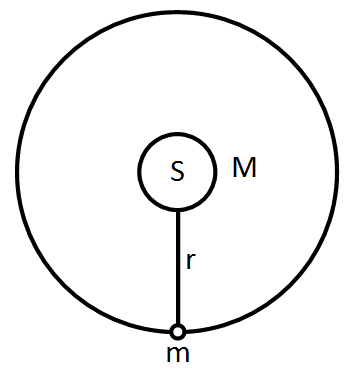
In equilibrium condition, when a body moves around a star, the gravitational pull result in a centripetal force. Let us consider a body of mass m is rotating around the star S of mass M in circular path of radius r.
$\text{F}_\text{c}=\frac{\text{mv}^2_0}{\text{r}}=\frac{\text{GMm}}{\text{r}^2}$
  1. Then orbital velocity $\text{v}_0=\sqrt{\frac{\text{GM}}{\text{r}}}\text{or}\text{ v}_0\propto\frac{1}{\sqrt{\text{r}}}$
Hence, on increasing radius of circular path orbital velocity decreases.
  1. Angular velocity $\omega=\frac{2\pi}{\text{T}}$ and $\text{T}^2\propto\text{r}^3$ by Kepler’s third law
$\therefore\ \omega=\frac{2\pi}{\text{Kr}^{\frac{3}{2}}} \text{ or }\omega\propto\frac{1}{\sqrt{\text{r}^3}}$

Hence, on increasing the radius of circular orbit the angular velocity decreased.
  1. Kinetic energy $\text{E}_\text{k}=\frac{1}{2}\text{ m }\frac{\text{GM}}{\text{r}}$
Or $\text{E}_\text{k}\propto\frac{1}{\text{r}}.$ Hence on increasing the radius of circular path the kinetic energy decreased.
  1. Gravitation potential energy $\text{E}_\text{p}=\frac{-\text{GMm}}{\text{r}}$ or $\text{E}_\text{p}\propto-\Big(\frac{1}{\text{r}}\Big)$ so.
On increasing radius of circular orbit the P.E. (Ep) increases.
  1. Total energy $\text{E}=\text{E}_\text{k}+\text{E}_\text{p}=\frac{\text{GMm}}{2\text{r}}+\Big(\frac{-\text{GMm}}{\text{r}}\Big)$
$\text{E}=\frac{-\text{GMm}}{2\text{r}}$

Hence, on increasing the radius of circular orbit the total energy E will also be increased.
  1. Angular momentum $=\text{L}=\text{mvr}=\text{m}\sqrt{\frac{\text{GM}}{\text{r}}}\text{r}$
$\text{L}=\text{m}\sqrt{\text{GMr}}$ or $\text{L}\propto\sqrt{\text{r}}$

Hence, the increasing radius r of circular orbit increases the angular momentum.

Need a full question paper?

Generate a complete, print-ready paper with questions like this in minutes — across 16+ boards, with answer keys.

Start Generating Free

Similar questions

A charge Q is placed at the centre of an uncharged, hollow metallic sphere of radius a:
  1. Find the surface charge density on the inner surface and on the outer surface.
  2. If a charge q is put on the sphere, what would be the surface charge densities on the inner and the outer surfaces?
  3. Find the electric field inside the sphere at a distance x from the centre in the situations (a) and (b).
Define conservative and non-conservative forces and also describe their examples.
Two masses of 90kg and 160kg are at a distance 5m apart. Compute the magnitude of intensity of the gravitational field at a point distance 3m from the 90kg and 4m from the 160kg mass. $G = 6.67 \times 10^{-11}Nm^2kg^{-2}$.
What is the amplitude, wavelength and velocity of the wave represented by
$\phi(\text{x, t})=5\sin(6\pi\text{t}-4\text{x})?$
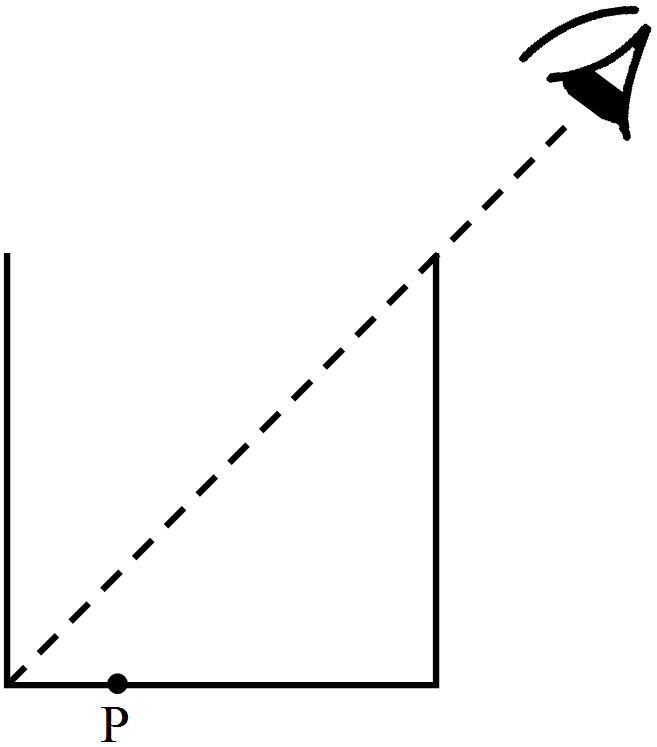
A cylindrical vessel, whose diameter and height both are equal to 30cm, is placed on a horizontal surface and a small particle P is placed in it at a distance of 5.0cm from the centre. An eye is placed at a position such that the edge of the bottom is just visible. The particle P is in the plane of drawing. Up to what minimum height should water be poured in the vessel to make the particle P visible?
An object falling through a fluid is observed to have acceleration given by a = g - bv where g = gravitational acceleration and b is constant. After a long time of release, it is observed to fall with constant speed. What must be the value of constant speed?
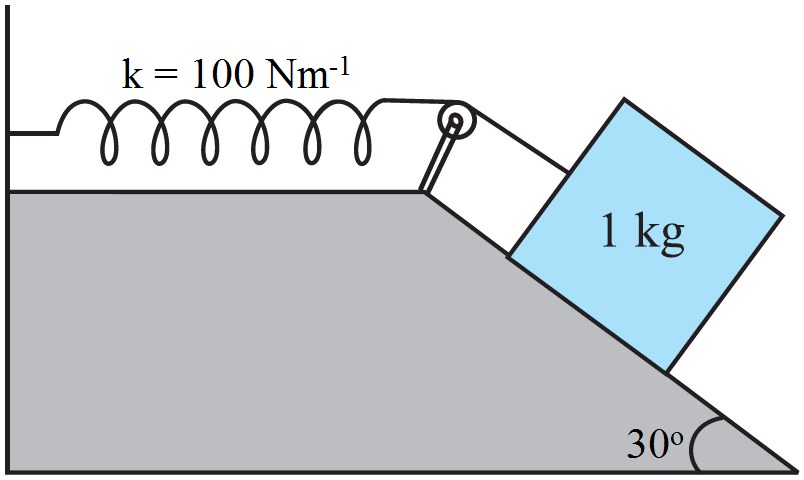
A 1kg block situated on a rough incline is connected to a spring of spring constant 100Nm as shown below. The block is released from rest with the spring in the unstretched position. The block moves 10cm down the incline before coming to rest. Find the coefficient of friction between the block and the incline. Assume that the spring has a negligible mass and the pulley is frictionless.
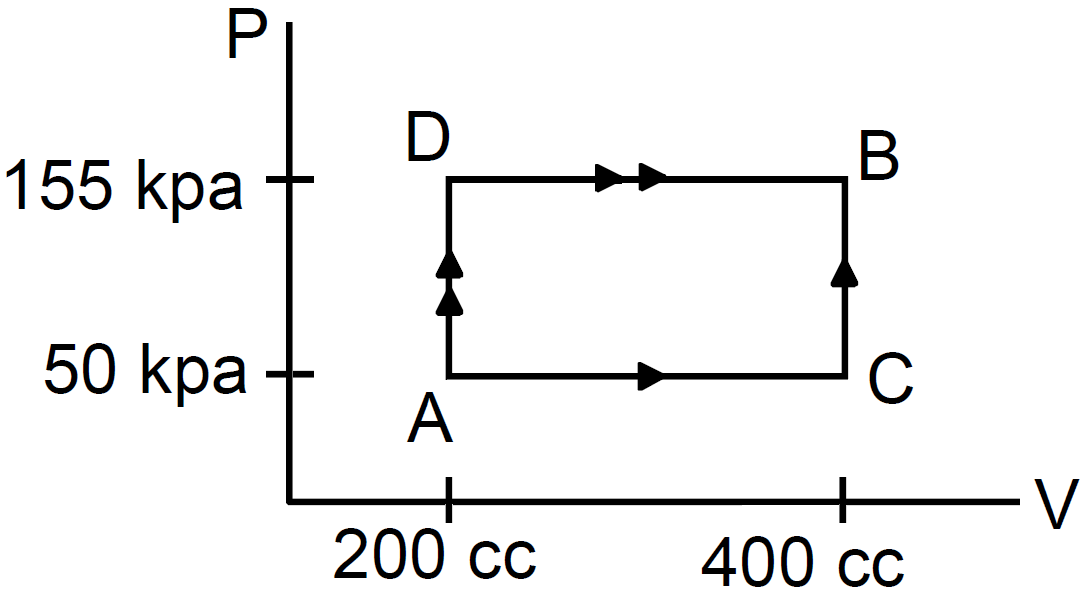
$50cal$ of heat should be supplied to take a system from the state A to the state B through the path ACB as shown in figure. Find the quantity of heat to be supplied to take it from A to B via ADB.
Two capacitors of capacitances $20.0pF$ and $50.0pF$ are connected in series with a $6.00V$ battery. Find:
  1. The potential difference across each capacitor.
  2. The energy stored in each capacitor.
What is a heat engine? What are its essential parts? Explain its principle and establish the formula for its efficiency.