Question
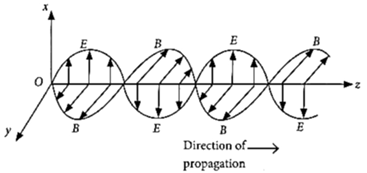
A stationary charge produces only an electrostatic field while a charge in uniform motion produces a magnetic field, that does not change with time. An oscillating charge is an example of accelerating charge. It produces an oscillating magnetic field, which in turn produces an oscillating electric fields and so on. The oscillating electric and magnetic fields regenerate each other as a wave which propagates through space.
Image
$(i).$ Magnetic field in a plane electromagnetic wave is given by $\vec{B}= B _0 \sin ( kx +\omega t ) \hat{j} T$Expression for corresponding electric field will be (Where c is speed of light.)
$(a) \ \vec{E}= B _0 c \sin ( kx +\omega t ) \hat{k} V / m$
$(b) \ \vec{E}=- B _0 c \sin ( kx -\omega t ) \hat{k} V / m$
$(c) \ \vec{E}=- B _0 c \sin ( kx +\omega t ) \hat{k} V / m$
$(d) \ \vec{E}=\frac{B_0}{c} \sin ( kx +\omega t ) \hat{k} V / m$
$(ii)$ The electric field component of a monochromatic radiation is given by $\vec{E}=2 E _0 \hat{i} \cos kz \cos \omega t$. Its magnetic field $\vec{B}$ is then given by
$(a) \ -\frac{2 E_0}{c} \hat{j} \sin kz \sin \omega t$
$(b) \ \frac{2 E_0}{c} \hat{j} \sin kz \sin \omega t$
$(c) \ \frac{2 E_0}{c} \hat{j} \sin kz \cos \omega t$
$(d) \ \frac{2 E_0}{c} \hat{j} \cos kz \cos \omega t$
$(iii)$ A plane em wave of frequency $25 MHz$ travels in a free space along $x -$direction. At a particular point in space and time, $E =(6.3 \hat{j}) V / m$. What is magnetic field at that time?
$(a) \ 0.089 \mu T$
$(b) \ 0.124 \mu T$
$(c) \ 0.021 \mu T$
$(d) \ 0.095 \mu T$
OR
A plane electromagnetic wave travels in free space along $x-$axis. At a particular point in space, the electric field along $y-$axis is $9.3 V m ^{-1}$. The magnetic induction $(B)$ along $z -$axis is
$(a) \ 3.1 \times 10^{-8} T$
$(b) \ 3 \times 10^{-5} T$
$(c) \ 3 \times 10^{-6} T$
$(d) \ 9.3 \times 10^{-6} T$
$(iv)$ A plane electromagnetic wave travelling along the $x-$direction has a wavelength of $3 \ mm$ . The variation in the electric field occurs in the $y-$direction with an amptitude $66 V m ^{-1}$. The equations for the electric and magnetic fields as a function of $x$ and $t$ are respectively
$ \text { a) } E_y =11 \cos 2 \pi \times 10^{11}\left(t-\frac{x}{c}\right), \text { b) } E_y =66 \cos 2 \pi \times 10^{11}\left(t-\frac{x}{c}\right),$
$B_y =11 \times 10^{-7} \cos 2 \pi \times 10^{11}\left(t-\frac{x}{c}\right) B_z =2.2 \times 10^{-7} \cos 2 \pi \times 10^{11}\left(t-\frac{x}{c}\right)$
$\text { c) } E_x =33 \cos \pi \times 10^{11}\left(t-\frac{x}{c}\right), \text { d) } E_y =33 \cos \pi \times 10^{11}\left(t-\frac{x}{c}\right),$
$B_x =11 \times 10^{-7} \cos \pi \times 10^{11}\left(t-\frac{x}{c}\right) B_z =1.1 \times 10^{-7} \cos \pi \times 10^{11}\left(t-\frac{x}{c}\right)$
Answer

A stationary charge produces only an electrostatic field while a charge in uniform motion produces a magnetic field, that does not change with time. An oscillating charge is an example of accelerating charge. It produces an oscillating magnetic field, which in turn produces an oscillating electric fields and so on. The oscillating electric and magnetic fields regenerate each other as a wave which propagates through space.
Image
$(i) \ (a) \ \vec{E}= B _0 c \sin ( kx +\omega t ) \hat{k} V / m$
Explanation: Given : $\vec{B}= B _0 \sin ( kx +\omega t ) \hat{j} T$
The relation between electric and magnetic field is, $c =\frac{E}{B}$ or $E = cB$
The electric field component is perpendicular to the direction of propagation and the direction of magnetic field. Therefore, the electric field component along z-axis is obtained as $\vec{E}= cB _0 \sin ( kx +\omega t ) \hat{k} V / m$
$(ii) \ (b) \ \frac{2 E_0}{c} \hat{j} \sin kz \sin \omega t$
Explanation: $\frac{d E}{d z}=-\frac{d B}{d t}$
$\frac{d E}{d z}=-2 E _0 k \sin kz \cos \omega t =-\frac{d B}{d t}$
$dB =+2 E _0 k \sin kz \cos \omega tdt$
$B =+2 E _0 k \sin kz \int \cos \omega tdt =+2 E _0 \frac{k}{\omega} \sin kz \sin \omega t$
$\frac{E_0}{B_0}=\frac{\omega}{k}=c$
$B =\frac{2 E_0}{c} \sin kz \sin \omega t \therefore \vec{B}=\frac{2 E_0}{c} \sin kz \sin \omega t \hat{j}$
$E$ is along $y-$direction and the wave propagates along $x-$axis.
$\therefore B$ should be in a direction perpendicular to both $x$-and $y-$axis.
$(iii) \ (c) \ 0.021 \mu T$
Explanation: Here, $E =6.3 \hat{j} ; c =3 \times 10^8 m / s$
The magnitude of $B$ is
$B_{Z}=\frac{E}{c}=\frac{6.3}{3 \times 10^8}=2.1 \times 10^{-8} T=0.021 \mu T$
$OR$
$(a) 3.1 \times 10^{-8} T$
Explanation: At a particular point, $E =9.3 V m ^{-1}$
$\therefore$ Magnetic field at the same point $=\frac{9.3}{3 \times 10^8}$
$=3.1 \times 10^{-8} T$
$(iv) \ (b) \ E_y=66 \cos 2 \pi \times 10^{11}\left(t-\frac{x}{c}\right), B_z=2.2 \times 10^{-7} \cos 2 \pi \times 10^{11}\left(t-\frac{x}{c}\right)$
Explanation: Here : $E _0=66 Vm ^{-1}, E _y=66 \cos \omega\left(t-\frac{x}{c}\right)$,
$\lambda=3 mm=3 \times 10^{-3} m, k=\frac{2 \pi}{\lambda}$
$\frac{\omega}{k}=c \Rightarrow \omega=ck=3 \times 10^8 \times \frac{2 \pi}{3 \times 10^{-3}}$
$\text { or } \omega=2 \pi \times 10^{11}$
$\therefore E _{ y }=66 \cos 2 \pi \times 10^{11}\left(t-\frac{x}{c}\right)$
$B _{ z }=\frac{E_y}{c}=\left(\frac{66}{3 \times 10^8}\right) \cos 2 \pi \times 10^{11}\left(t-\frac{x}{c}\right)$
$=2.2 \times 10^{-7} \cos 2 \pi \times 10^{11}\left(t-\frac{x}{c}\right)$

Need a full question paper?

Generate a complete, print-ready paper with questions like this in minutes — across 16+ boards, with answer keys.

Start Generating Free

Similar questions

  1. A small compass needle of magnetic moment $'m\ ’ $ is free to turn about an axis perpendicular to the direction of uniform magnetic field $'B\ ’$. The moment of inertia of the needle about the axis is $'I\ ’$. The needle is slightly disturbed from its stable position and then released. Prove that it executes simple harmonic motion. Hence deduce the expression for its time period.
  2. A compass needle, free to turn in a vertical plane orients itself with its axis vertical at a certain place on the earth. Find out the values of $(i)$ horizontal component of earth’s magnetic field and $(ii)$ angle of dip at the place.
A magnetic needle is free to rotate in a vertical plane which makes an angle of 60° with the magnetic meridian. If the needle stays in a direction making an angle of $\tan^{-1}\Big(\frac{2}{\sqrt{3}}\Big)$ with the horizontal, what would be the dip at that place?
$50cc$ of oxygen is collected in an inverted gas jar over water. The atmospheric pressure is $99.4\ kPa$ and the room temperature is $27^\circ\ C.$ The water level in the jar is same as the level outside. The saturation vapour pressure at $27^\circ\ C$ is $3.4\ kPa.$ Calculate the number of moles of oxygen collected in the jar.
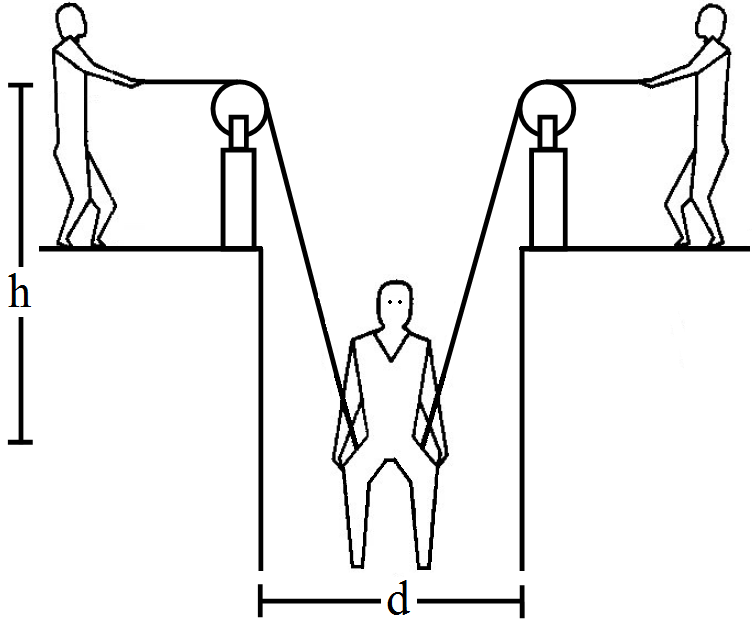
A man has fallen into a ditch of width d and two of his friends are slowly pulling him out using a light rope and two fixed pulleys as shown in figure. Show that the force (assumed equal for both the friends) exerted by each friend on the road increases as the man moves up. Find the force when the man is at a depth h.
Refraction of light is the change in the path of light as it passes obliquely from one transparent medium to another medium. According to law of refraction $\frac{\sin\text{i}}{\sin\text{r}}=\ ^1\mu_2,$ where $^1\mu_2$ is called refractive index of second medium with respect to first medium. From refraction at a convex spherical surface, we have $\frac{\mu_2}{\text{v}}=\frac{\mu_1}{\text{u}}=\frac{\mu_2-\mu_1}{\text{R}}.$ Similarly from refraction at a concave spherical surface when object lies in the rarer medium, we have $\frac{\mu_2}{\text{v}}-\frac{\mu_1}{\text{u}}=\frac{\mu_2-\mu_1}{\text{R}}$ and when object lies in the denser medium, we have $\frac{\mu_1}{\text{v}}-\frac{\mu_2}{\text{u}}=\frac{\mu_1-\mu_2}{\text{R}}.$
  1. Refractive index of a medium depends upon:
  1. Nature of the medium.
  2. Wavelength of the tight used.
  3. Temperature.
  4. All of these.
  1. A ray of light of frequency $5 \times 10^{14}Hz$ is passed through a liquid. The wavelength of light measured inside the liquid is found to be $450 \times 10^{-9m.}$ The refractive index of the liquid is:
  1. $1.33$
  2. $2.52$
  3. $2.22$
  4. $0.75$
  1. A ray of light is incident at an angle of $60^\circ$ on one face of a rectangular glass slab of refractive index $1.5.$ The angle of refraction is:
  1. $\sin^-1 (0.95)$
  2. $\sin^-1 (0.58)$
  3. $\sin^-1 (0.79)$
  4. $\sin^-1 (0.86)$
  1. $A$
  2. point object is placed at the centre of a glass sphere of radius $6 \ cm$ and refractive index $1.5.$ The distance of the virtual image from the surface of sphere is:
  1. $2\ cm$
  2. $4\ cm$
  3. $6\ cm$
  4. $12\ cm$
  1. In refraction, light waves are bent on passing from one medium to the second medium because in the second medium:
  1. The frequency is different.
  2. The co$-$efficient of elasticity is different.
  3. The speed is different.
  4. The amplitude is smaller.
What can be said about the centre of mass of a uniform hemisphere without making any calculation? Will its distance from the centre be more than $\frac{\text{r}}{2}$ or less than $\frac{\text{r}}{2}?$
A compound microscope is an optical instrument used for observing highly magnified images of tiny objects. Magnifying power of a compound microscope is defined as the ratio of the angle subtended at the eye by the final image to the angle subtended at the eye by the object, when both the final image and the object are situated at the least distance of distinct vision from the eye. It can be given that : $m = m_e \times m_0,$ where $m_e$ is magnification produced by eye lens and $m0$ is magnification produced by objective lens.
Consider a compound microscope that consists of an objective lens of focal length $2.0\ cm$ and an eyepiece of focal length $6.25\ cm$ separated by a distance of $15\ cm.$
  1. The object distance for eye$-$piece, so that final image is formed at the least distance of distinct vision, will be:
  1. $3.45\ cm$
  2. $5\ cm$
  3. $1.29\ cm$
  4. $2.59\ cm$
  1. How far from the objective should an object be placed in order to obtain the condition described in part $(i)$?
  1. $4.5\ cm$
  2. $2.5\ cm$
  3. $1.5\ cm$
  4. $3.0\ cm$
  1. What is the magnifying power of the microscope in case of least distinct vision?
  1. $20$
  2. $30$
  3. $40$
  4. $10$
  1. The intermediate image formed by the objective of a compound microscope is:
  1. Real, inverted and magnified.
  2. Real, erect, and magnified.
  3. Virtual, erect and magnified.
  4. Virtual, inverted and magnified.
  1. The magnifying power of a compound microscope increases with :
  1. The focal length of objective lens is increased and that of eye lens is decreased.
  2. The focal length of eye lens is increased and that of objective lens is decreased.
  3. Focal lengths of both objects and eye$-$piece are increased.
  4. Focal lengths of both objects and eye$-$piece are decreased.
A uniform magnetic field of $0.20 \times 10^{-3} T$ exists in the space. Find the change in the magnetic scalar potential as one moves through $50\ cm$ along the field.
What is logic gate? Differentiate between AND gate and OR gate.
Suppose in an imaginary world the angular momentum is quantized to be even integral multiples of $\frac{\text{h}}{2\pi}$ What is the longest possible wavelength emitted by hydrogen atoms in visible range in such a world according to Bohr's model?