MCQ
A stone is projected from the ground with velocity $25\,m/s$. Two seconds later, it just clears a wall $5 \,m$ high. The angle of projection of the stone is ........ $^o$ $(g = 10m/{\sec ^2})$
  • ${30}$
  • B
    ${45}$
  • C
    ${50.2}$
  • D
    ${60}$

Answer

Correct option: A.
${30}$
a
(a) For vertical upward motion $h = ut - \frac{1}{2}g{t^2}$

$5 = (25\sin \theta ) \times 2 - \frac{1}{2} \times 10 \times {(2)^2}$

$⇒$ $25 = 50 \sin \theta $ 

$⇒$ $\sin \theta = \frac{1}{2}$

$⇒$ $\theta = 30^\circ $

Need a full question paper?

Generate a complete, print-ready paper with questions like this in minutes — across 16+ boards, with answer keys.

Start Generating Free

Similar questions

According to Newton, the viscous force acting between liquid layers of area $A$ and velocity gradient $\Delta v/\Delta z$ is given by $F = - \eta A\frac{{\Delta v}}{{\Delta z}}$ where $\eta $ is constant called coefficient of viscosity. The dimension of $\eta $ are
Water enters through end $A$ with a speed $v_1$ and leaves through end $B$ with a speed $v_2$ of a cylindrical tube $A B$. The tube is always completely filled with water. In case $I$ the tube is horizontal, in case $II$ it is vertical with the end $A$ upward and in case $III$ it is vertical with the end $B$ upward. We have $v_1=v_2$ for
A car is travelling in the north direction. To stop, it produces a deceleration of $60\ m/ s^2$. Which of the following is a correct representation for the deceleration?
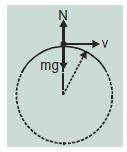
A circular overbridge has radius $20\,m$. What is the maximum speed with which a car can cross the bridge without leaving contact with the overbridge at the heighest point ? $ (g = 9.8\, m/s^2)$ 

............ $m/s$

The moment of inertia of a solid cylinder about its axis is $I$. It is allowed to roll down an incline without slipping. If its angular velocity at the bottom be $\omega $, then $K.E.$ of the cylinder will be
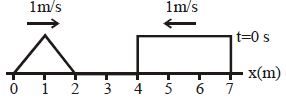
Two pulses on a string approach each other at speeds of $1 m/s$. What is the shape of the string at $t = 3s$ :-
In Vander Waal's equation $\left[ {P + \frac{a}{{{V^2}}}} \right]\,(V - b) = RT,$ the dimensions of $a$ are
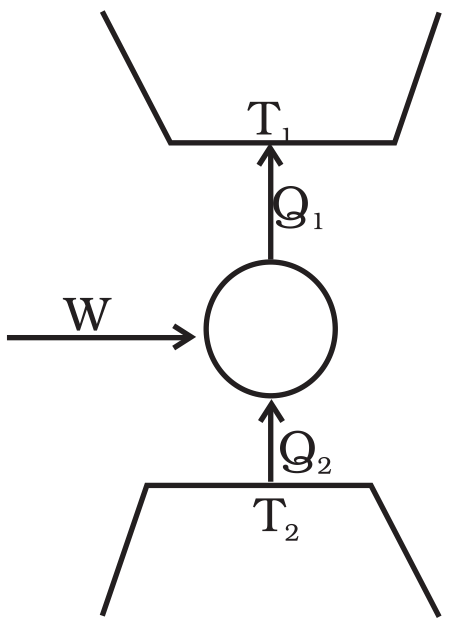
Consider a heat engine as shown in $Q_1$ and $Q_2$ are heat added to heat bath $T_1$ and heat taken from $T_2$ in one cycle of engine. W is the mechanical work done on the engine. If $W > 0,$ then possibilities are:
In solids, inter$-$atomic forces are:
In a water-fall the water falls from a height of $100\,m.$ If the entire $K.E.$ of water is converted into heat, the rise in temperature of water will be........ $^oC$