MCQ
A stretched rubber has
  • A
    Increased kinetic energy
  • Increased potential energy
  • C
    Decreased kinetic energy
  • D
    Decreased potential energy

Answer

Correct option: B.
Increased potential energy
b
(b) Due to stretching, a potential energy is stored in the rubber band which is released on releasing the rubber. Thus, potential energy is increased.

Need a full question paper?

Generate a complete, print-ready paper with questions like this in minutes — across 16+ boards, with answer keys.
Start Generating Free

Similar questions

When a wire is compressed, the potential energy of its molecules:
An unknown frequency $x$ produces $8$ beats per seconds with a frequency of $250 Hz$ and $12$ beats with $270 Hz$ source, then $x$ is  .... $Hz$
At constant volume temperature is increased then:
A student measured the diameter of a small  steel ball using a screw gauge of least count $0.001\, cm.$ The main scale reading is $5\, mm$ and zero of circular scale division coincides with $25$ divisions above the reference level. If screw gauge has a zero error of $-0.004 \,cm,$ the correct diameter of the ball is
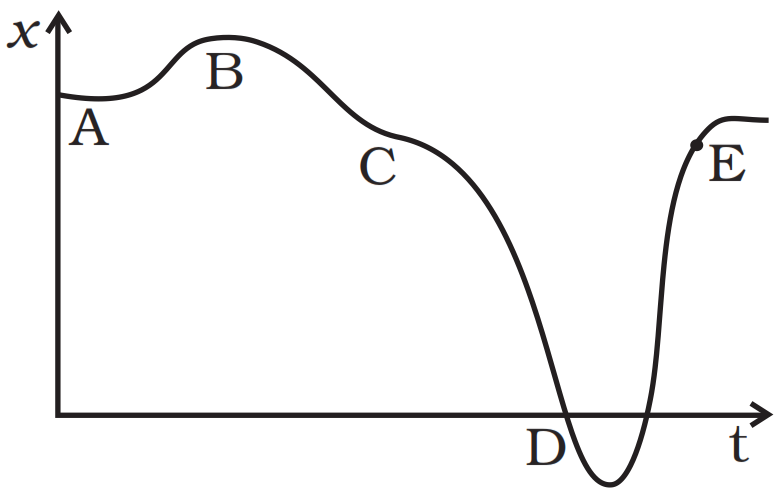
A graph of x versus t is shown in Fig. Choose correct alternatives from below:

A transverse wave travels along $x$-axis. The particles of medium move
Whose dimensions is $M{L^2}{T^{ - 1}}$
A stretched string of $1m$ length and mass $5 \times {10^{ - 4}}kg$ is having tension of $20N.$ If it is plucked at $25cm$ from one end then it will vibrate with frequency ... $Hz$
Some physical quantities are given in Column $I$ and some possible $SI$ units in which these quantities may be expressed are given in Column $II$. Match the physical quantities in Column $I$ with the units in Column $II$ and indicate your answer by darkening appropriate bubbles in the $4 \times 4$ matrix given in the $ORS$.

Column $I$ Column $II$

$(A)$ $\mathrm{GM}_e \mathrm{M}_5$

$\mathrm{G} \rightarrow$ universal gravitational constant, $\mathrm{M}_{\mathrm{e}} \rightarrow$ mass of the earth,

$\mathrm{M}_5 \rightarrow$ mass of the Sun

$(p)$ (volt) (coulomb) (metre)

$(B)$ $\frac{3 \mathrm{RT}}{\mathrm{M}} ; \mathrm{R} \rightarrow$ universal gas constant, $\mathrm{T} \rightarrow$ absolute temperature,

$\mathrm{M} \rightarrow$ molar mass

$(q)$ (kilogram) $(\text { metre) })^3$ (second) $)^{-2}$
$(C)$ $\frac{F^2}{q^2 B^2}$ ;$\quad F \rightarrow$ force, $q \rightarrow$ charge, $B \rightarrow$ magnetic field  $(r)$ $(\text { meter })^2$ (second) $)^{-2}$

$(D)$ $\frac{\mathrm{GM}_e}{\mathrm{R}_{\mathrm{e}}}, G \rightarrow$ universal gravitational constant,

$\mathrm{M}_{\mathrm{e}} \rightarrow$ mass of the earth, $\mathrm{R}_{\mathrm{e}} \rightarrow$ radius of the earth

$(s)$ (farad) $(\text { volt) })^2(\mathrm{~kg})^{-1}$
A binary star system consists of two stars one of which has double the mass of the other. The stars rotate about their common centre of mass :-