MCQ
A string of length $1\ m$ fixed at both ends is vibrating in $3^{rd}$ overtone. Tension in string is $200\ N$ and linear mass density is $5\ gm/m$ . Frequency of these vibrations is ..... $Hz$
  • A
    $200$
  • B
    $250$
  • C
    $300$
  • $400$

Answer

Correct option: D.
$400$
d
$II{I^{rd}}$ overtone

$\mathrm{f}=\frac{4 \mathrm{V}}{2 \mathrm{L}}=\frac{2 \mathrm{V}}{\mathrm{L}}=\frac{2}{1} \sqrt{\frac{200}{(5 / 1000)}}=2(200)$

$\mathrm{f}=400 \mathrm{\,Hz}$

Need a full question paper?

Generate a complete, print-ready paper with questions like this in minutes — across 16+ boards, with answer keys.

Start Generating Free

Similar questions

A wire under tension T emits a note of fundamental frequency 200Hz. If the tension is increased by 3T, the fundamental frequency will be:
A particle of mass m is hanging vertically by an ideal spring of force constant K. If the mass is made to oscillate vertically, its total energy is
When the temperature of a gas is raised from $27^o C$ to $90^o C$, the percentage increase in the $r.m.s.$ velocity of the molecules will be ..... $\%$
When the displacement is half the amplitude, the ratio of potential energy to the total energy is
A bullet is dropped from the same height when another bullet is fired horizontally. They will hit the ground
A small block of mass $m$ is projected horizontally with speed $u$ where friction coefficient between block and plane is given by $\mu = cx$, where $x$ is displacement of the block on plane. Find maximum distance covered by the block 
A uniform metallic rod rotates about its perpendicular bisector with constant angular speed. If it is heated uniformly to raise its temperature slightly:
Consider two containers A and B containing identical gases at the same pressure, volume and temperature. The gas in container A is compressed to half of its original volume isothermally while the gas in container B is compressed to half of its original value adiabatically. The ratio of final pressure of gas in B to that of gas in A is

  1. $2^{\gamma-1}$

  2. $\Big(\frac{1}{2}\Big)^{\gamma-1}$

  3. $\Big(\frac{1}{1-\gamma}\Big)^2$

  4. $\Big(\frac{1}{\gamma-1}\Big)^2$

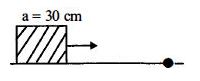
A cubical block of side $30\,cm$  is moving with  velocity $2\,\,ms^{-1}$ on a smooth horizontal surface. The surface has a bump at a point $O$ as shown in figure. The angular velocity (in rad/s) of the block immediately after it hits the bump, is
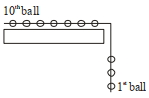
A system to $10$ balls each of mass $2 \; kg$ are connected via massless and unstretchable string. The system is allowed to slip over the edge of a smooth table as shown in figure. Tension on the string between the $7^{th}$ and $8^{th}$ ball is $N$ when $6^{th}$ ball just leaves the table.