MCQ
A uniform metallic rod rotates about its perpendicular bisector with constant angular speed. If it is heated uniformly to raise its temperature slightly:
  • A
    Its speed of rotation increases.
  • B
    Its speed of rotation decreases.
  • C
    Its speed of rotation remains same.
  • D
    Its speed increases because its moment of inertia increases.

Answer

  1. Its speed of rotation decreases.

Explanation:

On heating a uniform metallic rod its length will increase so moment of inertia of rod increased from I1 to I2 (i.e., I1 < I2). Due to law of conservation of angular momentum,

$\text{I}_1\omega_1=\text{I}_2\omega_2$

$\because\ \text{I}_1<\text{I}_2\Rightarrow\omega_1>\omega_2,$ so angular speed decreases.

Need a full question paper?

Generate a complete, print-ready paper with questions like this in minutes — across 16+ boards, with answer keys.

Start Generating Free

Similar questions

A boat is moving with a velocity $3i + 4j $ with respect to ground. The water in the river is moving with a velocity $-3i -4j $ with respect to ground. The relative velocity of the boat with respect to water is
A ball is thrown up in the sky. After reaching a height, the ball falls back. What can be said about the average velocity?
The echo of a gun shot is heard $8\, sec$. after the gun is fired. How far from him is the surface that reflects the sound .... $m$ (velocity of sound in air $= 350 \,m/s$)
In Boyle's law what remains constant
It is found that if a neutron suffers an elastic collinear collision with deuterium at rest, fractional loss of its energy is $p_d $ ; while for its similar collision with carbon nucleus at rest, fractional loss of energy is $P_c$. The values of $P_d$ and $P_c$ are respectively
Two particles of identical mass are moving in circular orbits under a potential given by $V(r)=K r^{-n}$, where $K$ is a constant. If the radii of their orbits are $r_1 \cdot r_2$ and their speeds are $v_1 \cdot v_2$, respectively. Then,
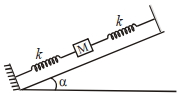
In the given figure, a body of mass $M$ is held between two massless springs, on a smooth inclined plane. The free ends of the springs are attached to firm supports. If each spring has spring constant $k,$ the frequency of oscillation of given body is :
The frequency of a tunning fork is $384$ per second and velocity of sound in air is $352 m/s$. How far the sound has traversed while fork completes $36$ vibration .... $m$
Hydrogen gas is filled in a balloon at $20^\circ C$. If temperature is made $40^\circ C$, pressure remaining same, what fraction of Hydrogen will come out