Question
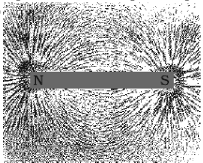
A student fixes a sheet of white paper on a drawing board using some adhesive materials. She places a bar magnet in the centre of it and sprinkles some iron filings uniformly around the bar magnet using a salt sprinkler.
On tapping the board gently, she observes that the iron filings have arranged themselves in a particular pattern.
(a) What makes iron filings arrange in a definite pattern?
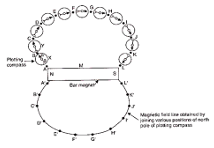
(b) Draw a diagram to show this pattern of iron filings.
(c) How is the direction of magnetic field at a point determined using the field lines? Why do two magnetic
field lines not cross each other?
OR
How are the magnetic field lines of a bar magnet drawn using a small compass needle? Draw one magnetic field line each on both sides of the magnet.
Answer

A student fixes a sheet of white paper on a drawing board using some adhesive materials. She places a bar magnet in the centre of it and sprinkles some iron filings uniformly around the bar magnet using a salt sprinkler. On tapping the board gently, she observes that the iron filings have arranged themselves in a particular pattern.
(i) The bar magnet kept at the centre of board has its magnetic field around it. The iron filings sprinkled on the board
experience a force on them due to the magnetic field of bar magnet. So, when the student taps the board the iron filings align themselves according to the magnetic field lines of the bar magnet.
(ii)Image
(iii)The direction of a magnetic field at a point is determined by placing a small compass needle. The N - pole of compass
indicates the direction of magnetic field at that point.
Two magnetic field lines do not intersect each other because if there was point of intersection, The compass needle would point towards 2 directions.
OR
Image

Need a full question paper?

Generate a complete, print-ready paper with questions like this in minutes — across 16+ boards, with answer keys.

Start Generating Free

Similar questions

The table given below shows the hints given by the quiz master in a quiz.
S.NO HINT
(i) Substance 'C' is used as a preservative.
(ii) 'C' has two carbon atoms; 'C' is obtained by the reaction of 'A' in presence of alkaline Potassium permanganate followed by acidification.
(iii) Misuse of 'A' in industries is prevented by adding Methanol, Benzene, and pyridine to 'A'.
(iv) 'F' is formed on heating 'A' in presence of conc Sulphuric acid.
(v) 'F' reacts with Hydrogen gas in presence of Nickel and Palladium catalyst.
Based on the above hints answer the following questions
a) Give the IUPAC names of $A$ and $F$
b) Illustrate with the help of chemical equations the changes taking place. ( $A \rightarrow C$ and $A \rightarrow F$ )
OR
Name the chemical reactions which occur in steps 2 and 5 . Identify the compounds formed in these steps if ' $A$ ' is replaced with its next homologue.
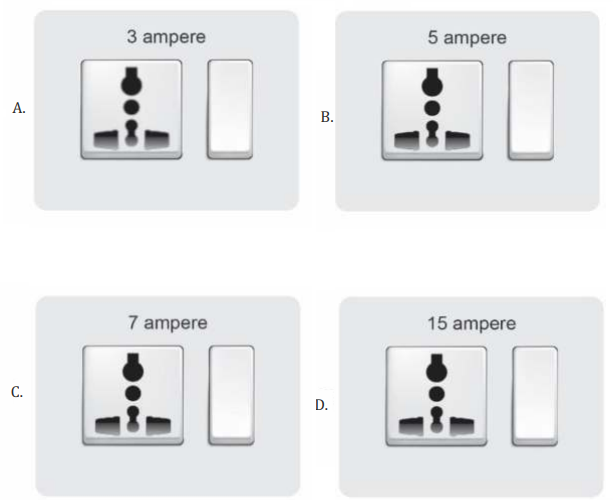
Electrical devices often have an ampere marking to indicate the strength of electric current
required for it to work.
10. Will there be any change in the ammeter reading if the length of the wire in the circuit is doubled?
Explain your answer.

Image

Read the following and answer any three questions from (i) to (iv).An insulated copper wire wound on a cylindrical cardboard tube such that its length is greater than its diameter is called a solenoid. When an electric current is passed through the solenoid, it produces a magnetic field around it. The magnetic field produced by a current-carrying solenoid is similar to the magnetic field produced by a bar magnet. The field tines inside the solenoid are in the form of parallel straight tines. The strong magnetic field produced inside a current-carrying solenoid can be used to magnetise a piece of magnetic material, like soft iron, when placed inside the solenoid. The strength of magnetic field produced by a current carrying solenoid is directly proportional to the number of turns and strength of current in the solenoid.
  1. The strength of magnetic field inside a long current-carrying straight solenoid is called?
     
  2. The north-south polarities of an electromagnet can be found easily by using which rule?
     
  3. Define a solenoid?
     
  4. A long solenoid carrying a current produces a magnetic field B along its axis. If the current is double and the number of turns per cm is halved, then new value of magnetic field will be?

Read the following and answer any three questions from: (i) to (iv).
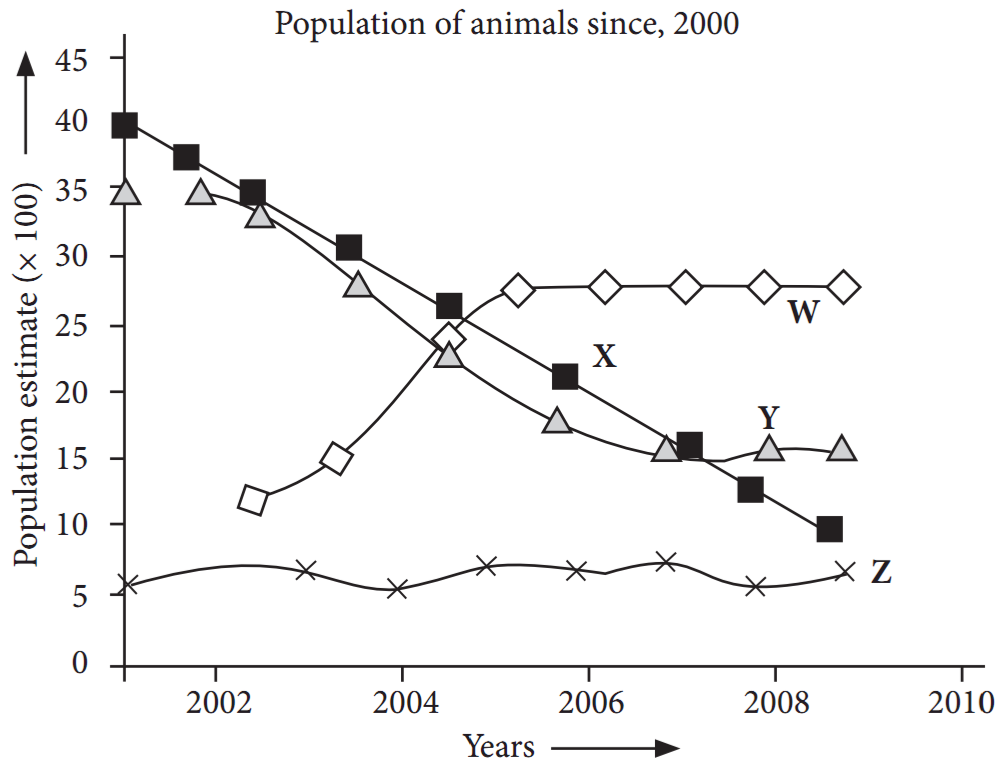
A group of ecologists studied and monitored the change in population of three animal species X, Y and Z over a period often years. During their research, they found that a new animal species W appeared in the area and its population was also monitored.
  1. Which animal species will unlikely to be alive in IO years without some intervention?
     
  2. Which species is most likely be the food source of W?
     
  3. What will be the likely consequence if population of X completely declines?

    OR
     
  4. A) What would be the most probable reason for the constant population of Z?
    B) What could be the reason for declining of X?
Following questions are based on the two tables given below. Study these tables related to blood sugar levels:
Table A (Blood glucose chart)
Mean Blood Glucose Level (mg/dL)
Doctor's advice needed380
350
315
280
250
215
Good180
150
Excellent115
80
50
Table B (Blood Report of Patient X and Y)
Time of checkBlood Glucose ranges (mg/dL)
Patient XPatient Y
Before breakfast (Fasting)<10070 – 130
Before lunch, supper and snack<11070 - 130
Two hours after meals<140<180
Bedtime<12090 - 15
(a). Refer to Table B showing the blood report of the levels of glucose of patients X and Y. Infer the disease
which can be diagnosed from the given data.
(b). Identify the hormone whose level in the blood is responsible for the above disease.
(c). High/low sugar and a low/high-fat diet What would you recommend to the affected patient?

OR

Refer to Table A and suggest the value of the mean blood glucose level beyond which doctor’s advice is necessary.
Some reaction of metal with some compounds are given in the table:
MetalIron (II) SulphateCopper (II) SulphateZinc SulphateSilver Nitrate
ANo reactionDisplacement………………………………
BDisplacement………………No reaction………………
CNo reactionNo reactionNo reactionDisplacement
DNo reactionNo reactionNo reactionNo reaction

(i) Name the most and least active metal.
(ii) Arrange the metals $A, B, C$ and $D$ in order of increasing reactivity.
or
(ii) Container of which metal can be used to store both zinc sulphate solution and silver nitrate solution?

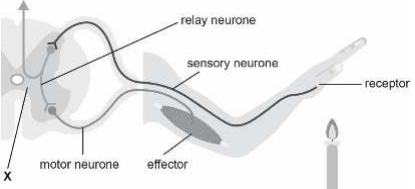
The igure shows a relex arc formed in response to heat.

Image
4. Which of these is the correct sequence of the low of information in the relex arc?
A. Sensory Neurone → Receptor → Motor Neurone → Relay Neurone → Effector
B. Receptor → Sensory Neurone → Relay Neurone → Motor Neurone → Effector
C. Sensory Neurone → Receptor → Motor Neurone → Relay Neurone → Effector
D. Effector → Motor Neurone → Relay Neurone → Sensory Neurone → Receptor
5. What is labelled as ‘X’ in the igure?
A. Cerebrum
B. Spinal cord
C. Pituitary gland
D. Hypothalamus

In each of the following situations what happens to the rate of photosynthesis?
i. Cloudy days
ii. No rainfall in the area
iii. Good manuring in the area
iv. Stomata get blocked due to dust
Read the following and answer any three questions from: (i) to (iv).An ecosystem may be defined as a structural and functional unit of the biosphere comprising living organisms and their non-living environment which interact by means of food chains and biogeochemical cycles resulting in energy-flow, biotic diversity and material cycling to form a stable, self-supporting system.
  1. The two basic processes involved in an ecosystem are?
     
  2. Give two examples of not an artificial ecosystem?
     
  3. What is the role of fungi and bacteria in an ecosystem?
     
  4. What would one of the likely result if all decomposers in a particular ecosystem were wiped out?
Read the following and answer any three questions from (i) to (iv).The food which is prepared by the process of photosynthesis in the leaves of a plant has to be transported to other parts like stem, roots, branches, etc. Therefore this food is transported to other parts of the plant through phloem.
i. A few drops of sap were collected by cutting across a plant stem by a suitable method.'Tile sap was tested chemically. Which test results indicate that it is phloem sap?

ii. What is the direction of movement of sugars in phloem?

iii. A girdled plant (Upto bast) may survive for some time but it will eventually die, because?

OR
  1. a) Phloem sap is mainly made of?
    b) How food is transported to phloem?