MCQ
A system of two linear equations in two variables is dependent consistent, if their graphs :
  • A
    Do not intersect at any point
  • Coincide with each other
  • C
    Cut the $x-$ axis
  • D
    Intersect only at a point

Answer

Correct option: B.
Coincide with each other
A system of two linear equations in two variables is dependent consistent, if their graphs coincide with each other
i.e. they superimpose each other and all points in one line are also a solution for the other line.

Need a full question paper?

Generate a complete, print-ready paper with questions like this in minutes — across 16+ boards, with answer keys.
Start Generating Free

Similar questions

A line segment is of length $10$ units. If the coordinates of its one end are $(2, -3)$ and the abscissa of the other end is $10,$ then its ordinate is :
If $\theta$ is an acute angle such that $\tan^2\theta=\frac{8}{7},$ then the value of $\frac{(1+\sin\theta)(1-\sin\theta)}{(1+\cos\theta)(1-\cos\theta)}$ is:
The area of the sector of a circle with radius $6 \ cm$ which subtends an angle of $60^{\circ}$ at the centre of the circle is:
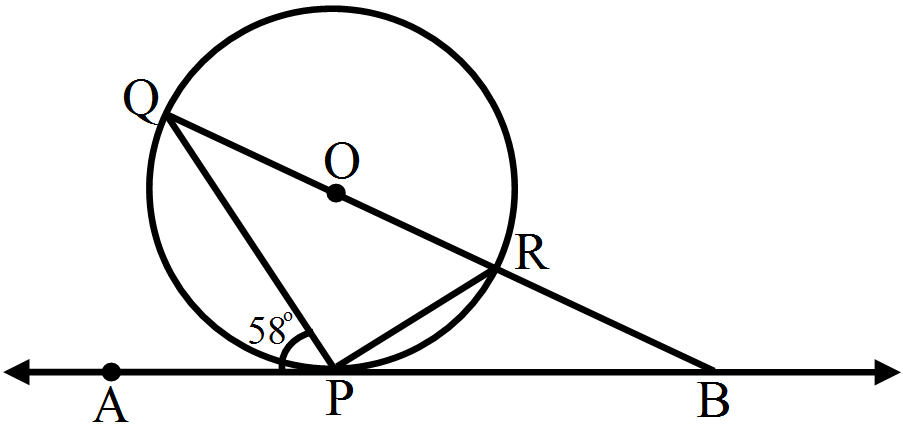
In the given figure, O is the centre of the circle. AB is the tangent to the circle at the point P. If $\angle\text{APQ}=58^\circ$ then the measure of $\angle\text{PQB}$ is:
A man on the top of an observation tower finds an object at an angle of depression $30^\circ$ . After the object was moved $30$ metres in a straight line towards the tower, he finds the angle of depression to be $45^\circ$ . The distance of the object now from the foot of the tower in metres is :
The surface area of a sphere is $154 \mathrm{~cm}^2$. The volume of the sphere is :
$\triangle A B C$ is such that $A B=3 cm, B C=2 cm, C A=2.5 cm$. If $\triangle A B C \sim \triangle D E F$ and $E F=4 cm$, then perimeter of $\triangle D E F$ is
The smallest number by which $\sqrt{27}$ should be multiplied so as to get a rational number is
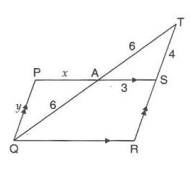
In the given figure if $\ce{PS\|QR}$ and $\ce{PQ\|SR}$ and $\ce{AT = AQ = 6, AS = 3, TS = 4,}$ then
Image
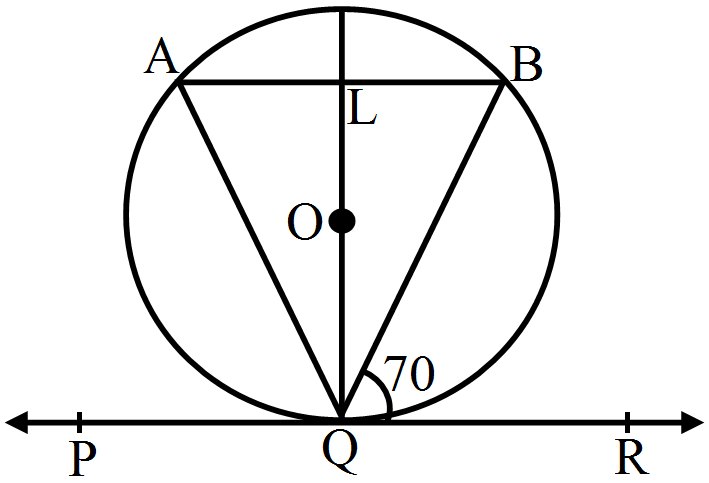
In the given figure, PQR is a tangent to the circle at Q, whose centre is O and AB is a chord parallel to PR, such that$ \angle\text{BQR} = 70^\circ.$ Then, $\angle\text{AQB}=?$