$A$. The drift velocity of electrons decreases with the increase in the temperature of conductor.
$B$. The drift velocity is inversely proportional to the area of cross-section of given conductor.
$C$. The drift velocity does not depend on the applied potential difference to the conductor.
$D$. The drift velocity of electron is inversely proportional to the length of the conductor.
$E$. The drift velocity increases with the increase in the temperature of conductor.
Choose the correct answer from the options given below:
JEE MAIN 2022, Diffcult
Download our app for free and get started
Drift velocity $=\left(\frac{ e \tau}{ m }\right) E$
$v _{ d }=\left(\frac{ e \tau}{ m }\right)\left(\frac{\Delta V }{\ell}\right)$
$\Delta V=$ Potential difference applied across the wire
As temperature increases, relaxation time decreases, hence $V _{ d }$ decreases.
As per formula, $V _{ d } \propto \frac{1}{\ell}$
$v _{ d }=\frac{ I }{\text { neA }}$, as it is not mentioned that current is at steady state neither it is mentioned that $n$ is constant for given conductor. So it can't be said that $v _{ d }$ is inversely proportional to $A$.
$I=n e A v_{d}=\frac{V}{R}=\frac{V}{\rho \ell} A$
$v _{ d }=\frac{ V }{\rho \ell \text { ne }} \quad\left( E =\frac{ V }{\ell}\right)$
$v _{ d }=\frac{ eE \tau}{ m }$
$\tau$ decrease with temperature increase.
First and fourth statements are correct.

Download our appand get started for free
Experience the future of education. Simply download our apps or reach out to us for more information. Let's shape the future of learning together!No signup needed.*
Similar Questions
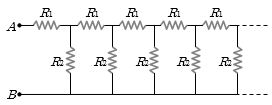
- 1An infinite sequence of resistance is shown in the figure. The resultant resistance between $A$ and $B$ will be, when ${R_1} = 1\,ohm$ and ${R_2} = 2\,ohm$ ............. $\Omega$View Solution
- 2The resistivity of a potentiometer wire is $40 \times {10^{ - 8}}\,ohm - m$ and its area of cross-section is $8 \times {10^{ - 6}}\,{m^2}$. If $0.2\, amp$ current is flowing through the wire, the potential gradient will beView Solution
- 3A copper wire of diameter $1.02\, mm$ carries a current of $1.7\, amp$. Find the drift velocity $(v_d)$ of electrons in the wire. Given $n$, number density of electrons in copper $= 8.5 \times 10^{27} /m^3$....................... $mm/sec$View Solution
- 4The temperature coefficient of resistance of tungsten is $4.5 \times 10^{-3}{ }^{\circ} C ^{-1}$ and that of germanium is $-5 \times 10^{-2}{ }^{\circ} C ^{-1}$. A tungsten wire of resistance $100 \,\Omega$ is connected in series with a germanium wire of resistance $R$. The value of $R$ for which the resistance of combination does not change with temperature is .......... $\Omega$View Solution
- 5Equal potentials are applied on an iron and copper wire of same length. In order to have the same current flow in the two wires, the ratio $r$ (iron)/$r$ (copper) of their radii must be (Given that specific resistance of iron = $1.0 \times {10^{ - 7}}$ $ ohm-m$ and specific resistance of copper = $1.7 \times {10^{ - 8}}\,ohm-m$)View Solution
- 6How much energy in kilowatt hour is consumed in operating ten $50\, watt$ bulbs for $10$ hours per day in a month ($30$ days).View Solution
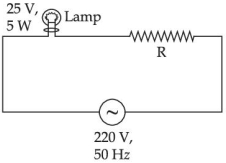
- 7A $220 \; V , 50 \; Hz$ AC source is connected to a $25 \; V$, $5 \; W$ lamp and an additional resistance $R$ in series (as shown in figure) to run the lamp at its peak brightness, then the value of $R$ (in ohm) will beView Solution
- 8The drift velocity of electrons in silver wire with cross-sectional area $3.14 \times 10^{-6}\,m ^2$ carrying a current of $20\,A$ is. Given atomic weight of $Ag =108$ , density of silver $=10.5 \times 10^3\,kg / m ^3..........\times 10^{-4} m / sec$.View Solution
- 9If current in an electric bulb changes by $1\%$, then the power will change by ............ $\%$View Solution
- 10In the circuit shown, the reading of the Ammeter is doubled after the switch is closed. Each resistor has a resistance $1\,\Omega$ and the ideal cell has an $e.m.f.$ $10\,V$. Then, the Ammeter has a coil resistance equal to ............ $\Omega$View Solution