MCQ
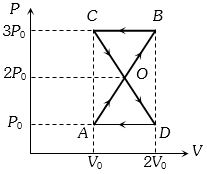
A thermodynamic system undergoes cyclic process $ABCDA $ as shown in figure. The work done by the system in the cycle is
  • A
    ${P_0}{V_0}$
  • B
    $2{P_0}{V_0}$
  • C
    $\frac{{{P_0}{V_0}}}{2}$
  • Zero

Answer

Correct option: D.
Zero
d
(d) $W_{BCOB} = -$ Area of triangle $BCO   = - \frac{{{P_0}{V_0}}}{2}$ 

$W_{AODA} = + $ Area of triangle $AOD  = + \frac{{{P_0}{V_0}}}{2}$

Need a full question paper?

Generate a complete, print-ready paper with questions like this in minutes — across 16+ boards, with answer keys.
Start Generating Free

Similar questions

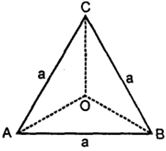
$ABC$ is an equilateral triangle. Length of each side is $a$ and centroid is point $O$. then $\overrightarrow{O A}+\overrightarrow{O B}+\overrightarrow{O C}=.......$
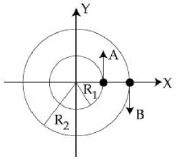
Two particles $A, B$ are moving on two concentric circles of radii $R_1$ and $R_2$ with equal angular speed $\omega $. At $t = 0,$ their positions and direction of motion are shown in the figure

The relative velocity $\overrightarrow {{V_A}}  - \overrightarrow {{V_B}} $ at $t = \frac{\pi }{{2\omega }}$ is given by
An object is projected from ground with speed $20 \,m / s$ at angle $30^{\circ}$ with horizontal. Its centripetal acceleration one second after the projection is .......... $m / s ^2$ [Take $g=10 \,m / s ^2$ ]
In a stationary wave all the particles
Which of the following properties show that light is a transverse wave?
  1. Reflection.
  2. Interference.
  3. Diffraction.
  4. Polarization.
N divisions on the main scale of a vernier calipers coincide with (N + 1) divisions on the vernier scale. If each division on the main scale is of a unit, determine the least count of instrument.
A cyclist riding the bicycle at a speed of $14 \sqrt{3} \,m / s$ takes a turn around a circular road of radius $20 \sqrt{3} \,m$ without skidding. What is his inclination to the vertical?
A particle executing $SHM$ of amplitude $4\,cm$ and $T = 4s.$ The time taken by it to move from $+2\,cm$ to $+2\sqrt 3\,cm$ is
An annular ring with inner and outer radii R1 and R2 is rolling without slipping with a uniform angular speed. The ratio of the forces experienced by the two particles situated on the inner and outer parts of the ring, $\frac{\text{F}_1}{\text{F}_2}$is:
The function of time representing a simple harmonic motion with a period of $\frac{\pi}{\omega}$ is :