Question
A thin circular loop of radius R rotates about its vertical diameter with an angular frequency $\omega.$ Show that a small bead on the wire loop remains at its lowermost point for $\omega\le\sqrt{\frac{\text{g}}{\text{R}}}.$ What is the angle made by the radius vector joining the centre to the bead with the vertical downward direction for $\omega=\sqrt{\frac{2\text{g}}{\text{R}}}?$ Neglect friction.
Answer

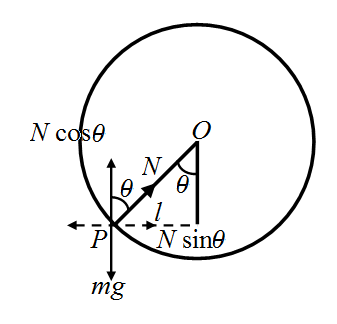
Let the radius vector joining the bead with the centre make an angle $\theta,$ with the vertical downward direction.

OP = R = Radius of the circle
N = Normal reaction
The respective vertical and horizontal equations of forces can be written as:
$\text{mg}=\text{N}\cos\theta\ ....(\text{i})$
$\text{ml}\omega=\text{N}\sin\theta\ ...(\text{ii})$
In $\triangle\text{OPQ},$ we have:
$\sin\theta=\frac{\text{l}}{\text{R}}$
$\text{l}=\text{R}\sin\theta\ ...(\text{iii})$
Substituting equation (iii) in equation (ii), we get:
$\text{m}(\text{R}\sin\theta)\omega^2=\text{N}\sin\theta$
$\text{mR}\omega^2=\text{N}\ ...(\text{iv})$
Substituting equation (iv) in equation (i), we get:
$\text{mg}=\text{mR}\omega^2\cos\theta$
$\cos\theta=\frac{\text{g}}{\text{R}\omega^2}\ ...(\text{v})$
Since $\cos\theta\le1,$ the bead will remain at its lowermost point for $\frac{\text{g}}{\text{R}\omega^2\le1},$ i.e., for $\omega\le\Big(\frac{\text{g}}{\text{R}}\Big)^{1/2}$
For $\omega=\Big(\frac{2\text{g}}{\text{R}}\Big)^{1/2}\ \text{or}\ \omega^2=\frac{2\text{g}}{\text{R}}\ ...(\text{vi})$ 
On equating equations (v) and (vi), we get:
$\frac{2\text{g}}{\text{R}}=\frac{\text{g}}{\text{R}\cos\theta}$
$\cos\theta=\frac{1}{2}$
$\therefore\theta=\cos^{-1}(0.5)=60^\circ$

Need a full question paper?

Generate a complete, print-ready paper with questions like this in minutes — across 16+ boards, with answer keys.

Start Generating Free

Similar questions

A body performs simple harmonic motion according to the following equation :
$
x=6 \sin \left(3 \pi t+\frac{\pi}{3}\right)
$
Find out : (i) amplitude (ii) period (iii) initial art (iv) displacement, velocity and acceleration at time $t = 2$.
An ideal gas $(\gamma=1.67)$ is taken through the process abc shown in the figure. The temperature at point a is 300K. Calculate,
  1. The temperatures at b and c.
  2. The work done in the process.
  3. The amount of heat supplied in the path ab and in the path bc.
  4. The change in the internal energy of the gas in the process.

Shows plot of $\frac{\text{PV}}{\text{T}}$ versus P for 1.00 × 10⁻³kg of oxygen gas at two different temperatures:

What is the value of $\frac{\text{PV}}{\text{T}}$ where the curves meet on the y-axis?

Two particles, each of mass m and speed v, travel in opposite directions along parallel lines separated by a distance d. Show that the angular momentum vector of the two particle system is the same whatever be the point about which the angular momentum is taken.
Taking an example of angular simple harmonic motion, establish an expression for the time period of the oscillator.
A ball of mass 50g moving at a speed of 2.0m/s strikes a plane surface at an angle of incidence 45°. The ball is reflected by the plane at equal angle of reflection with the same speed. Calculate
  1. The magnitude of the change in momentum of the ball.
  2. The change in the magnitude of the momentum of the ball.
If the linear momentum is increased by 50%, what is the change in its kinetic energy?
A rocket is fired vertically with a speed of 5km s-1 from the earth’s surface. How far from the earth does the rocket go before returning to the earth? Mass of the earth = 6.0 × 1024kg; mean radius of the earth = 6.4 × 10⁶m; G = 6.67 × 10⁻¹¹Nmkg-2.
State Newton's third law of motion. Discuss its consequences.
Two billiard balls each of mass 0.05kg moving in opposite directions with speed 6ms-1 collide and rebound with the same speed. What is the impulse imparted to each ball due to the other?