Question
A thin diamagnetic rod is placed vertically between the poles of an electromagnet. When the current in the electromagnet is switched on, then the diamagnetic rod is pushed up, out of the horizontal magnetic field. Hence, the rod gains gravitational potential energy. The work required to do this comes from:
Answer

  1. The current source.

Need a full question paper?

Generate a complete, print-ready paper with questions like this in minutes — across 16+ boards, with answer keys.

Start Generating Free

Similar questions

Two photons having:
One microgram of matter converted into energy will give
A magnet is dropped down an infinitely long vertical copper tube(a) The magnet moves with continuously increasing velocity and ultimately acquires a constant terminal velocity (b) The magnet moves with continuously decreasing velocity and ultimately comes to rest(c) The magnet moves with continuously increasing velocity but constant acceleration(d) The magnet moves with continuously increasing velocity and acceleration


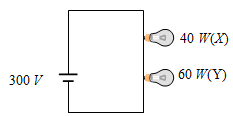
Two bulbs $X$ and $Y$ having same voltage rating and of power $40$ watt and $60$ watt respectively are connected in series across a potential difference of $300$ volt, then
Rutherford’s a-particle experiment showed that the atoms have:
The new resistance of wire of $R\Omega,$ whose radius is reduced half, is
The wavelength of a monochromatic light is 6000 Å in vacuum. When it enters in the glass slab of refractive index 2 its wavelength will be :
Assertion :   The capacity of a given conductor remains same even if charge is varied on it.
Reason      : Capacitance depends upon nearly medium as well as size and shape of conductor.(a) If both assertion and reason are true and the reason is the correct explanation of the assertion.(b) If both assertion and reason are true but reason is not the correct explanation of the assertion.(c) If assertion is true but reason is false.(d) If the assertion and reason both are false.


A parallel plate capacitor is charged. If the plates are pulled apart:
Total flux produced by a source of $1\ cd$ is