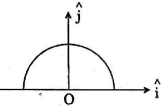
Correct option: D.$-$$\;\frac{q}{{2{\pi ^2}{\varepsilon _0}{r^2}}}\hat j$
d
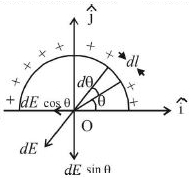
Let us consider a differential element $d l .$ charge on this element.
$d q=\left(\frac{q}{\pi r}\right) d l$
$=\frac{q}{\pi r}(r d \theta)(\because d l=r d \theta)$
$=\left(\frac{q}{\pi}\right) d \theta$
Electric field at $O$ due to $d q$ is
$d E=\frac{1}{4 \pi \in_{0}} \cdot \frac{d q}{r^{2}}=\frac{1}{4 \pi \in_{0}} \cdot \frac{q}{\pi r^{2}} d \theta$
The component $d E \cos \theta$ will be counter balanced by another element on left portion. Hence resultant field at $\mathrm{O}$ is the resultant of the component $d E \sin \theta$ only.
$\therefore E=\int d E \sin \theta=\int_{0}^{\pi} \frac{q}{4 \pi^{2} r^{2} \in_{0}} \sin \theta d \theta$
$=\frac{q}{4 \pi^{2} r^{2} \in_{0}}[-\cos \theta]_{0}^{\pi}=\frac{q}{4 \pi^{2} r^{2} \in_{0}}(+1+1)$
$=\frac{q}{2 \pi^{2} r^{2} \in_{0}}$
The direction of $E$ is towards negative $y-$ axis.
$\therefore \vec{E}=-\frac{q}{2 \pi^{2} r^{2} \in_{0}} \hat{j}$