Question
A thin straight infinitely long conducting wire having charge density λ is enclosed by a cylindrical surface of radius r and length l, its axis coinciding with the length of the wire. Find the expression for the electric flux through the surface of the cylinder.
Answer

Charge enclosed by the cylindrical surface $\text{q} = \lambda l $

Flux $\varphi =\frac{\text{q}}{\varepsilon_{0}}$

$ = \frac{\lambda l }{\varepsilon_{0}}$

Alternate Answer

$\varphi = \oint\overrightarrow{\text{E}}.\text{d}\overrightarrow{\text{S}} = \frac{\text{q}}{\varepsilon_{0}}$

$\varphi = \frac{\lambda l }{\varepsilon_{0}}.$

Need a full question paper?

Generate a complete, print-ready paper with questions like this in minutes — across 16+ boards, with answer keys.

Start Generating Free

Similar questions

If you jump barefooted on a hard surface, your legs get injured. But they are not injured if you jump on a soft surface like sand or pillow. Explain.
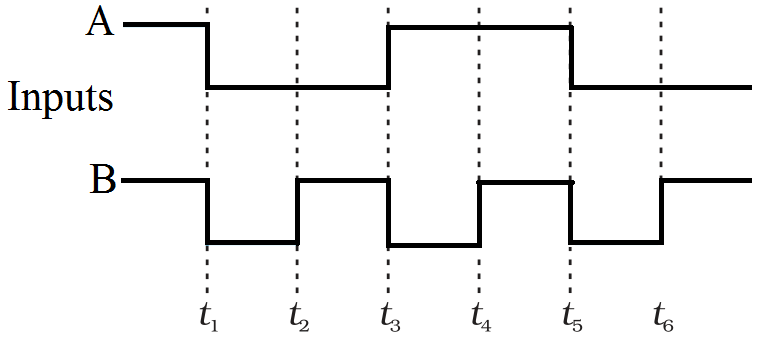
The given inputs A and B are fed to 2-inputs NAND gate. Draw the output waveform of the gate.

A tightly-wound, long solenoid has n turns per unit length, a radius r and carries a current i. A particle having charge q and mass m is projected from a point on the axis in a direction perpendicular to the axis. What can be the maximum speed for which the particle does not strike the solenoid ?
A screen is placed 90 cm from an object. The image of the object on the screen is formed by a convex lens at two different locations separated by 20 cm. Determine the focal length of the lens.
Explain in brief about emission spectrum and absorption spectrum.
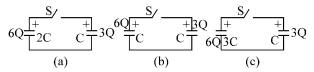
Three circuits, each consisting of a switch ' S ' and two capacitors, are initially charged as shown in the figure. In which circuit, when the switch is closed, the charge on the given capacitor will (i) increase, (ii) decrease and (iii) remain unchanged? Give reason.
Image
A particle moves from a point $\vec{\text{r}}_1=(2\text{m})\vec{\text{i}}+(3\text{m})\vec{\text{j}}$ to another point $\vec{\text{r}}_2=(3\text{m})\vec{\text{i}}+(2\text{m})\vec{\text{j}}$ during which a certain force $\vec{\text{F}}=(5\text{N})\vec{\text{i}}+(5\text{N})\vec{\text{j}}$ acts on it. Find the work done by the force on the particle during the displacement.
The minimum deviations suffered by red, yellow and violet beams passing through an equilateral transparent prism are 38.4°, 38.7° and 39.2° respectively. Calculate the dispersive power of the medium.
The masses of 11C and 11B are respectively 11.0114u and 11.0093u. Find the maximum energy a positron can have in the $\beta^+$-decay of 11C to 11B.
What is the importance of radial magnetic field in a moving coil galvanometer?