MCQ
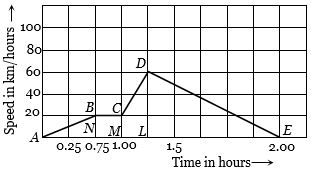
A train moves from one station to another in $2$ hours time. Its speed-time graph during this motion is shown in the figure. The maximum acceleration during the journey is.............$km\, h^{-2}$
  • A
    $140$
  • $160$
  • C
    $100$
  • D
    $120$

Answer

Correct option: B.
$160$
b
(b) Maximum acceleration will be represented by $CD$ part of the graph

Acceleration $ = \frac{{dv}}{{dt}} = \frac{{(60 - 20)}}{{0.25}} = 160\;km/{h^2}$

Need a full question paper?

Generate a complete, print-ready paper with questions like this in minutes — across 16+ boards, with answer keys.
Start Generating Free

Similar questions

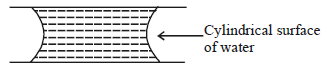
If two glass plates have water between them and are separated by very small distance ( see figure), it is very difficult to pull them apart. It is because the water in between forms cylindrical surface on the side that gives rise to lower pressure in the water in comparison to atmosphere. If the radius of the cylindrical surface is $R$ and surface tension of water is $T$ then the pressure in water between the plates is lower by
The ratio of spring constants of two springs is 2 : 3. What is the ratio of their potential energy if they are stretched by the same force?
A closed organ pipe of radius $r_1$ and an open organ pipe of radius $r_2$ and having same length $'L'$ resonate when excited with a given tunning fork. Closed organ pipe resonates in its fundamental mode where as open organ pipe resonates in its first overtone, then
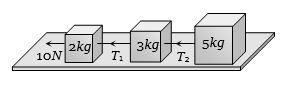
Three blocks of masses $2 \,kg, 3 \,kg$ and $5\, kg$ are connected to each other with light string and are then placed on a frictionless surface as shown in the figure. The system is pulled by a force $F = 10N,$ then tension ${T_1} = $  .......... $N$ 
Select incorrect statement regarding turbulent flow
50% of the X-ray coming from a Coolidge tube is able to pass through a 0.1mm thick aluminium foil. The potential difference between the target and the filament is increased. The thickness of the aluminium foil that will allow 50% of the X-ray to pass through will be:
  1. zero
  2. < 0.1mm
  3. 0.1mm
  4. > 0.1mm
A body of mass $40\,kg$ having velocity $4 \,m/s$ collides with another body of mass $60\,kg$ having velocity $2\, m/s$. If the collision is inelastic, then loss in kinetic energy will be .............. $J$
The coordinates of a moving particle at any time are given by $x = a{t^2}$ and $y = b{t^2}$. The speed of the particle at any moment is
For a particle executing simple harmonic motion, the kinetic energy $K$ is given by $K = {K_o}{\cos ^2}\omega t$. The maximum value of potential energy is
Two uniform solid spheres having unequal masses and unequal radii are released from rest from the same height on a rough incline. If the spheres roll without slipping:
  1. The heavier sphere reaches the bottom first.
  2. The bigger sphere reaches the bottom first.
  3. The two spheres reach the bottom together.
  4. The information given is not sufficient to tell which sphere will reach the bottom first.