MCQ
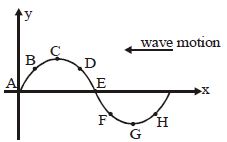
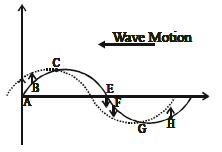
A transverse wave is travelling along a stretched string from right to left. The figure  shown represents the shape of the string at a given instant. At this instant
  • A
    the particles at $A, B$ and $H$ have downward velocity
  • the particles at $D, E$ and $F$ have downward velocity
  • C
    the particles at $C, E$ and $G$ have zero velocity
  • D
    the particles at $A$ and $F$ have maximum velocity
Answer

Correct option: B.
the particles at $D, E$ and $F$ have downward velocity
b

Need a full question paper?

Generate a complete, print-ready paper with questions like this in minutes — across 16+ boards, with answer keys.

Start Generating Free

Similar questions

Projection of vector $\vec A$ on $\vec B$ is
A source of frequency $150 Hz$ is moving in the direction of a person with a velocity of $110\, m/s$. The frequency heard by the person will be  .... $Hz$ (speed of sound in medium $= 330 m/s$)
The internal energy of an ideal gas increases during an isothermal process when the gas is 
A $5\, m$ long aluminium wire ($Y = 7 \times {10^{10}}N/{m^2})$ of diameter $3\, mm$ supports a $40\, kg$ mass. In order to have the same elongation in a copper wire $(Y = 12 \times {10^{10}}N/{m^2})$ of the same length under the same weight, the diameter should now be, in $mm.$
The change in potential energy, when a body of mass $m$ is raised to a height $nR$ from the earth's surface is ($R =$ Radius of earth)
Two spheres of different materials one with double the radius and one-fourth wall thickness of the other, are filled with ice. If the time taken for complete melting ice in the large radius one is $25$ minutes and that for smaller one is $16$ minutes, the ratio of thermal conductivities of the materials of larger sphere to the smaller sphere is
The two thin bones (femurs), each of cross-sectional area 10cm2 support the upper part of human body of mass 40 kg. Estimate the average pressure sustained by the femurs:
A satellite is revolving round the earth with orbital speed $v_0$. If it stops suddenly, the speed with which it will strike the surface of earth would be : ($v_e =$ escape velocity of a particle on earth's surface)
The kinetic energy acquired by a mass $m$ in travelling a certain distance $d$ starting from rest under the action of a constant force is directly proportional to
A sphere of radius $r$ is kept on a concave mirror of radius of curvature $R$. The arrangement is kept on a horizontal table (the surface of concave mirror is frictionless and sliding not rolling). If the sphere is displaced from its equilibrium position and left, then it executes $S.H.M.$ The period of oscillation will be