Question
A tungsten cathode and a thoriated-tungsten cathode have the same geometric dimensions and are operated at the same temperature. The thoriated-tungsten cathode gives 5000 times more current than the other cathode. Find the operating temperature. Take relevant data from the previous problem.

Answer

Pure tungsten:

$\phi=4.5\text{eV}$

$\text{A}=60\times10^{4}\text{A/m}^2-\text{k}^2$

$\text{i}=\text{AST}^2\text{e}^{\frac{\phi}{\text{KT}}}$

Thoriated tungsten:

$\phi=2.6\text{eV}$

$\text{A}=3\times10^{4}\text{A/m}^2-\text{k}^2$

$\text{i}_{\text{Thoriated Tungsten}}=5000\text{i}_{\text{Tungsten}}$

So, $5000\times\text{S}\times60\times10^{4}\times\text{T}_2\times\text{e}^{\frac{-4.5\times1.6\times10^{-19}}{1.38\times\text{t}\times10^{-23}}}$

$\Rightarrow\text{S}\times3\times10^{4}\times\text{T}^2\times\text{e}^{\frac{-2.56\times1.6\times10^{-19}}{1.38\times\text{T}\times10^{-23}}}$

$\Rightarrow3\times10^{8}\times\text{e}^{\frac{-4.5\times1.6\times10^{-19}}{1.38\times\text{t}\times10^{-23}}}=\text{e}^{\frac{-2.56\times1.6\times10^{-19}}{1.38\times\text{T}\times10^{-23}}}\times3\times10^4$

Taking 'in'

$\Rightarrow9.21\text{T}=220.29$

$\Rightarrow\text{T}=\frac{22029}{9.21}=2391.856\text{K}$
Need a full question paper?

Generate a complete, print-ready paper with questions like this in minutes — across 16+ boards, with answer keys.

Start Generating Free

Similar questions

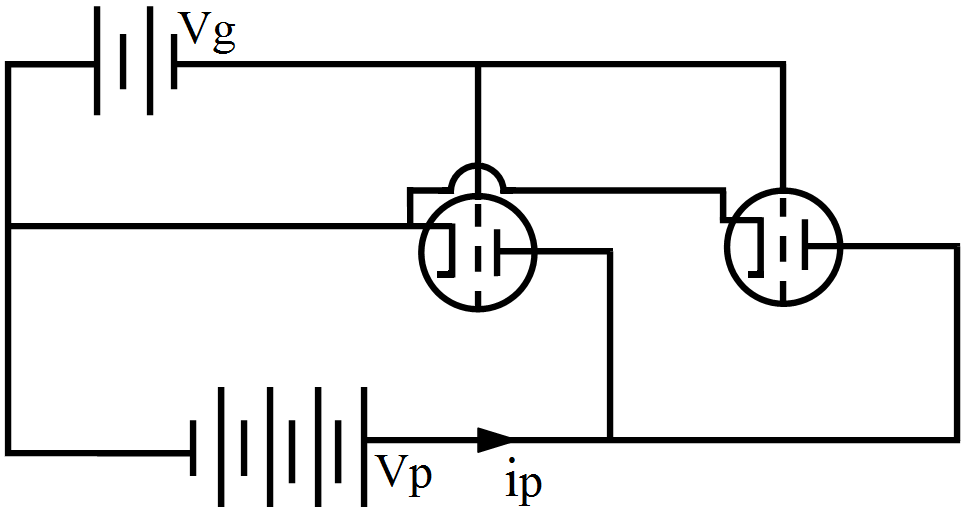
The figure shows two identical triode tubes connected in parallel. The anodes are connected together and the cathodes are connected together. Show that the equivalent plate resistance is half the individual plate resistance, the equivalent mutual conductance is double the

individual mutual conductance and the equivalent amplification factor is the same as the individual amplification factor.
Read the passage given below and answer the following questions from (i) to (v).
When a system (such as a simple pendulum or a block attached to a spring) is displaced from its equilibrium position and released, it oscillates with its natural frequency $\omega,$ and the oscillations are called free oscillations. All free oscillations eventually die out because of the ever present damping forces. However, an external agency can maintain these oscillations. These are called forced or driven oscillations. We consider the case when the external force is itself periodic, with a frequency wd called the driven frequency. The most important fact of forced periodic oscillations is that the system oscillates not with its natural frequency $\omega,$ but at the frequency $\omega,$ d of the external agency; the free oscillations die out due to damping. The most familiar example of forced oscillation is when a child in a garden swing periodically presses his feet against the ground (or someone else periodically gives the child a push) to maintain the oscillations. The maximum possible amplitude for a given driving frequency is governed by the driving frequency and the damping, and is never infinity. The phenomenon of increase in amplitude when the driving force is close to the natural frequency of the oscillator is called resonance. In our daily life, we encounter phenomena which involve resonance. Your experience with swings is a good example of resonance. You might have realized that the skill in swinging to greater heights lies in the synchronization of the rhythm of pushing against the ground with the natural frequency of the swing.
  1. When a system oscillates with its natural frequency ω, and the oscillations are called:
  1. Free oscillations.
  2. Forced oscillations.
  1. All free oscillations eventually die out because of:
  1. Damping force.
  2. electromagnetic force.
  3. None of these.
  1. What is free oscillation?
  2. What is forced oscillations?
  3. What is resonance?
Read the passage given below and answer the following questions from 1 to 5.
The scalar product or dot product of any two vectors A and B, denoted as A.B (read A dot B) is defined as
$\text{A}\cdot\text{B}=\text{AB}\cos\theta$
Where q is the angle between the two vectors. Since A, B and $\cos\theta$ are scalars, the dot product of A and B is a scalar quantity. Each vector, A and B, has a direction but their scalar product does not have a direction. Following are properties of dot product
  • the scalar product follows the commutative law: A.B = B.A
  • Scalar product obeys the distributive law: (B + C) = A.B + A.C Further, A. $(\lambda\text{B})=\lambda(\text{A}\cdot\text{B})$ where $\lambda$ is a real number.
  • For unit vectors i, j, k we have
i × i = j × j = k × k = 1 and i × j = j × k = k × i = 0
$\text{A}\times\text{A}=\mid\text{A}\parallel\text{A}\mid\cos\theta=\text{A}^2.$
B = 0, if A and B are perpendicular.
The work done by the force is defined to be the product of component of the force in the direction of the displacement and the magnitude of this displacement. Thus
$\text{W}=(\text{F}\cos\theta)\text{d}=\text{F}\cdot\text{d}$ (We see that if there is no displacement, there is no work done even if the force is large. Work has only magnitude and no direction. Its SI unit is (N m) or joule (J). Thus, When you push hard against a rigid brick wall, the force you exert on the wall does not work.
No work is done if:
  • The displacement is zero.
  • The force is zero. A block moving on a smooth horizontal table is not acted upon by Horizontal force (since there is no friction), but may undergo a large displacement.
  • The force and displacement are mutually perpendicular. This is so since, for $\theta=\frac{\pi}{2}$ rad
  • $\cos\big(\frac{\pi}{2}\big)=\theta.$ For the block moving on a smooth horizontal table, the gravitational force mg does no work since it acts at right angles to the displacement. If we assume that the moon’s orbits around the earth are perfectly circular then the earth’s gravitational force does no work. The moon’s instantaneous displacement is tangential while the earth’s force is radially inwards and $\theta=\frac{\pi}{2}.$
  1. Scalar product A.B = B.A is:
  1. Commutative law
  2. Distributive law
  3. Both a and b
  4. None of these
  1. When force acts in the direction of displacement then work done will be:
  1. Positive
  2. Negative
  3. Both a and b can possible
  4. None of these
  1. Define scalar product. give its properties:
  1. Define work done. Give its SI unit
  1. Write down the conditions for which work done is zero
A ladder is resting with one end on a vertical wall and the other end on a horizontal floor. Is it more likely to slip when a man stands near the bottom or near the top?
Read the passage given below and answer the following questions from 1 to 5.
The proportional region within the elastic limit of the stress-strain curve is of great importance for structural and manufacturing engineering designs. The ratio of stress and strain, called modulus of elasticity, is found to be a characteristic of the material.
Experimental observation show that for a given material, the magnitude of the strain produced
is same whether the stress is tensile or compressive. The ratio of tensile (or compressive) stress $(\sigma)$ to the longitudinal strain $(\in)$ is defined as Young’s modulus and is denoted by the symbol Y.
$\text{Y}=\frac{\sigma}{\in}$
Since strain is a dimensionless quantity, the unit of Young’s modulus is the same as that of stress i.e., N-m-2 or Pascal (Pa). As steel has more modulus of elasticity than copper brass and aluminum hence steel is preferred in heavy-duty machines and in structural designs. Wood, bone, concrete and glass have rather small Young’s moduli. Answer the following.
  1. If stress strain changes then young’s modulus is:
  1. Also changes.
  2. Remains constant.
  3. Either changes or remains constant depends on amount of stress and strain.
  4. None of these.
  1. SI unit of young’s modulus is:
  1. N-m-2
  2. Pascal (Pa).
  3. N-m-2 or Pascal (Pa).
  4. None of these
  1. Which of the following is more elastic
  1. Aluminum
  2. Steel
  3. Wood
  4. Glass
  1. Defines young’s modulus. Give its SI unit and dimensions.
  1. Why steel is more preferred in heavy industries than copper and brass?
A simple pendulum fixed in a car has a time period of 4 seconds when the car is moving uniformly on a horizontal road. When the accelerator is pressed, the time period changes to 3.99 seconds. Making an approximate analysis, find the acceleration of the car.
A magnetic needle is free to rotate in a vertical plane which makes an angle of 60° with the magnetic meridian. If the needle stays in a direction making an angle of $\tan^{-1}\Big(\frac{2}{\sqrt{3}}\Big)$ with the horizontal, what would be the dip at that place?
The plate current in a triode can be written as $\text{i}_\text{p}=\text{k}\Big(\text{V}_\text{g}+\frac{\text{V}_\text{p}}{\mu}\Big)^{\frac{3}{2}}$ Show that the mutual conductance is proportional to the cube root of the plate current.
Read the passage given below and answer the following questions from (i) to (v).

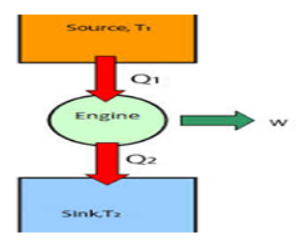
Heat engine is a device by which a system is made to undergo a cyclic process that results in conversion of heat to work. It consists of a working substance–the system. For example, mixture of fuel vapors and air in a gasoline or diesel engine or steam in a steam engine are the working Substances. The working substance goes through a cycle consisting of several processes. In some of these processes, it absorbs a total amount of heat Q1 from an external reservoir at some high temperature T1. In some other processes of the cycle, the working substance releases a total amount of heat Q2 to an external reservoir at some lower temperature T2. The work done (W) by the system in a cycle is transferred to the environment via some arrangement (e.g. the working substance may be in a cylinder with a moving piston that transfers mechanical energy to the wheels of a vehicle via a shaft). The basic features of a heat engine are schematically represented in Fig.

The cycle is repeated again and again to get useful work for some purpose. The discipline of Thermodynamics has its roots in the study of heat engines. A basic question relates to the efficiency of a heat engine. The efficiency (h) of a heat engine is defined by

$\text{n}=\frac{\text{W}}{\text{Q}_1}$

Where Q1 is the heat input i.e., the heat absorbed by the system in one complete cycle and W is the work done on the environment in a cycle. In a cycle, a certain amount of heat (Q2) may also be rejected to the environment. Then according to the First Law of Thermodynamics, over one complete cycle.

W = Q1 – Q2

$\text{n}=1-\frac{\text{Q}_2}{\text{Q}_1}$

For Q2 = 0, n = 1, i.e., the engine will have 100% efficiency in converting heat into work. Note that the First Law of Thermodynamics i.e., the energy conservation law does not rule out such an engine. But experience shows that such an ideal engine with η = 1 is never possible.

A refrigerator is the reverse of a heat engine. Here the working substance extracts heat Q2 from the cold reservoir at temperature T2, some external work W is done on it and heat Q1 is released to the hot reservoir at temperature T1. The efficiency of refrigerator is expressed in terms of  coefficient of performance $(\alpha)$ of a refrigerator is given by

$\alpha=\frac{\text{Q}_2}{\text{W}}$

where Q2 is the heat extracted from the cold reservoir and W is the work done on the system

  1. In a heat engine the process need not be cyclic. True or False?
  1. True
  2. False
  1. Efficiency of heat engine N = 100% is it practically possible?
  1. Yes
  2. No
  1. Define efficiency of heat engine.
  2. Define coefficient of performance.
  3. Write a note on heat engine.
A closed bottle contains some liquid. The bottle is shaken vigorously for 5 minutes. It is found that the temperature of the liquid is increased. Is heat transferred to the liquid? Is work done on the liquid? Neglect expansion on heating.