Question
Read the passage given below and answer the following questions from (i) to (v).
When a system (such as a simple pendulum or a block attached to a spring) is displaced from its equilibrium position and released, it oscillates with its natural frequency $\omega,$ and the oscillations are called free oscillations. All free oscillations eventually die out because of the ever present damping forces. However, an external agency can maintain these oscillations. These are called forced or driven oscillations. We consider the case when the external force is itself periodic, with a frequency wd called the driven frequency. The most important fact of forced periodic oscillations is that the system oscillates not with its natural frequency $\omega,$ but at the frequency $\omega,$ d of the external agency; the free oscillations die out due to damping. The most familiar example of forced oscillation is when a child in a garden swing periodically presses his feet against the ground (or someone else periodically gives the child a push) to maintain the oscillations. The maximum possible amplitude for a given driving frequency is governed by the driving frequency and the damping, and is never infinity. The phenomenon of increase in amplitude when the driving force is close to the natural frequency of the oscillator is called resonance. In our daily life, we encounter phenomena which involve resonance. Your experience with swings is a good example of resonance. You might have realized that the skill in swinging to greater heights lies in the synchronization of the rhythm of pushing against the ground with the natural frequency of the swing.
  1. When a system oscillates with its natural frequency ω, and the oscillations are called:
  1. Free oscillations.
  2. Forced oscillations.
  1. All free oscillations eventually die out because of:
  1. Damping force.
  2. electromagnetic force.
  3. None of these.
  1. What is free oscillation?
  2. What is forced oscillations?
  3. What is resonance?

Answer

  1. a) Free oscillations.
  2. a) Damping force.
  3. When a system (such as a simple pendulum or a block attached to a spring) is displaced from its equilibrium position and released, it oscillates with its natural frequency ω, and the oscillations are called free oscillations.
  4. Forced oscillations are oscillations where external force drives the oscillations with frequency given by external force.
  5. The phenomenon of increase in amplitude when the driving force is close to the natural frequency of the oscillator is called resonance. In our daily life, we encounter phenomena which involve resonance. Your experience with swings is a good example of resonance. You might have realized that the skill in swinging to greater heights lies in the synchronization of the rhythm of pushing against the ground with the natural frequency of the swing.

Need a full question paper?

Generate a complete, print-ready paper with questions like this in minutes — across 16+ boards, with answer keys.

Start Generating Free

Similar questions

A discharge tube contains helium at low pressure. A large potential difference is applied across the tube. Consider a helium atom that has just been ionised due to the detachment of an atomic electron. Find the ratio of the distance travelled by the free electron to that by the positive ion in a short time dt after ionisation.
If the temperature of a tungsten filament is raised from 2000K to 2010K, by what factor does the emission current change? Work function of tungsten is 4.5eV.
Read the case study given below and answer any four subparts:
Potential energy is the energy stored within an object, due to the object's position, arrangement or state. Potential energy is one of the two main forms of energy, along with kinetic energy. Potential energy depends on the force acting on the two objects.

  1. A body is falling freely under the action of gravity alone in vacuum. Which of the following quantities remain constant during the fall?
    1. kinetic energy
    2. potential energy
    3. mechanical energy
    4. none of these
  2. Work done by a conservative force is positive, if
    1. potential energy decreases
    2. potential energy increases
    3. kinetic energy decreases
    4. kinetic energy increases
  3. When does the potential energy of a spring increases?
    1. only when spring is stretched
    2. only when spring is compressed 
    3. both a and b
    4. none of these
  4. Dimension of k/m is, here k is force constant
    1. T2
    2. T-2
    3. T1
    4. T-1
  5. A vehicle of mass 5000kg climbs up a hill of 10 m. The potential energy gained by it
    1. 5J
    2. 500J
    3. 5 × 104J
    4. 5 × 105J
Two bodies of masses 10 kg and 20 kg respectively kept on a smooth, horizontal surface are tied to the ends of a light string. A horizontal force F = 600 N is applied to (i) A, (ii) B along the direction of string. What is the tension in the string in each case?
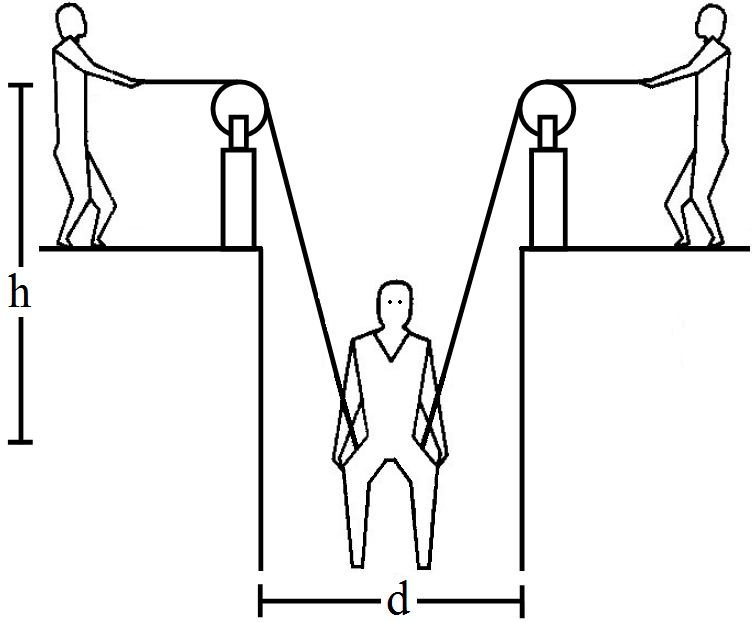
A man has fallen into a ditch of width d and two of his friends are slowly pulling him out using a light rope and two fixed pulleys as shown in figure. Show that the force (assumed equal for both the friends) exerted by each friend on the road increases as the man moves up. Find the force when the man is at a depth h.

The plate current in a triode valve is zero. The temperature of the filament is high. It is possible that:
  1. Vg > 0, Vp > 0
  2. Vg > 0, Vp < 0
  3. Vg < 0, Vp > 0
  4. Vg < 0, Vp < 0
Read the passage given below and answer the following questions from 1 to 5.
Centre of Mass:
The centre of mass of a body or a system of bodies is the point which moves as though all of the mass were concentrated there and all external forces were applied to it. Hence, a point at which the entire mass of the body or system of bodies is supposed to be concentrated is known as the centre of mass. If a system consists of more than one particles (or bodies) and net external force on the system in a particular direction is zero with centre of mass at rest. Then, the centre of mass will not move along that direction. Even though some particles of the system may move along that direction.
  1. The centre of mass of a system of two particles divides, the distance between them:
  1. in inverse ratio of square of masses of particles
  2. in direct ratio of square of masses of particles
  3. in inverse ratio of masses of particles
  4. in direct ratio of masses of particles
  1. Two bodies of masses 1kg and 2 kg are lying in xy-plane at ( -1, 2 ) and ( 2, 4 ) respectively. What are the coordinates of the centre of mass?
  1. $\big(1,\frac{10}{3}\big)$
  2. (1, 10)
  3. (0, 1)
  4. None of these
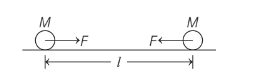
  1. Two balls of same masses start moving towards each other due to gravitational attraction, if the initial distance between them is l. Then, they meet at:

  1. $\frac{\text{ l}}{2}$
  2. l
  3. $\frac{\text{ l}}{3}$
  4. $\frac{\text{ l}}{4}$
  1. All the particles of a body are situated at a distance R from the origin. The distance of centre of mass of the body from the origin is:
  1. $=\text{R}$
  2. $\leq\text{R}$
  3. $>\text{R}$
  4. $\geq\text{R}$
  1. Two particles A and B initially at rest move towards each other under a mutual force of attraction. At the instant, when the speed of A is v and the speed of B is 2v, the speed of centre of mass of the system is:
  1. zero
  2. v
  3. 1. 5v
  4. 3v
Why do marine animals live deep inside a lake when the surface of the lake freezes?
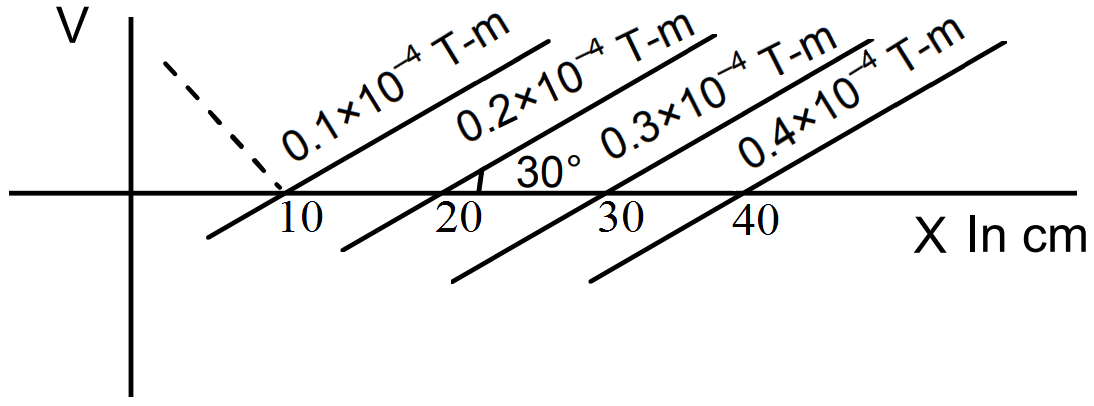
Figure shows some of the quipotential surfaces of the magnetic scalar potential. Fmd the magnetic field B at a point in the region.

The weight Mg of an extended body is generally shown in a diagram to act through the centre of mass. Does it mean that the earth does not attract other particles?