MCQ
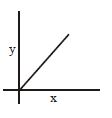
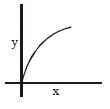
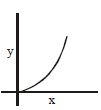
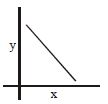
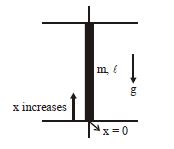
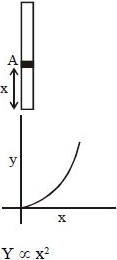
A uniform dense rod with non uniform young's modulus is hanging from ceiling under gravity. If elastic energy density at every point is same then young's modulus with $x$ will change as which of the shown graph
  • A

  • B


  • D

Answer

Correct option: C.

c
Elastic energy density at

$A=\frac{1}{2} \frac{(\text { stress })^{2}}{Y}=$ constant

$\frac{_{1}}{2} \frac{\left(\frac{M}{L} \frac{x}{A} g\right)^{2}}{Y}=$ constant
Need a full question paper?

Generate a complete, print-ready paper with questions like this in minutes — across 16+ boards, with answer keys.

Start Generating Free

Similar questions

For a solenoid keeping the turn density constant its length is halved and its cross section radius is doubled then the inductance of the solenoid increased by.....$\%$
According to the quantum theory, a photon of electromagnetic radiation of frequency $v$ has energy $E=h v$, where $h$ is known as Planck's constant. According to the theory of relativity, a particle of mass $m$ has equivalent energy $E=m c^2$, where $c$ is speed of light. Thus, a photon can be treated as a particle having effective mass $m=\frac{h v}{c^2}$ If a flash of light is sent horizontally in earth's gravitational field, then photons while travelling a horizontal distance $d$ would fall through a distance given by
A solid disc of mass $M$ is just held in air horizontally by throwing $40$ stones per sec vertically upwards to strike the disc each with a velocity $6\,m{s^{ - 1}}$. If the mass of each stone is $0.05\,kg$ what is the mass of the disc  ........... $kg$     $(g = 10\,m{s^{ - 2}}$)
At atmospheric pressure, the water boils at $100°C$. If pressure is reduced, it will boil at
A stone tied with a string, is rotated in a vertical circle. The minimum speed with which the string has to be rotated
A free hydrogen atom after absorbing a photon of wavelength $\lambda_{ a }$ gets excited from the state $n =1$ to the state $n =4$. Immediately after that the electron jumps to $n=m$ state by emitting a photon of wavelength $\lambda_{\text {. }}$. Let the change in momentum of atom due to the absorption and the emission are $\Delta p_2$, and $\Delta p_\theta$, respectively. If $\lambda_2 / \lambda_0=\frac{1}{5}$. Which of the option(s) is/are correct ?

[Use $hc =1242 eV nm ; 1 nm =10^{-9} m , h$ and $c$ are Planck's constant and speed of light, respectively]

$(1)$ $\lambda_0=418 nm$

$(2)$ The ratio of kinetic energy of the electron in the state $n = m$ to the state $n =1$ is $\frac{1}{4}$

$(3)$ $m =2$

$(4)$ $\Delta p_{ a } / \Delta p _{ o }=\frac{1}{2}$

When a wave travels in a medium, the particle displacements are given by $y = a\, sin\, 2\pi\, (bt -cx)$ where $a, b,$ and $c$ are constants. The maximum particle velocity will be twice the wave velocity if
In Young's double slit experiment, if the separation between coherent sources is halved and the distance of the screen from the coherent sources is doubled, then the fringe width becomes:
Dielectric constant of pure water is $81$. Its permittivity will be
Given below are two statements: one is labelled as Assertion $A$ and the other is labelled as Reason $R$.

Assertion $A$: The potential ( $V$ ) at any axial point, at $2 \mathrm{~m}$ distance ( $r$ ) from the centre of the dipole of dipole moment vector $\vec{P}$ of magnitude, $4 \times 10^{-6} \mathrm{C} \mathrm{m}$, is $\pm 9 \times 10^3 \mathrm{~V}$.

(Take $\frac{1}{4 \pi \epsilon_0}=9 \times 10^9 \mathrm{Sl}$ units)

Reason $R$: $V= \pm \frac{2 P}{4 \pi \epsilon_0 r^2}$, where $r$ is the distance of any axial point, situated at $2 \mathrm{~m}$ from the centre of the dipole.

In the light of the above statements, choose the correct answer from the options given below: