Question
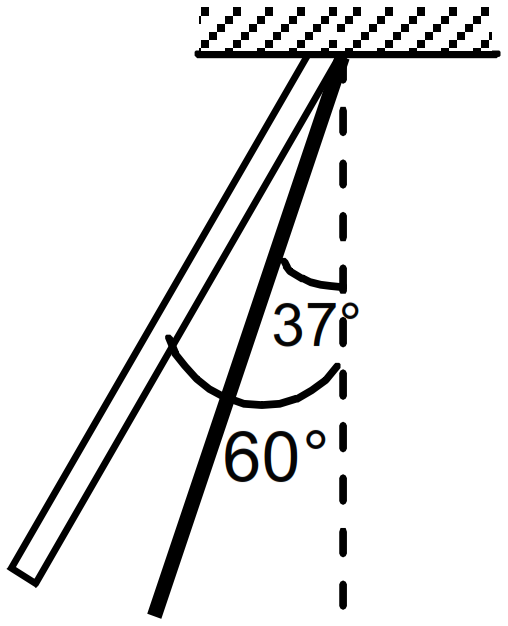
A uniform rod pivoted at its upper end hangs vertically. It is displaced through an angle of 60° and then released. Find the magnitude of the force acting on a particle of mass dm at the tip of the rod when the rod makes an angle of 37° with the vertical.
Answer

Let l = length of the rod, and m = mass of the rod.

Applying energy principle
$\Big(\frac{1}{2}\Big)\text{l}\omega^2-0=\text{mg}\Big(\frac{1}{2}\Big)(\cos37^\circ-\cos60^\circ)$

$\Rightarrow\frac{1}{2}\times\frac{\text{ml}^2}{3}\omega^2$

$=\text{mg}\times\frac{1}{2}\Big(\frac{4}{5}-\frac{1}{2}\Big)\text{t}$

$\Rightarrow\omega^2=\frac{9\text{g}}{10\text{l}}=0.9\Big(\frac{\text{g}}{\text{l}}\Big)$

Again $\Big(\frac{\text{ml}^2}{3}\Big)\alpha=\text{mg}\Big(\frac{1}{2}\Big)\sin37^\circ=\text{mgl}\times\frac{3}{5}$

$\therefore\alpha=0.9\Big(\frac{\text{g}}{\text{l}}\Big)=$ angular acceleration.

So, to find out the force on the particle at the tip of the rod

Fi = centrifugal force $=(\text{dm})\omega^2\text{l}=0.9(\text{dm})\text{g}$

Ft = tangential force $=(\text{dm})\alpha\text{l}=0.9(\text{dm})\text{g}$

So, total force $\text{F}=\sqrt{\big(\text{F}_{\text{i}}^2+\text{F}_{\text{t}}^2\big)}=0.9\sqrt2(\text{dm})\text{g}$

Need a full question paper?

Generate a complete, print-ready paper with questions like this in minutes — across 16+ boards, with answer keys.

Start Generating Free

Similar questions

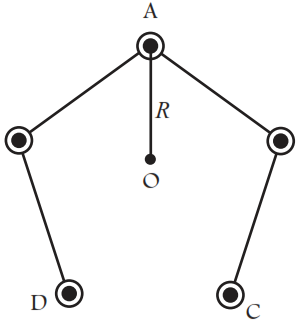
Five long wires A, B, C, D and E, each carrying current I are arranged to form edges of a pentagonal prism as shown in Fig. Each carries current out of the plane of paper.

  1. What will be magnetic induction at a point on the axis O? Axis is at a distance R from each wire.
  2. What will be the field if current in one of the wires (say A) is switched off?
  3. What if current in one of the wire (say) A is reversed?
The $\text{K}_\beta$ X-rays from certain elements are given below. Draw a Moseley-type plot of $\sqrt{\text{v}}$ versus Z for $\text{K}_\beta$ radiation.
Element
Ne
P
Ca
Mn
Zn
Br
Energy (keV)
0.858
2.14
4.02
6.51
9.57
13.3
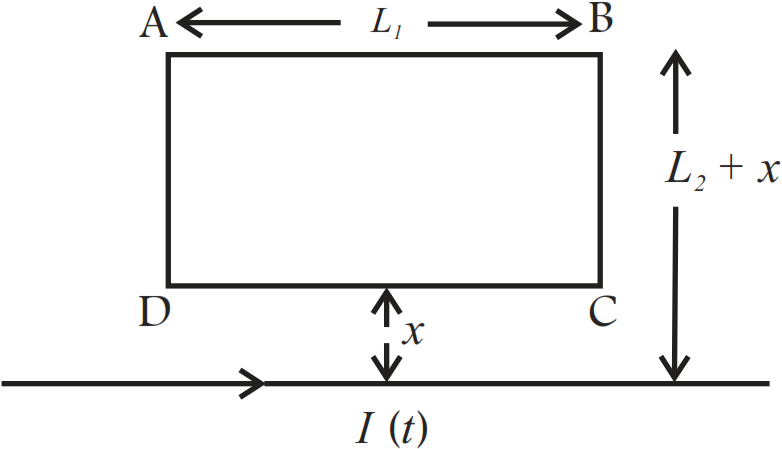
A rectangular loop of wire ABCD is kept close to an infinitely long wire carrying a current $\text{I}(\text{t})=\text{I}_0\Big(1-\frac{\text{t}}{\text{T}}\Big)$ for 0 and I(0) = 0 for t > T (Fig). Find the total charge passing through a given point in the loop, in time T. The resistance of the loop is R.

The current−voltage characteristic of an ideal p-n junction diode is given by $\text{i}=\text{i}_0\Big(\text{e}^{\frac{\text{eV}}{\text{kT}}}-1\Big)$ where, the drift current i0 equals $10\mu\text{A}.$ Take the temperature T to be 300K.
  1. Find the voltage V0 for which $\text{e}^{\frac{\text{eV}}{\text{KT}}}=100.$ One can neglect the term 1 for voltages greater than this value.
  2. Find an expression for the dynamic resistance of the diode as a function of V for V > V0.
  3. Find the voltage for which the dynamic resistance is $0.2\Omega.$
A thin prism of angle $6.0^\circ,\omega=0.07$ and $\mu_\text{y}=1.50$ is combined with another thin prism having $\omega=0.08$ and $\mu_\text{y}=1.60.$ The combination produces no deviation in the mean ray.
  1. Find the angle of the second prism.
  2. Find the net angular dispersion produced by the combination when a beam of white light passes through it.
  3. If the prisms are similarly directed, what will be the deviation in the mean ray
  4. Find the angular dispersion in the situation described in (c).
A pendulum clock gives correct time at 20°C at a place where g = 9.800m s-2. The pendulum consists of a light steel rod connected to a heavy ball. It is taken to a different place where g = 9.788m s-2. At what temperature will it give correct time ? Coefficient of linear expansion of steel = 12 × 10-6 °C-1.
An electric bulb is designed to consume 55W when operated at 110 volts. It is connected to a 220V, 50Hz line through a choke coil in series. What should be the inductance of the coil for which the bulb gets correct voltage?
Consider a p-n junction diode having the characteristic $\text{i}-\text{i}_0\Big(\text{e}^{\frac{\text{eV}}{\text{kT}}}-1\Big)$ where $\text{i}_0=20\mu\text{A}.$ The diode is operated at T = 300K.
  1. Find the current through the diode when a voltage of 300mV is applied across it in forward bias.
  2. At what voltage does the current double?
  1. Compare the individual dipole moment and the specimen dipole moment for H2O molecule and O2 molecule when placed in:
  1. Absence of external electric field.
  2. Presence of external eclectic field. Justify your answer.
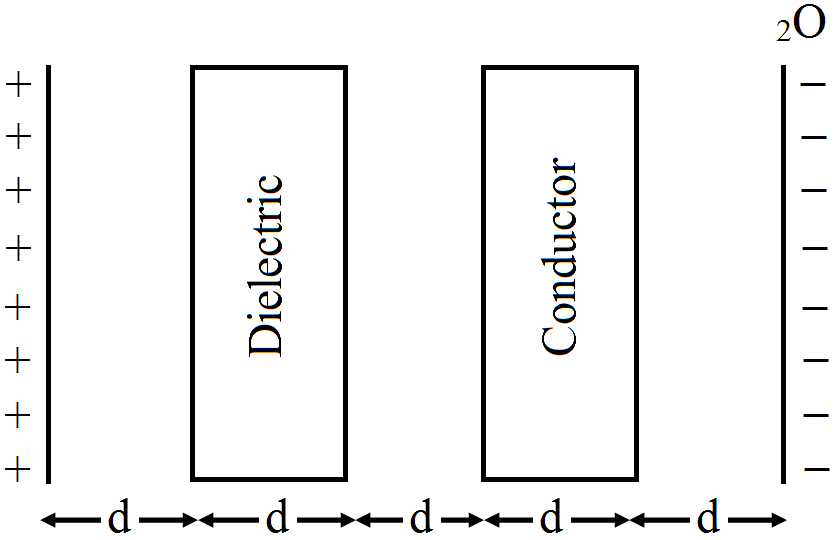
  1. Given two parallel conducting plates of area A and charge densities $+\sigma$ and $-\sigma.$ A dielectric slab of constant K and a conducting slab of thickness d each are inserted in between them as shown.

  1. Find the potential difference between the plates.
  2. Plot E versus x graph, taking x = 0 at positive plate and x = 5d at negative plate.