Question
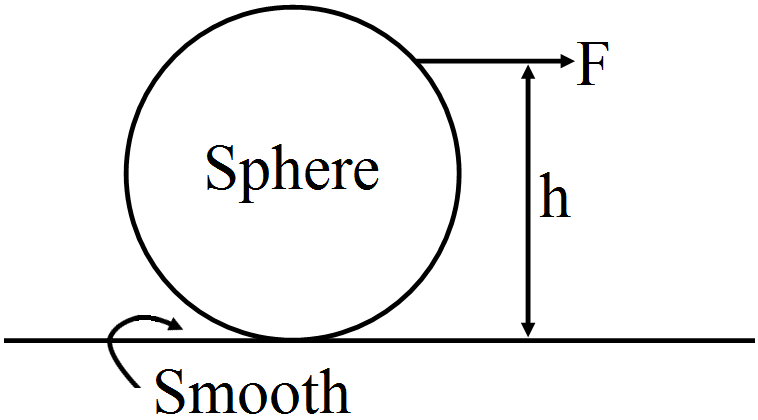
A uniform sphere is placed on a smooth horizontal surface and a horizontal force F is applied on it at a distance h above the surface. The acceleration of the centre:
  1. Is maximum when h = 0.
  2. Is maximum when h = R.
  3. Is maximum when h = 2R.
  4. Is independent of h.

Answer

  1. Is independent of h.

Explanation:

As the uniform sphere is placed on a smooth surface, the sphere only slips.

The acceleration of the centre of the sphere is given by,

$\frac{\text{Applied force}}{\text{Mass of the sphere}},$ which is independent of height h.

Need a full question paper?

Generate a complete, print-ready paper with questions like this in minutes — across 16+ boards, with answer keys.

Start Generating Free

Similar questions

A closed pipe and an open pipe have their first overtones identical in frequency. Their lengths are in the ratio
The time period of a satellite revolving around earth in a given orbit is $7 \,hours$. If the radius of orbit is increased to three times its previous value, then approximate new time period of the satellite will be ...... $hours$
A particle executing $S.H.M.$ of amplitude 4 cm and $T = 4 \,sec.$ The time taken by it to move from positive extreme position to half the amplitude is ..... $\sec$
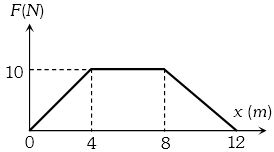
A particle of mass $0.1 \,kg$ is subjected to a force which varies with distance as shown in fig. If it starts its journey from rest at $x = 0$, its velocity at $x = 12\,m$ is .......... $m/s$
The resultant of $\overrightarrow{\text{A}}$ and $\overrightarrow{\text{B}}$ makes an angle a with $\overrightarrow{\text{A}}$ and $\beta$ with $\overrightarrow{\text{B}},$

  1. $\alpha<\beta$

  2. $\alpha<\beta \text{ if}\text{ A}<\text{B}$

  3. $\alpha<\beta \text{ if}\text{ A}>\text{B}$

  4. $\alpha<\beta \text{ if}\text{ A}=\text{B}$

............  $gm$ of a liquid of specific heat $0.2$ at a temperature $40°C$ must be mixed with $100 \,gm$ of a liquid of specific heat of $0.5 $ at a temperature $20°C,$ so that the final temperature of the mixture becomes $32°C$
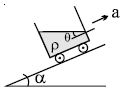
A fluid container is containing a liquid of density $\rho $ is accelerating upward with acceleration a along the inclined place of inclination $\alpha$  as shown. Then the angle of inclination $ \theta $ of free surface is :
A proton of mass $ 1.6  \times 10^{-27} kg$ goes round in a circular orbit of radius $0.10\, m$ under a centripetal force of $4  \times 10^{-13}\, N$. then the frequency of revolution of the proton is about 
The speed of sound in a gas, in which two waves of wavelength $1.0\,\, m$ and $1.02\,\, m$ produce $6$ beats per second, is approximately .... $m/s$
A $1 \;kg$ stationary bomb is exploded in three parts having mass $1: 1: 3$ respectively. Parts having same mass move in perpendicular direction with velocity $30\; ms ^{-1}$, then the velocity of bigger part will be