MCQ
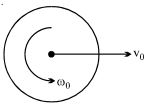
$A$ uniform sphere of radius $R$ is placed on $a$ rough horizontal surface and given a linear velocity $v_0$ angular velocity $\omega_0$ as shown. The sphere comes to rest after moving some distance to the right. It follows that:
  • A
    $v_0 = \omega_0R$
  • B
    $2v_0 = 5\omega_0R$
  • $5v_0 = 2\omega_0R$
  • D
    $2v_0 = \omega_0R$

Answer

Correct option: C.
$5v_0 = 2\omega_0R$
c

Need a full question paper?

Generate a complete, print-ready paper with questions like this in minutes — across 16+ boards, with answer keys.

Start Generating Free

Similar questions

The root mean square speed of the molecules of a diatomic gas is $v$. When the temperature is doubled, the molecules dissociate into two atoms. The new root mean square speed of the atom is
For a particle in a non-uniform accelerated circular motion
Two balls $A$ and $B$ having masses $1\, kg$ and $2\, kg$, moving with speeds $21\, m/s$ and $4\, m/s$ respectively in opposite direction, collide head on. After collision Amoves with a speed of $1\,m/s$ in the same direction, then correct statements is :
A particle is projected with a velocity of $30\,m / s$, at an angle of $\theta_0=\tan ^{-1}\left(\frac{3}{4}\right)$ After $1\,s$, the particle is moving at an angle $\theta$ to the horizontal, where $\tan \theta$ will be equal to $\left(g=10\,m / s ^2\right)$
In an experiment to determine the velocity of sound in air at room temperature using a resonance is observed when the air column has a length of $20.0 \,cm$ for a tuning fork of frequency $400 \,Hz$ is used. The velocity of the sound at room temperature is $336 \,ms ^{-1}$. The third resonance is observed when the air column has a length of ......... $cm$
Which of the following quantities remain constant in a planetary motion (consider elliptical orbits) as seen from the sun?
  1. Speed.
  2. Angular speed.
  3. Kinetic Energy.
  4. Angular momentum.
Which one of the following statements is not true about the motion of a projectile?
Which is the quantity which remains conserved in both elastic and inelastic collisions?
A body is sliding down an inclined plane (angle of inclination $45^o$). If the coefficient of friction is $0.5$ and $g = 9.8\, m/s^2$. then the acceleration of the body downwards in $m/s^2$ is
Which of the following statements are correct ?

$(a)$ Centre of mass of a body always coincides with the centre of gravity of the body

$(b)$ Central of mass of a body is the point at which the total gravitational torque on the body is zero

$(c)$ A couple on a body produce both translational and rotation motion in a body

$(d)$ Mechanical advantage greater than one means that small effort can be used to lift a large load