Question
A uniform spring whose unstretched length is l has a force constant k. The spring is cut into two pieces of unstretched lengths. l1, and l2 where l1 = nl2, and n is an integer. What are the corresponding force constants k1 and k1 in terms of n and k?
Answer

Here l = l1 + l2 ...(i)

and l1 = nl2 ...(ii)

We khow, $\text{k}=\frac{\text{Mg}}{\text{l}}\cdots\text{(iii)}$

$\therefore\text{k}_1=\frac{\text{Mg}}{\text{l}_1}\cdots\text{(iv)}$

$\text{k}_2=\frac{\text{Mg}}{\text{l}_2}\cdots\text{(v)}$

Dividing equation (iv) by equation (iii) we find

$\frac{\text{k}_1}{\text{k}}=\frac{\text{l}}{\text{l}_1}=\frac{\text{l}_1+\text{l}_2}{\text{l}_1}=1+\frac{\text{l}_2}{\text{l}_1}$

From equation (ii) we find

$\frac{\text{l}_1}{\text{l}_2}=\text{n}$

$\therefore\frac{\text{k}_1}{\text{k}}=1+\frac{1}{\text{n}}$

$\text{k}_1=\Big(\frac{\text{n}+1}{\text{n}}\Big)\text{k}$

From equation (ii) and (iii), we find:

$\frac{\text{k}_2}{\text{k}}=\frac{\text{l}}{\text{l}_2}=\frac{\text{l}_1+\text{l}_2}{\text{l}_2}=\frac{\text{l}_1}{\text{l}_2}+1$

From equation (ii) we have $\frac{\text{l}_1}{\text{l}_2}=\text{n}$.

$\therefore\frac{\text{k}_2}{\text{k}}=(\text{n}+1)$

$\therefore\text{k}_2=\text{k}(\text{n}+1)$

Need a full question paper?

Generate a complete, print-ready paper with questions like this in minutes — across 16+ boards, with answer keys.

Start Generating Free

Similar questions

A 250g block slides on a rough horizontal table. Find the work done by the frictional force in bringing the block to rest if it is initially moving at a speed of 40cm/s. If the friction coefficient between the table and the block is 0.1, how far does the block move before coming to rest?
A batsman deflects a ball by an angle of 45° without changing its initial speed which is equal to 54km/h. What is the impulse imparted to the ball? (Mass of the ball is 0.15 kg)
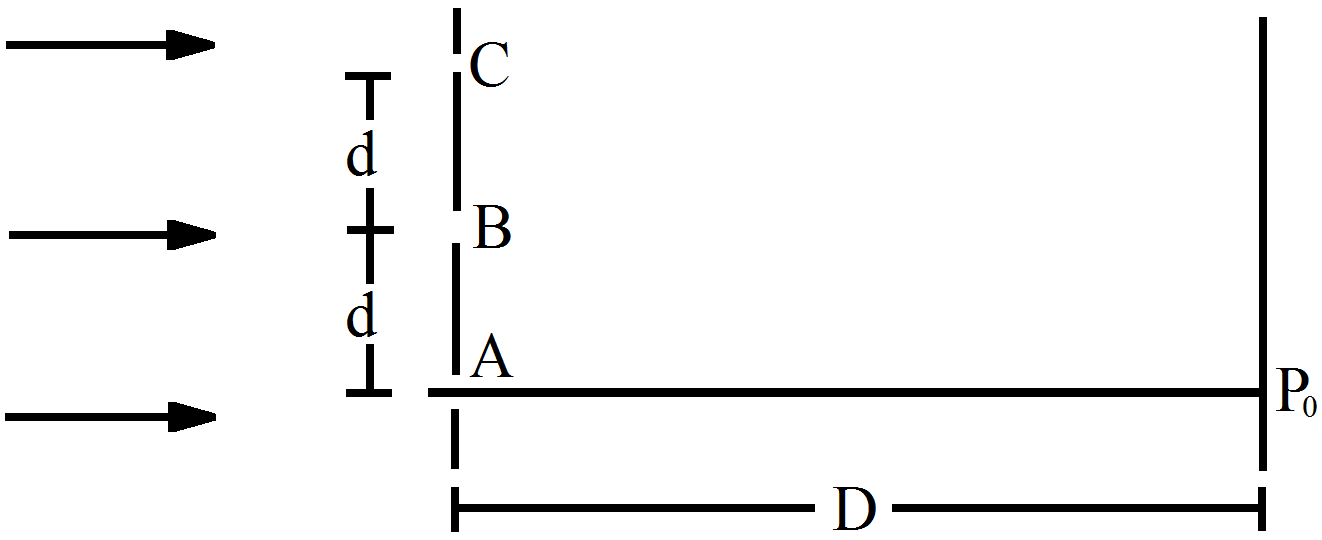
Figure shows three equidistant slits being illuminated by a monochromatic parallel beam of light. Let $\text{BP}_0-\text{AP}=\frac{\lambda}{3}$ and $\text{D}>\lambda.$
  1. Show that in this case $\text{d}=\sqrt{\frac{2\lambda\text{D}}{3}}.$
  2. Show that the intensity at P, is three times the intensity due to any of the three slits individually.

A hole is drilled in a copper sheet. The diameter of the hole is 4.24cm at 27.0 °C. What is the change in the diameter of the hole when the sheet is heated to 227°C? Coefficient of linear expansion of copper = 1.70 × 10⁻⁵ K-1.
In an experiment on determining the density of a rectangular block, the dimensions of the block are measured with a Venier Caliper (with a least count of 0.01cm) and its mass is measured with a beam balance of least count of 0.1gm. How do we report our result for the density of the block?
An eye can distinguish between two points of an object if they are separated by more than 0.22mm when the object is placed at 25cm from the eye. The object is now seen by a compound microscope having a 20D objective and 10D eyepiece separated by a distance of 20cm. The final image is formed at 25cm from the eye. What is the minimum separation between two points of the object which can now be distinguished?
Which of the following symptoms is likely to afflict an astronaut in space (a) swollen feet, (b) swollen face, (c) headache, (d) orientational problem.
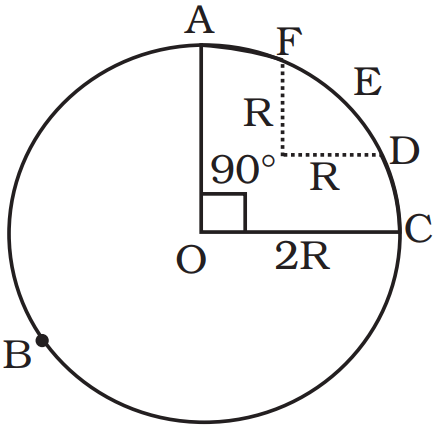
A racing car travels on a track (without banking) ABCDEFA ABC is a circular arc of radius 2 R. CD and FA are straight paths of length R and DEF is a circular arc of radius R = 100 m. The co-effecient of friction on the road is $\mu = 0.1.$ The maximum speed of the car is 50m s–1. Find the minimum time for completing one round.

A satellite orbits the earth at a height of 400km above the surface. How much energy must be expended to rocket the satellite out of the earth’s gravitational influence? Mass of the satellite = 200kg; mass of the earth = 6.0 × 1024kg; radius of the earth = 6.4 × 10⁶m; G = 6.67 × 10⁻¹¹N m2 kg-2.
How does the behaviour of a real gas differ from the behaviour of an ideal gas? Under what conditions does a real gas behave like an ideal gas?