Question
In an experiment on determining the density of a rectangular block, the dimensions of the block are measured with a Venier Caliper (with a least count of 0.01cm) and its mass is measured with a beam balance of least count of 0.1gm. How do we report our result for the density of the block?
Answer

Let the measured values be:
Mass the block (m) = 39.3g
length (l) = 5.12cm
breadth (b) = 2.56cm
thickness (t) = 0.37cm
The density of the block is given by:
$\text{d}=\frac{\text{mass}}{\text{volume}}=\frac{\text{m}}{\text{l}\text{ ,b}\text{ ,h}}$
$=\frac{39.3}{5.12'2.56'0.37}=8.1037\text{gram}/\text{ cm}^3$
Now the uncertain value are:
$\text{l}=\pm0.01\text{cm}$
$\text{b}=\pm0.01\text{cm}$
$\text{t}=\pm0.01\text{cm}$
Maximum relative error, in the density, value is given by:
$\frac{\text{Dd}}{\text{d}}=\frac{\text{Dl}}{\text{l}}+\frac{\text{Db}}{\text{b}}+\frac{\text{Dt}}{\text{t}}+\frac{\text{Dm}}{\text{m}}$
$=\frac{0.01}{5.12}+\frac{0.01}{2.56}+\frac{0.01}{0.37}+\frac{0.7}{39.3}$
$=0.0019+0.0039+0.027+0.0024=0.0358$
$\therefore\Delta\text{d}=0.358\times8.1037=0.3\text{g}/\text{cm}^3\text{approx}$

Need a full question paper?

Generate a complete, print-ready paper with questions like this in minutes — across 16+ boards, with answer keys.

Start Generating Free

Similar questions

Consider a non-conducting plate of radius r and mass m that has a charge q distributed uniformly over it. The plate is rotated about its axis with an angular speed $\omega.$ Show that the magnetic moment $\mu$ and the angular momentum of the plate are related as $\mu=\frac{\text{q}}{2\text{m}}\text{l}.$
A gas undergoes reduction in volume (i) adiabatically, (ii) isothermally. Find the work done in the process.
  1. Derive an expression for the excess pressure inside a soap bubble.
  2. State Bernoulli's theorem.
A glass vessel measures exactly 10cm × 10cm × 10cm at 0°C. It is filled completely with mercury at this temperature. When the temperature is raised to 10°C, 1.6cm3 of mercury overflows. Calculate the coefficient of volume expansion of mercury. Coefficient of linear expansion of glass = 6.5 × 10⁻⁶ °C.
Obtain an expression for linear acceleration of a cylinder rolling down an inclined plane and hence find the condition for the cylinder to roll down the inclined plane without slipping.
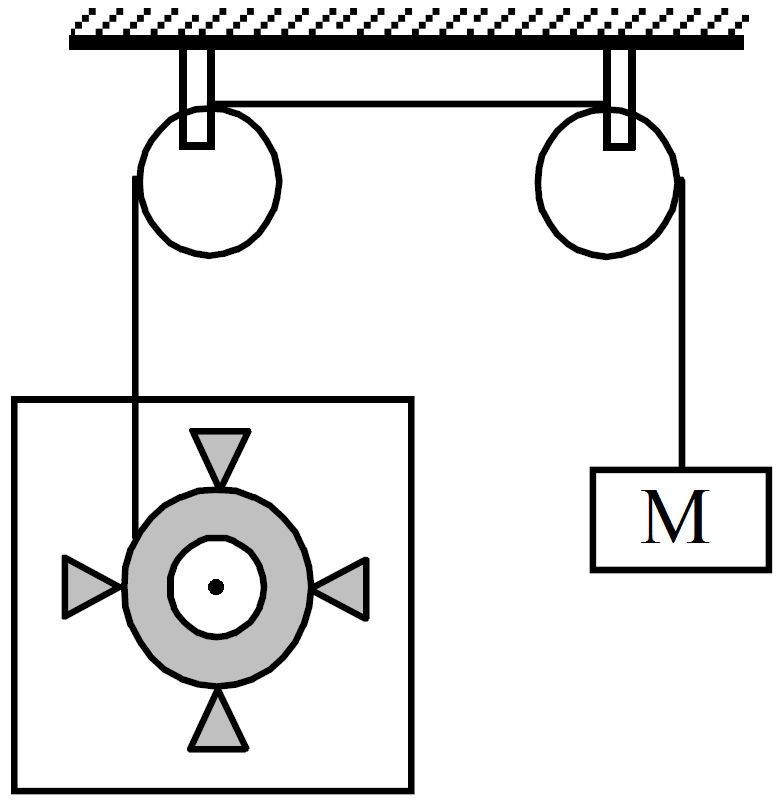
Figure, shows water in a container having 2.0mm thick walls made of a material of thermal conductivity $0.50\text{Wm}^{-1}{^{\circ}}\text{C}^{-1}.$ The container is kept in a melting-ice bath at 0°C. The total surface area in contact with water is 0.05m2. A wheel is clamped inside the water and is coupled to a block of mass M as shown in the figure. As the block goes down, the wheel rotates. It is found that after some time a steady state is reached in which the block goes down with a constant speed of 10cms-1 and the temperature of the water remains constant at 1.0°C. Find the mass M of the block. Assume that the heat flows out of the water only through the walls in contact. Take g = 10ms-2.

A 5cm cube has its upper face displaced by 0.2cm by a tangential force of 8N. Calculate the shearing strain, shearing stress and modulus of rigidity of the material of cube.
State Newton's third law of motion. Discuss its consequences.
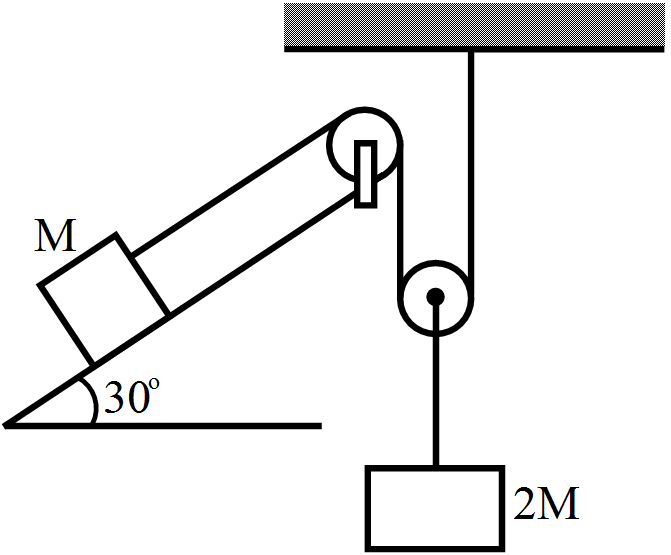
Find the acceleration of the block of mass M in the situation shown in figure. All the surfaces are frictionless and the pulleys and the string are light.

A wave travelling along a string is described by equation y (x, t) = 0.05 sin(40x - 5t) in which the numerical constants are in SI units (0.05m, 40 radm-1 and 5 rad s-1).
Calculate the (a) amplitude (b) wavelength (c) time period (d) frequency of wave. Also calculate the displacement at distance 35cm and time 10 sec.